

The Tate Murders: Why Sharon Tate's Sister Still Says the Case Isn't Closed

On the night of August 8, 1969, five people were murdered at 10050 Cielo Drive in Los Angeles, and the story that came out of it, Charles Manson, a race war he called Helter Skelter, a group of young followers acting on his orders, has been repeated so many times it feels like a closed case. Books got written, a prosecutor became famous, everyone involved either died in prison or spent decades fighting parole boards. But pull on two threads still hanging off that story and it stops looking finished. One is a string of unsolved Los Angeles murders the LAPD itself says might be connected. The other is that the man who built the entire prosecution around Helter Skelter reportedly didn't fully believe it himself.
The Night at Cielo Drive
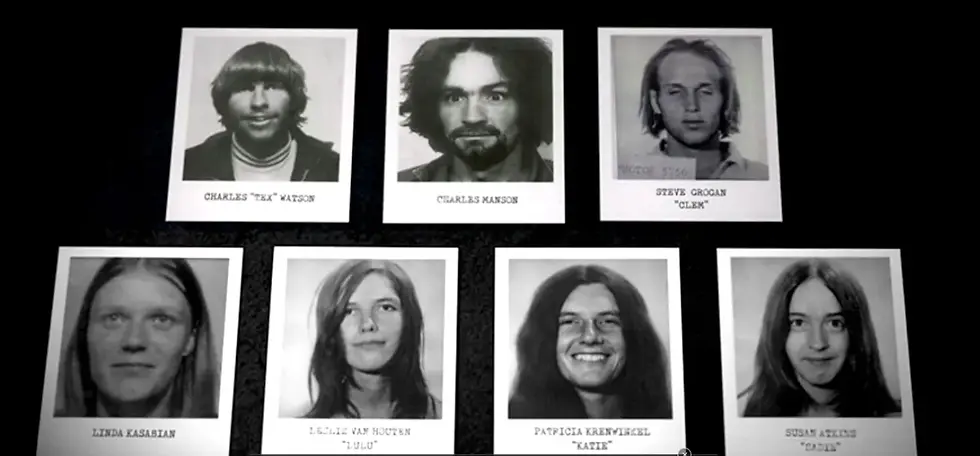
Just after midnight on August 9, Tex Watson climbed a telephone pole outside the gate at 10050 Cielo Drive and cut the line before he, Susan Atkins, Patricia Krenwinkel and Linda Kasabian moved in on Manson's orders to kill everyone inside. Eighteen year old Steven Parent was already on his way out. He'd been visiting William Garretson, the property's caretaker, who lived in a separate guest house on the grounds, and was pulling out in his car when Watson stepped up to the window with a revolver and told him to halt. He shot Parent four times before the others had even reached the main house, leaving blood on the steering wheel and making Parent the first person killed that night.
Watson slipped in through a window and let Atkins and Krenwinkel in through the front door.

This is a very graphic collection of images from the crime scene.

Hallway where krenwinkle chased Folger 
Steven Parent in his car 
Sharon Tate and Sebring 
Wojciech Frykowski 
Steven Parent 
Top shot showing where phone lines were cut 
Window where Watson entered 
Abigail Folger 

The sofa where Sharon Tate was killed 
Jay Sebring 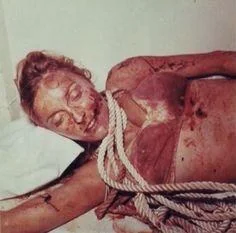
Sharon Tate 
Atkins wrote the word PIG in Tate's blood.
Wojciech Frykowski was asleep on the living room couch when Watson shot him with a .22, and when the gun jammed, Watson beat him with it until the grip snapped off in his hand. Frykowski fought back hard enough that he ended up on the front porch in pools of blood, shot twice and stabbed fifty one times by the time it was over. Down the hall, Abigail Folger had been reading in her bedroom. She broke free at one point and ran for the pool area, leaving a blood trail through the hallway and across the lawn before Krenwinkel caught her and stabbed her twenty eight times. Jay Sebring was with Tate in her bedroom when Atkins came in with a knife and marched them both into the living room. When Sebring objected to how Tate, eight and a half months pregnant, was being tied up, Watson shot him, and he was later found with seven wounds total between the gunshot and the knife. Watson looped a rope around Tate's neck and threw the other end over a ceiling beam, tying her to Sebring's body as she begged for her unborn child's life. She was stabbed sixteen times. Atkins wrote the word pig on the front door afterward, using Tate's blood.
It wasn't the first time that summer the family had written a message in someone's blood. About a month earlier, Bobby Beausoleil had tortured and killed a Manson associate named Gary Hinman over a soured drug deal, with Manson reportedly slashing Hinman's face with a sword partway through the ordeal, and the group scrawled political piggy alongside a panther paw print on Hinman's wall in his own blood, an attempt to pin the murder on the Black Panthers. Pig on Tate's door wasn't improvised. It was a method they'd already tried once.
The next night, Watson, Krenwinkel and Leslie Van Houten killed Leno and Rosemary LaBianca in their own home across town, writing death to pigs and rise on the walls and a misspelled healter skelter on the refrigerator, all in Leno LaBianca's blood. The crime scene photos from that weekend are still some of the most reproduced images in American true crime, part of the same wider stash of vintage LAPD crime scene photography that documents Los Angeles's darker history decade by decade.

The Motive Everyone Repeats
The version most people know comes from Vincent Bugliosi, the prosecutor who tried the case and then turned it into the bestselling book Helter Skelter. His argument was that Manson believed an apocalyptic race war was coming, that he wanted to speed it along by making the murders look like they'd been committed by Black militants, and that the Tate house was chosen partly out of resentment toward Terry Melcher, a record producer and Doris Day's son who used to live there and had turned down Manson's music. It's a tidy explanation, and it's also one Bugliosi apparently had doubts about himself. Journalist Tom O'Neill spent twenty years investigating the case after Bugliosi told him something off the record, during what was supposed to be a routine interview, that O'Neill has said sent him down a rabbit hole he never fully climbed out of. Separately, a research blog that's tracked the case for years cites Bugliosi telling documentarian Bill Curtis flatly that he didn't believe Manson bought into all aspects of Helter Skelter either. Even the Melcher connection is murkier than the trial made it sound. Police later concluded Manson actually knew Melcher had moved out of Cielo Drive seven months before the murders, which undercuts the idea that the house was targeted by mistake or by a straightforward grudge. It wouldn't be the last time an LA celebrity case left the public more unsettled than satisfied, Claudine Longet's manslaughter trial seven years later did something similar.

The Body That Waited 46 Years for a Name
On November 16, 1969, just three months after the Tate murders, a birdwatcher found a young woman's body in the brush off Mulholland Drive, a few miles from the Cielo Drive house. She'd been stabbed roughly 150 times and had no identification on her, so the LAPD logged her as Jane Doe No. 59 and the case went cold.
She stayed nameless for 46 years. In 2015, a friend of the victim's family spotted her photo on the missing persons database NamUs and recognized her. DNA testing confirmed she was Reet Jurvetson, a 19 year old from Montreal who'd moved to Los Angeles that same year. A postcard she'd sent home sixteen days before her death described nice weather and an apartment in Hollywood. Given the timing and the location, detectives went as far as questioning Manson himself about it at Corcoran State Prison. By the LAPD's own account, the conversation didn't produce anything fruitful, and the case remains open, unsolved and not officially attributed to the Manson family or anyone else.
A Separate LAPD Case File, and a Set of Tapes Nobody's Heard
The Jurvetson case isn't the only loose end. Years before she was ever identified, LAPD Commander Andy Smith announced in October 2012 that detectives were investigating twelve separate unsolved murders around Los Angeles with possible ties to the Manson family, cases that had happened near known Manson hangouts and looked similar to the Tate and LaBianca killings. Part of what detectives wanted was a set of tapes: hours of recorded conversations between Tex Watson and his defense attorney, Bill Boyd, made not long after Watson's 1969 arrest. Watson fought to keep them sealed, citing attorney-client privilege, but his own side had already undercut that argument decades earlier.
Back in 1976, Watson let Boyd sell copies of the tapes to a chaplain who used them to co-write a book with him, for $49,000 that went toward his legal bills. In March 2013, a federal judge ruled that sale had waived the privilege, Watson missed his window to appeal, and the LAPD finally got its hands on the recordings. More than a decade later, the tapes still haven't been made public. Officials have cited an ongoing investigation exemption under California law, though no case tied to the tapes has ever surfaced, and it's unclear whether Jurvetson's case is even among the twelve.
The Search That Never Quite Ended
Sharon Tate's sister, Debra Tate, has spent decades arguing the official body count is too low. She's pointed to Barker Ranch, the remote Death Valley property where Manson and his followers hid out after the murders, as a possible burial site for other victims, and said publicly that we are just scraping the surface. In 2008, a forensic team that included researchers from Oak Ridge National Laboratory searched the ranch with a cadaver dog and ground penetrating radar, working off decades old rumors, including a reported jailhouse claim from Susan Atkins about three more people killed and left in the desert. The dig turned up animal bones, a shell casing and a rat's nest, nothing human. The county sheriff at the time, Bill Lutze, called the lack of remains a relief rather than a disappointment. Debra Tate hasn't dropped the subject since. A 2025 documentary revisited the Jurvetson case directly, and Tate has continued pushing for the Watson tapes to be released, still hoping there's something in them nobody's heard yet.
More than fifty years later, the Manson case gets treated like one of the tidiest true crime stories there is, a motive, a trial, a book, a movie. But the prosecutor who wrote that book reportedly wasn't fully convinced by his own theory, a body found three months after Tate's murder has never been officially connected to anyone, and a dozen more cases sit open in an LAPD file somewhere, waiting on tapes nobody's been allowed to hear. Closed cases don't usually come with this many loose threads still hanging off them.


