

Suck: The Underground Sex Paper Germaine Greer Helped Launch

A year before Germaine Greer became one of the most famous feminists on earth, she was writing essays with titles like “I Am a Whore” for a magazine so explicit that Britain banned it before a single copy ever reached a newsstand. That magazine was called Suck, and for five strange years it tried to prove that pornography could be intellectual, political, and made by the people who actually wanted to be in it, rather than for them.
Born in a London Summer
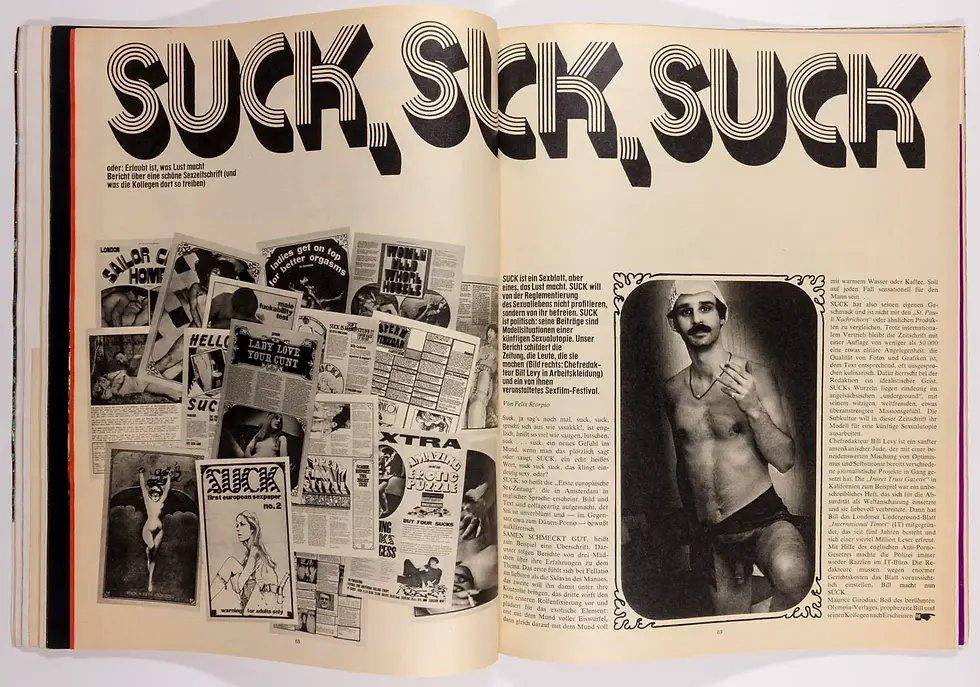
Suck came together in the summer of 1969, when a small group of writers, editors and artists in London decided the countercultural press wasn't going far enough. The founding group included Jim Haynes, the American expat behind Edinburgh's Traverse Theatre and London's Arts Lab, Bill Levy, editor of the underground paper International Times, playwright Heathcote Williams, model Jean Shrimpton, and Greer, who by then had already built a small reputation writing under the pen name “Dr G” for the countercultural magazine Oz. Design and production fell to Willem de Ridder, a Dutch Fluxus artist, who gave the paper its instantly recognizable logo, a multi-tongued seaweed illustration that on several covers ran paired with the name Comstock, a pointed jab at Anthony Comstock, the 19th-century American anti-vice crusader whose name had become shorthand for exactly the kind of censorship Suck existed to provoke.
Banned Before It Existed
Britain didn't wait to see what Suck actually contained. The publication was effectively banned in the UK before its first issue was even printed, forcing the entire operation to relocate to Amsterdam, where obscenity laws were considerably looser. The move gave the magazine its full title, Suck: The First European Sex Paper, and its new home became a running theme, with Greer later recalling being summoned to the vice squad's office roughly once a month simply for talking openly about sex in print.
More Than Skin
What set Suck apart from ordinary pornography of the era wasn't just its explicitness, it was its ambition. Greer described the goal as inventing “a new kind of erotic art, away from the tits 'n' ass and the peep-show syndrome,” and the paper largely delivered on that pitch. Nearly everything was written in the first person, much of it submitted by readers rather than staff, and the contributor list read like an underground literary who's who: William S. Burroughs, Olympia Press founder Maurice Girodias, French artist Jean-Jacques Lebel, illustrator Roland Topor, and poet John Giorno all appeared in its pages alongside anonymous reader confessions and, in one issue, actress Jean Stapleton's own account of an early sexual experience.

Dr G's Alter Ego
Within Suck, Greer wrote under the name Earth Rose, dishing gossip about London's underground scene and pushing the magazine's politics as hard as any of her male co-founders. She insisted, by her own account, on featuring male bodies as often as female ones, refusing to let the magazine slide into simply photographing women for men. Her essay “I Am a Whore” became one of the paper's defining pieces of writing, a deliberately provocative reclaiming of a word usually used as an insult, published a full year before The Female Eunuch turned her into an international name.
The Photo That Became a Flashpoint
Greer's own involvement in Suck produced its most lasting controversy. For issue four, she agreed to pose nude for the magazine on the understanding that her fellow editors would publish equally explicit images of themselves alongside hers. Only her photograph ran. Decades later, addressing a university audience about the pose she'd chosen, she described it bluntly: “A split beaver had not been seen before.” The mismatch between what she'd agreed to and what actually got published became an early, uncomfortable preview of exactly the kind of double standard she'd go on to spend her career writing about.
The Wet Dream Film Festival
Suck's editors didn't stop at print. In 1970 they organized the first Wet Dream Film Festival in Amsterdam, an international showcase of erotic and pornographic film screened at the Leidseplein Theatre, drawing an audience from as far as New York, Tokyo and San Francisco. Greer served as a judge alongside Screw magazine's Al Goldstein and Village Voice columnist Mike Zwerin. A second festival followed in 1971, but the goodwill didn't last. Greer and others grew openly critical of the event after a live performance by Austrian artist Otto Muehl involving a goose he intended to maim, a moment that exposed just how far apart the festival's idea of sexual liberation and its idea of shock value had actually drifted. The editors commemorated both festivals in a 1973 companion book, Wet Dreams: Films and Adventures, by which point the Suck team had taken to living and working together in short, intense stretches across several European cities rather than running anything resembling a conventional editorial office.

Only Eight Issues
For a magazine remembered as a landmark of the sexual revolution, Suck was remarkably short-lived and irregular, publishing only eight issues between 1969 and 1974. Its final issue included Greer's own resignation letter, closing the book on a project that had, by its own editors' later admission, become as much a magazine about art and literature as it ever was a straightforward vehicle for sex.
A Complicated Legacy
Suck occupies an odd place in cultural history now, too radical to be dismissed as ordinary pornography, too explicit and, at points, too troubling to be folded neatly into the feminist canon Greer would soon come to represent. It sits alongside a handful of other publications and figures from that same era who tried to force a public reckoning with sex on the page, including Linda Lovelace, whose own experience just a few years later would end up revealing exactly how far the gap could stretch between the sexual revolution's stated ideals and what actually happened to the people living inside it.
Sources


