Peter Gowland: The Photographer Who Built His Own Cameras to Shoot Hollywood's Pin-Ups
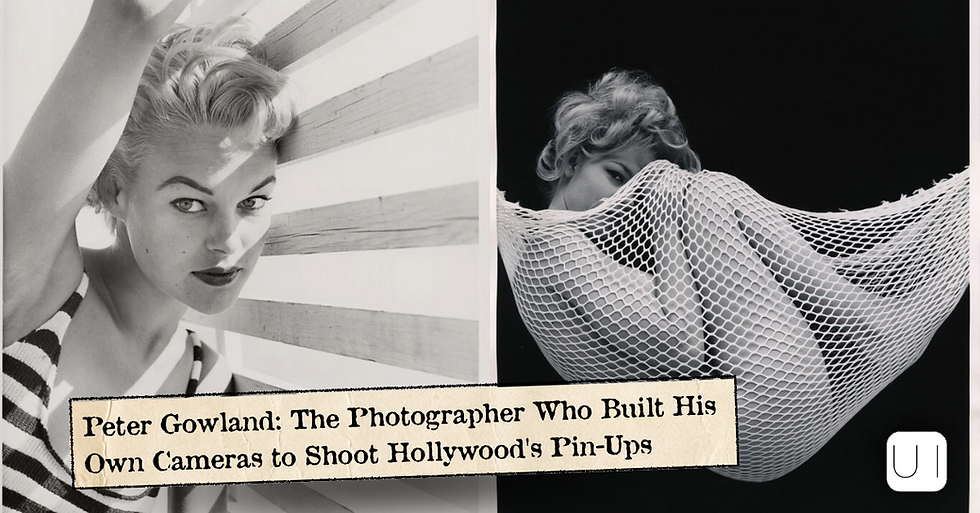
In 1954, the New York Times gave Peter Gowland a title that followed him for the rest of his life: America's No. 1 Pin-Up Photographer. It wasn't just a flashy headline. Gowland spent more than six decades photographing some of the most famous women in the country, sold over a thousand magazine covers, and got so annoyed with the cameras available to buy that he just started building his own instead. By the time he died in 2010, he'd designed more than twenty different camera models and built somewhere around 1,500 individual cameras by hand, no two of them exactly alike.
Born Into a Hollywood Family
Gowland was born on April 3, 1916, in a wooden shack near Sunset Boulevard, which is a pretty unglamorous start for a man who'd spend his life photographing glamour. His parents had emigrated from England around 1913 and worked as film extras for two dollars a day. His father, Gibson Gowland, went on to land the lead role of McTeague in Erich von Stroheim's Greed, the wildly ambitious 1924 silent film that's still studied today as one of the great triumphs and great disasters of the silent era. His mother, Sylvia Andrew, wrote the script for a 1916 Universal short called Small Magnetic Hand and put her own six week old son in it. Gowland's first film credit happened before he could hold his own head up.

A Malibu Childhood
He kept turning up on movie sets as a kid, working as a double and background extra, and later said that's where he first picked up an eye for lighting, watching how cinematographers lit the stars around him. When he was eleven, his mother decided Hollywood wasn't doing him any favors and sent him off to a British military academy in town instead. He remembered being dropped off clutching a toy truck with no idea what was going on. In 1930, he and his father moved into a one bedroom house on the Pacific Coast Highway near Malibu that cost five hundred dollars, with a ten dollar a month land lease, no gas, no electricity and an outhouse out back. Heavy rain would send eighteen inches of canyon debris straight through the place. His father went back to England in 1944 and died in London at seventy four, buried at Golders Green.

Love at First Sight
Gowland met his future wife Alice in December 1941. By his own account it was love at first sight, and they eloped three weeks later. It turned out to be one of the more successful impulsive decisions in Hollywood history. Alice was born in Pittsburgh in 1920 and moved to LA at eight years old, and she ended up running the business side of what became a genuine photography empire, handling sales, camera production and lecture bookings. They stayed married until his death, sixty eight years later.
War Breaks Out
Between 1942 and 1945, Gowland worked days as an engineering cinematographer for North American Aviation and spent evenings and weekends shooting portraits and pin-ups with Alice on the side. Then he shipped out with the Army Air Force to Germany, where he ran the photo lab at Furstenfeldbruck air base from 1945 to 1946. While he was gone, Alice kept selling their beach pin-up shots to magazines, so by the time he came home they already had a client list and a reputation to build on.

Building America's Pin-Up Empire
They used a GI loan to build their first studio in West LA in 1946, and things took off from there. Gowland found his models on film sets, through agencies and at beauty contests, then shot them in the studio or along the stretch of coast between LA and Malibu, feeding straight into the idea of California as one long sunny dream. He wasn't the first photographer to walk that particular line between art and titillation. Arthur Kales had already been treating the camera like a paintbrush in the Pictorialist scene of 1920s California, and across the Atlantic John Everard was quietly photographing nudes out of a small London studio under far stricter censorship laws. Decades earlier in New Orleans, E.J. Bellocq had photographed the women of Storyville with a similar kind of respect, and before any of them, Audrey Munson had already lived through what it meant to be America's first professional model and muse. Gowland's own version was cleaner and sunnier, tasteful black and white work that critics described as sitting someplace between titillation and art. He photographed Jayne Mansfield, Raquel Welch, Joan Collins, Muhammad Ali, Jonathan Winters and Alfred Hitchcock among plenty of others, and his photos ran in Playboy, Rolling Stone and Modern Photography, adding up to more than a thousand magazine covers.
The Cameras No One Else Was Making
None of that would have happened quite the same way without Gowland's other obsession, building his own gear. He owned sixteen Rolleiflex cameras at one point and loved how easy they were to use, but he wanted the big four by five inch negatives that large format cameras produced, and nothing on the market did both. So he took cameras apart to figure out how they worked and built his own twin lens reflex from scratch, the Gowlandflex, generally credited as the world's first large format twin lens reflex camera. It had a waist level finder, a Schneider Symmar f/5.6 180mm lens, and a mechanism that kept the viewing and taking lenses in sync as the bellows extended, which mattered when your subject was a moving person instead of a building. He sold more than 600 of the 4x5 model alone, and it ended up in the hands of Annie Leibovitz and Yousuf Karsh, and reportedly the FBI. He also built an eight by ten version nicknamed The Beast that stood almost a meter tall, plus view cameras, an aerial camera and a lightweight architectural model. His whole design philosophy came down to one line he liked to repeat: a camera is only a light-tight box. He answered his own phone at the workshop, and customers would sometimes get a call back from Gowland himself, not because anything was wrong with their order but because he genuinely wanted to know how they were using the camera.

Rustic Canyon and the Final Years
In 1954, Peter and Alice built a home and studio together in Rustic Canyon, designed by architect William F. Overpeck, and stayed there for the rest of their lives. Between them they wrote more than thirty five books on portrait and glamour photography and traveled internationally giving lectures on it. Alice split her time between the business and her own interests, beach cleanups, political volunteering, dancing, piano and swimming the coastal bluffs near their home. Gowland kept shooting and kept building cameras almost right up until the end. He died on March 17, 2010, in Los Angeles at ninety three, from complications after a fall. Alice outlived him by four years, passing away in 2014. In 2016, a selection of around 180 of his photographs was published as a book called Peter Gowland's Girls, pulled from an estate archive of thousands of prints and slides.
It's a strange kind of legacy, half of it hanging in gallery shows and photography books, the other half sitting in camera bags belonging to photographers who never met him but still shoot with a Gowlandflex because nothing else quite does what his cameras do. For a guy who summed up his entire profession as a light-tight box, Peter Gowland built a genuinely huge career out of very simple tools.