


The Murder of the Loughnane Brothers: The Dream That Led a Galway Village to Their Bodies

It's a Friday afternoon in late November 1920, and the threshing machine is roaring in a farmyard opposite the church in Shanaglish, a scatter of houses in south Galway. Fourteen neighbours have turned out to help the widow Loughnane get her corn in. Two of her sons are working among them. Pat, the eldest, is tall and broad, the captain of the parish hurling team. Harry, the youngest, is a shy, bookish lad who keeps goal behind him.
Then a lorry pulls up in the lane, and men in dark uniforms and tam o'shanters jump down with rifles.
Within a few hours the brothers will be roped to the back of that lorry. Within ten days a teenage cousin will wake from a dream knowing exactly where to find them. What he finds in a muddy pond near Kinvara would become one of the most horrifying photographs of the Irish War of Independence.
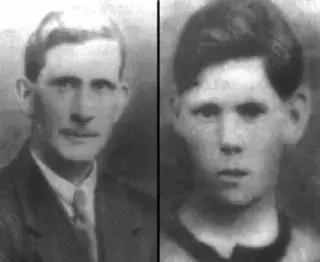
Two Brothers From Shanaglish
Patrick and Harry Loughnane farmed with their widowed mother, Katie, in the parish of Beagh, a few miles south of Gort. There'd been nine children in the house at the turn of the century. By 1920 one brother, Hugh, was working in London, a brother and sister had gone to America, and two sisters, Nora and Flora, were teaching in the north of the county. That left 29-year-old Pat and Harry, still only 21 or 22, to run the farm.
Pat was the kind of young man every rural parish had in those years. He was in Sinn Féin, the IRA, the secret Irish Republican Brotherhood and the GAA all at once, and he led the local IRA company. Harry was secretary of the Sinn Féin club. On a Sunday they were the backbone of the Beagh hurling team, Pat a stern and imposing full back with his little brother in goal behind him.
They'd played their last match together that September. Beagh were due to meet Craughwell in Ardrahan, but the game was called off after Black and Tans burned out several homes in the area. Neither brother would pull on a jersey again.
A Bad Month Around Gort
By the autumn of 1920 the war between the IRA and the Crown forces had turned vicious in south Galway. The ordinary Royal Irish Constabulary had been topped up with Black and Tans, and with the Auxiliaries, a force of former British Army officers paid a pound a day. Galway's D Company of the Auxiliaries was based at Lenaboy House in the city, with a detachment out at Drumharsna Castle, an old tower house near Ardrahan.
In October an RIC man was killed in an IRA ambush at Castledaly. Then the reprisals came. On 1 November Eileen Quinn, a 24-year-old mother, was shot from a passing lorry as she sat outside her home near Gort with her baby in her arms. She died hours later. A military court of inquiry put it down to precautionary shots. On 14 November Father Michael Griffin was taken from his house in Galway city and later found shot through the head in a bog near Barna.

A week after that, on the morning of 21 November, Michael Collins's men shot dead a string of British intelligence officers in Dublin, and that afternoon Crown forces opened fire on the crowd at a football match in Croke Park. Bloody Sunday left Crown forces across Ireland in a murderous mood. Five days later the Auxiliaries came to Shanaglish.
Picked Out of the Threshing Gang
They weren't there by chance. They were hunting for the men behind the Castledaly ambush, and the Loughnanes were already on their radar. Pat was suspected of raiding the home of John Carr, a former RIC man near Gort, to get his hands on a pistol. Carr's son William was by then an Auxiliary himself, and one IRA veteran later claimed William had recognised Pat's voice from the raid, according to records gathered on The Auxiliaries research site.
The Auxiliaries lined the threshers up in the haggard. A local constable from Tubber walked along the row and picked out Pat and Harry. The other dozen men were left alone. One Auxiliary reportedly told Pat to fetch the rifle he'd had at Castledaly. Robert Glynn, who owned the threshing machine, didn't wait to see what happened next and ran for it.
Pat had been told more than once to go on the run, as most active Volunteers did. He'd always refused. There was a farm to work and a mother to look after.
Eleven Yards of Rope
The brothers were beaten on the drive to Gort, beaten in the RIC barracks there and then handed over to the Auxiliaries. Before they left town, according to the statement Pádraig Ó Fathaigh later gave to the Bureau of Military History, the Auxiliaries took eleven yards of rope from a shop in the town.
What happened next was pieced together afterwards from rumour and eyewitnesses, and it's hard to read. The brothers were roped to each other and to the tailgate of a lorry, then made to run behind it on the road towards Ardrahan. When they couldn't keep up any more they fell, and they were dragged. One account puts the distance from Gort to Drumharsna at around eleven kilometres. Another man arrested at Tubber the same day, Michael Carroll, said he'd been treated exactly the same way.
At Drumharsna Castle the beatings carried on. Late that night, the story goes, the brothers were taken into Moy O'Hynes wood near Kinvara, and four shots were heard. Some locals swore that Harry was still alive and moaning there the next morning.
"Your Sons Have Escaped"
On the Monday night a party of Auxiliaries from Drumharsna knocked on Katie Loughnane's door. Her sons, they told her, had escaped from custody.
Nobody in Shanaglish believed a word of it. Their sister Nora came home and threw herself into the search, going from barracks to barracks and getting nowhere. The rumours made it worse. Some said the brothers had been seen dead in the wood. Others swore they were alive and being held at a camp in Galway. One searcher was said to have found what looked like brain matter among the trees at Moy O'Hynes, but there were no bodies.

That was because the Auxiliaries had come back on the Sunday night and moved them. They carried the bodies a couple of miles to an isolated spot called Umbriste, set fire to them and then, rather than finish burying them, dumped them in a muddy pond that local farmers used to water their cattle. To hide them, they threw dirty oil on the water.
The Dream at Umbriste
This is the part of the story that people in south Galway still tell first.
Michael Loughnane, a cousin of about 18 known locally as Tully, had been close to Pat and was haunted by his arrest. On the ninth day after the brothers vanished he prayed in Shanaglish church, and that night he dreamt he saw them lying in a pond he knew at Umbriste. On Sunday 5 December, after Mass, he cycled over there with a friend, crossed a field to the water, and there they were, exactly as he'd seen them in his sleep.

The boys told nobody until they reached Kinvara. More than twenty local IRA men then went back with a horse and van and pulled the bodies out of the water, which was a risky business. The Auxiliaries at Drumharsna were barely a mile away. A stranger asked where the bodies were being taken and was told Ballinderreen chapel, which was a lie. Sure enough, an Auxiliary lorry soon pulled up at the pond and searched it, then drove off to Kilcolgan. By then the little funeral was safely in Kinvara, with people falling in behind it along the road.
What the Bodies Showed
The brothers were laid out on linen in a barn belonging to a Mr Hynes in Kinvara. It was the only building left standing on his land, because his house had already been burned. Their sister Flora arrived and insisted on seeing them. She could identify Harry. She only knew Pat by the shape of his body.
Both men were naked except for one of Harry's boots, and both had been badly burned. Two of Harry's fingers had been cut off and his right arm was almost severed at the shoulder. Pat's wrists and arm were broken and diamond-shaped marks had been cut into his chest. Their skulls were so badly smashed that a doctor wondered whether grenades had been set off in their mouths. When the local doctor, Dr Connolly, examined them he found the letters "IV", for Irish Volunteers, carved into the charred flesh.
A local Irish teacher, Tomás Ó hEidhin, set up his camera and photographed the brothers in their coffins, tilted upright for the lens. The pictures went round the country and beyond. The National Museum of Ireland now holds prints of them in its collection on the propaganda war, and their sister's copies were later given to the Military Archives. They did more to show what was happening in the west of Ireland than any amount of republican press releases. Much like the photographs of Emmett Till 35 years later, the whole point was that people couldn't look away.
The Priest Who Wouldn't Keep His Mouth Shut
The brothers' coffins were draped in tricolours and IRA flags, and the IRA guarded them through the night. After a Requiem Mass they were carried to the family plot in Shanaglish churchyard and buried side by side, and as the last sods went on, six local Volunteers fired three volleys over the grave.
The parish priest of Beagh, Father John Nagle, was an unlikely rebel. He'd served as a chaplain with the British Army in the Boer War. But he wasn't about to let this one pass. When British officers and a doctor came to examine the remains on 7 December, he challenged them in front of the congregation to say what they thought of what they were looking at. He recognised Harry by his lips and chin, and wept. In his sermon he described the injuries in plain language and said he'd seen nothing in all his army service to compare with them.
The military court of inquiry sat in Gort barracks the day after the funeral. Nagle asked to give evidence and was turned down. Two doctors told the court the bodies were unrecognisable and had no bullet wounds, and the court's findings were never made public. When the death certificates finally came through, seven months later, they didn't mention the burning or the missing fingers. Father Nagle himself was dead within six months.
Promoted, Not Prosecuted
The official version never really got beyond the escape story. Section Leader C.W. Owen, in charge at Drumharsna, gave evidence about the arrest. Another Auxiliary, V.P. Laurenson, told the inquiry he'd heard a noise, stepped away for a minute to see what it was, and come back to find both prisoners gone. Locally the IRA believed the raid itself had been led by an Auxiliary officer called John Francis Ulic Burke, known as Jock.
Nobody was ever charged. The Galway historian Conor McNamara has spent years tracing the men responsible, and he's named three Auxiliaries as the killers. Every one of them was promoted. One later died in Mesopotamia. One retired to South Africa and died in Durban. The third, a Welsh speaker, went home and died in north Wales. The officer in charge was moved up to the depot in Dublin.
The Auxiliaries weren't finished with Kinvara either. They later came back and burned the barn where the brothers had been waked, along with the home of the man who'd organised the funeral.
The Forge, the Cross and the Wood
For a long time people around Beagh didn't talk about it much in front of the children. Tony Diviney, a local historian, told the Irish Times: "People were bitter when they did talk about it." Some families grew up with a softened version and only saw the photographs as adults.
But the brothers were never forgotten. In 1927 a Celtic cross was unveiled over their grave in Shanaglish, and there's another memorial at the spot in Moy O'Hynes wood where they're believed to have died. Canon Considine, the curate who'd sat with Eileen Quinn as she died, later built a parish hall in Ardrahan and called it the Quinn-Loughnane Memorial Hall. Commemorations have been held at the wood most Novembers since.
Their brother Hugh came home from London to run the farm, and worked as the village blacksmith. His old stone forge fell into ruin, but in the 1990s Beagh Rural Development restored it in memory of the brothers, turf fire and all. Nora, who'd led the search, gave up teaching, became a nun and worked abroad. Tully, the cousin who dreamt of the pond, emigrated to America. There are no Loughnanes left in Shanaglish now.
Ireland got its Treaty a year later, and decades after that Britain would face its own reckoning over another Bloody Sunday in Derry. There's never been any reckoning for Pat and Harry Loughnane. Just a forge, a cross in a wood and a photograph that's still hard to look at more than a century later.
Suggested Reading
Want to know more about the war in the west and the men who fought it? These are worth a look.
The Black and Tans: British Police and Auxiliaries in the Irish War of Independence by D.M. Leeson. The best history of the Tans and Auxiliaries: who they were, why they joined and how reprisals like this one happened.
Galway: The Irish Revolution 1912-23 by Conor McNamara. The county's revolution told by the historian who traced the men behind the Loughnane killings.
As an Amazon Associate, Utterly Interesting earns from qualifying purchases.
You Might Also Like
Sources
The Fate of the Brothers Loughnane, 1920 (Witness Statement 1517, Pádraig Ó Fathaigh), Bureau of Military History, via University of Limerick
Witness Statement 1652, Henry O'Mara: the murder of Mrs Malachy Quinn and the Loughnane brothers, Bureau of Military History
Sordid murder of hurling brothers still resonates in south Galway, The Irish Times
One of most powerful images of War of Independence, The Irish Times
The killing of Eileen Quinn, Law Society Gazette
Loughnane Brothers Murdered, 26 Nov 1920, The Auxiliaries
Loughnane brothers commemoration, 7 December 2000 edition, An Phoblacht
Loughnane Brothers Commemoration, 25 November 2004 edition, An Phoblacht
The tragic story of Patrick and Harry Loughnane, West Cork People
Loughnane Brothers Funeral, November 1920, National Museum of Ireland
P39: Harry and Pat Loughnan murdered in Co. Galway by British Forces, Nov. 1920, Military Archives
Loughnane Brothers collection, University of Galway Digital Archive
Terror in County Galway: The Life and Death of Harry and Patrick Loughnane, Galway Decade of Commemoration
Loughnane brothers remembered on centenary of their deaths, The Clare Champion


