

Mirin Dajo: The Untold Story of Arnold Gerrit Henskes, the Man Swords Couldn't Kill

In the summer of 1947, a group of Swiss surgeons watched a man walk calmly across a hospital corridor with a rapier sticking clean through his torso, entry wound in his back, tip poking out through his chest, no blood, no wincing, no apparent pain at all. They X-rayed him with the blade still inside. The film showed exactly what it looked like: a sword, threaded straight through several vital organs, in a man who was very much alive and, by all accounts, mildly bored by the fuss. His name was Mirin Dajo. He was born Arnold Gerrit Henskes, and for about three strange years he convinced some of Europe's most sceptical doctors that he was, in some sense, invulnerable.
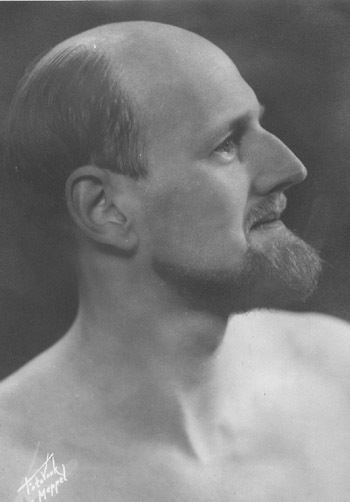
From Nol Henskes to "Wonderman"
Dajo was born on 6 August 1912 in Rotterdam, and as a young man he went by Nol. He trained in the fine arts and ended up running a design bureau in his twenties, a perfectly ordinary career for a man who'd later be filmed with a foil through his kidneys. He did have a few odd episodes in his youth, vivid dreams of a recently deceased niece that he sketched from memory, a portrait of a dead aunt in South Africa he'd never met that turned out to be eerily accurate, mornings where he woke to find he'd been drawing in his sleep without remembering it. None of it seemed to mean much at the time.
Then, at 33, Henskes decided his body was invulnerable. He quit his job, left for Amsterdam, and started hanging around pubs inviting strangers to push daggers through him for cash, a fairly direct route into the same freak show circuit that built acts around P.T. Barnum's model of the extraordinary body. His first party trick wasn't even swords. It was eating broken glass and razor blades, which he claimed simply dematerialised somewhere inside him, since none of it ever reappeared. He needed a licence to perform legally, so doctors at the University of Leiden tested him and granted him one, for the act, not the sermon he wanted to deliver alongside it. It was around this point that Nol Henskes became Mirin Dajo, a stage name built from the Esperanto word mirindaĵo, meaning "wonder." He'd taken up Esperanto as a genuine cause, convinced that one shared language could unite a world that had just finished tearing itself apart.
The Swords Come Out
Dajo's early assistants didn't work out, until he struck up a conversation with a neighbour, Jan Dirk de Groot, while waiting for a bus to Amsterdam. De Groot recognised him as the man half the country was talking about, and the two became inseparable, with de Groot handling the actual swordplay for the rest of Dajo's career.
In 1947 the pair moved to Switzerland, where Dajo was again licensed to perform but barred from lecturing the audience. Time magazine caught wind of the act and ran a piece that June under the headline "Miracle Man," describing Dajo standing stoically at Zurich's Corso theatre while de Groot appeared to push swords and spears through his chest. Dajo told the magazine plainly what he thought he was: "I am no artist, but a prophet. If you believe in God, your will can dominate your body." The show was popular enough that, as Time noted with a straight face, waiters at the Corso started demanding payment upfront, since so many audience members fainted mid-performance and never made it to the bill.

Baffling the Best Doctors in Switzerland
Word of the act reached Dr. Hans Naegeli-Osjord, who invited Dajo to Zurich Cantonal Hospital on 31 May 1947 to be examined properly. Naegeli-Osjord and Werner Brunner, the hospital's chief of surgery, watched a rapier go through Dajo's heart, lung and kidneys without a drop of blood. Then they asked him to hold still for an X-ray with the blade still lodged in his torso, expecting they'd need a stretcher to move him. Dajo said he'd just walk there, and did.
The image confirmed what the doctors could already see: the rapier had passed through several organs that should have killed him several times over. Braced for a haemorrhage once the blade came out, the doctors withdrew it and found almost nothing, no significant bleeding, just a faint trace of fluid at each puncture. Further demonstrations followed in Basel and Bern, where doctors did the piercing themselves rather than trusting de Groot's hand. According to de Groot, Dajo was run through as often as fifty times a day during this period, and on some days over a hundred, sometimes through the lungs, sometimes the heart, sometimes several organs in a single sitting, apparently without consequence. Audiences didn't fare as well as Dajo did. One performance reportedly ended with an audience member suffering a heart attack, and after a sword accidentally struck bone during a Corso show, sending a crack through the hall and several women into a faint, Swiss authorities pulled Dajo's public performance licence entirely, restricting him to private, closed-door demonstrations. Dajo, oddly, seemed to welcome the change. Away from the general public, he was finally free to deliver the lecture on peace and materialism that no one had let him give.
Bullets, Guardian Angels and a Message of Peace
Dajo's claims stretched well past swords. He told Time he'd been shot in the head twice from close range and survived both times, pointing to two scars as proof, though his eventual autopsy found no evidence of any old head wounds at all. According to de Groot, Dajo also believed he was guided by a series of guardian angels who instructed him on which tests to attempt next: submerging himself in ice, torching the hair off his chest with a blowtorch, washing in boiling water that never so much as reddened his skin. De Groot claimed Dajo was telepathic and could heal the sick, and described one test in which hollow steel tubes were pushed clean through Dajo's body and connected to a water supply, turning him briefly into what de Groot called a human fountain.

Dajo's own explanation for all of it was that the causality ran backwards: he didn't let the weapon pass through him, he passed through the weapon, with the pierced part of his body becoming, in his words, "lighter" and less solid, and therefore nothing there to injure. It's the kind of explanation that satisfies absolutely no one trying to reproduce it scientifically, which is rather the point. His entire second act, the one Swiss censors initially tried to suppress, was a plea for the world to give up materialism before it dragged humanity into another war.
The Needle, the Trance and His Death
Dajo's career, and his life, ended abruptly less than a year later. On 11 May 1948, he said he'd been instructed by his guiding voices to swallow a steel needle. Unlike his usual act, this one didn't resolve itself. Surgeons removed the needle on 13 May, and Dajo, keen to prove he was still in perfect health, checked himself out of hospital and went for a walk around Zurich almost immediately.

About ten days later, while de Groot was at the airport collecting his wife, Dajo lay down and appeared to slip into a trance, something de Groot said he did often during meditation. De Groot's wife wasn't convinced and kept asking her husband to check on him. He had a pulse the first two times. On the third check, he didn't. Mirin Dajo was declared dead on 26 May 1948, aged 35, roughly twelve hours after he'd actually died. An autopsy, carried out well before Swiss law technically allowed, gave the cause of death as an aortic rupture, a finding de Groot and at least one attending surgeon reportedly disputed, though neither had the legal standing to formally challenge it.
A Trick Nobody Has Fully Explained
Skeptics have never produced a tidy explanation for what Swiss doctors documented on X-ray film in 1947, which is part of why Dajo's story still circulates today. That puts him in a slightly different category to other performers whose seemingly impossible feats had a rational mechanism once you knew where to look, the way bantamweight boxer Johnny Coulon built an entire act around a simple pressure-point trick that made him briefly "unliftable". With Dajo, the doctors who examined him at the time, hardly a credulous audience, left without a convincing counter-explanation. Whether that's down to a genuinely exceptional case of anatomical luck, extraordinary pain tolerance and vessel positioning, or something else entirely, nobody has settled it more than seventy-five years later.
Dajo is barely remembered now outside a handful of parapsychology journals and true crime and oddities corners of the internet, but for three strange years just after the Second World War, he stood in front of some of Switzerland's best doctors and did something they couldn't account for. He died at 35, having spent his short adult life trying to convince the world of a message about peace that almost nobody remembers, attached to a party trick that nobody has forgotten.
Sources
1. Time Magazine (23 June 1947) — "Switzerland: Miracle Man" — http://content.time.com/time/magazine/article/0,9171,797981,00.html
2. Philip Coppens — "Mirin Dajo: Wonderman" — https://www.eyeofthepsychic.com/mirindajo/
3. W. Peter Mulacz (1998) — "Deliberately Caused Bodily Damage Phenomena: A Different Perspective," Journal of the Society for Psychical Research, 62 (852) — http://parapsychologie.info/dcbd/dcbd.pdf
4. Jan Dirk de Groot (2003) — De onkwetsbare profeet: het Nederlandse fenomeen Mirin Dajo (Frontier Publishing, ISBN 90-806700-6-5) — https://www.worldcat.org/isbn/9080670065
5. "Man Who Defies Death" (1947 newsreel footage) — https://www.youtube.com/watch?v=gqIDnm_6mu4


