

Mark Antony: The Man Who Nearly Ruled the World

He drank with common soldiers, racked up debts that would bankrupt a small country, fell head over heels for the most powerful woman on earth, and still came within a hair's breadth of becoming master of the entire Roman world. The story of Mark Antony is one of the most dramatic in all of ancient history, and yet so much of it gets buried beneath the Shakespeare-flavoured romance people already know. The real man was far messier, far more fascinating, and far more tragic than any play could capture.

Born Into the Wrong Kind of Reputation
Marcus Antonius arrived on 14 January, 83 BC, into a family that had wealth, connections, and a serious talent for embarrassment. His father, Marcus Antonius Creticus, was given command of Rome's Mediterranean anti-piracy campaign in 74 BC and managed to die in Crete in 71 BC having accomplished essentially nothing. The Roman orator Cicero, who would later become one of Antony's bitterest enemies, described the elder Antony as so incompetent that he'd been given power precisely because he was incapable of abusing it effectively.
When Antony's father died, his mother Julia, who was a third cousin of Julius Caesar, remarried a man named Publius Cornelius Lentulus Sura. The stepfather brought his own chaos into the picture: he was a central figure in the Catilinarian conspiracy against the Roman Republic and was executed on Cicero's orders in 63 BC. Young Antony had barely reached his teens when the men around him started dying in politically inconvenient ways.
According to the historian Plutarch, Antony spent those teenage years doing exactly what you'd expect from a boy left largely to his own devices in ancient Rome. He wandered the back streets with friends, drank heavily, gambled, and threw himself into a string of love affairs that scandalised his contemporaries. His closest friend at the time was a man named Curio, who by most accounts actively encouraged this lifestyle in order to keep Antony dependent and manageable. By the time he turned twenty, Antony had accumulated a personal debt of 250 talents, roughly the equivalent of five million dollars today, and he did so without appearing to own anything particularly valuable.
Faced with his creditors, Antony did what any sensible young Roman would do. He fled the country. In 58 BC he headed to Greece, where he studied philosophy and rhetoric in Athens. It was there that he fell deeply in love with Hellenistic culture, a passion that would later be used as political ammunition against him.
The Soldier Who Found His Calling
Debt and idleness turned out to be the making of Antony the soldier. In 57 BC, a general named Aulus Gabinius, serving as Proconsul of Syria, recruited the young Roman as commander of his cavalry. It was the beginning of a military career that would prove Antony's one undeniable gift.
He distinguished himself immediately, winning important engagements at Alexandrium and Machaerus in Judaea. The following year, in 55 BC, Gabinius turned his attention to Egypt, where the Pharaoh Ptolemy XII Auletes had been deposed by his own daughter Berenice IV in 58 BC and had been living in exile in Rome. The restoration was technically unauthorised by the Roman Senate, but it had Pompey's backing and the sweetener of a 10,000 talent bribe from Ptolemy. According to Plutarch, it was Antony himself who personally convinced Gabinius to finally move forward with the invasion.
It was during this Egyptian campaign that Antony had his first recorded encounter with a fourteen-year-old girl named Cleopatra, daughter of the king his troops had just restored to power. History doesn't record much about that first meeting beyond the fact that it happened. Antony was likely around 28 at the time. He wouldn't see her again for well over a decade.
Caesar's Man
By 54 BC Antony had made his way to Gaul, where he joined the military staff of Julius Caesar during the final phase of the conquest of modern-day France and Belgium. He was around 29 and Caesar was already one of the most celebrated generals in the Roman world. The two got along immediately.
Antony drank with the common soldiers, ate at their tables, and shared their jokes. His officers often found this insufferable. His troops adored him for it. Plutarch described soldiers who worshipped him as much for his raucous company as for his tactical ability.

In 52 BC Antony held the office of quaestor, which gave him a lifetime seat in the Senate. In 50 BC he was elected to the College of Augurs, the influential Roman priesthood responsible for interpreting divine omens, defeating a rival candidate in the process. Caesar was rising and Antony was rising with him.
Back in Rome, the political situation was deteriorating fast. The First Triumvirate of Caesar, Pompey, and Crassus had collapsed. Crassus had died catastrophically at the Battle of Carrhae against the Parthians in 53 BC, a defeat so humiliating it would haunt Roman foreign policy for decades. Caesar and Pompey were circling each other. Antony, serving as Tribune in Rome, gave a speech demanding that Pompey abandon politics for the good of the Republic. He received so many death threats from Pompey's supporters that he and his friend Curio fled Rome disguised as servants and rode to Caesar's camp beyond the Rubicon.
In January 49 BC, Caesar made his decision. He crossed the Rubicon with his army, an act that technically made him an outlaw, and marched on Rome. Antony crossed with him as his second in command. It is worth pausing to note what that crossing represented. There was no going back. Caesar understood it. Antony understood it. The phrase "crossing the Rubicon" has come down through two thousand years of history as a shorthand for exactly that kind of irreversible commitment.
The Man Left in Charge of Rome
When Caesar departed to track down Pompey and consolidate his position, he left Antony as Master of the Horse and effective ruler of Rome and Italy. It was the most significant responsibility Antony had ever been given. He managed it poorly.
The central crisis was a proposal by one of Pompey's former generals, Dolabella, for wholesale debt forgiveness. Antony opposed it. Street violence erupted. Something close to anarchy gripped the city. Caesar had to cut short his campaign in North Africa and return to sort it out. He was furious. The relationship between the two men suffered badly, and Antony was stripped of his positions and effectively sidelined for several years.
There was also a personal sting in Caesar's return. He didn't come back alone. He arrived with Cleopatra, now Queen of Egypt, in tow. Caesar had helped put her on the throne and she had come to Rome as his client. She would eventually bear his son, Caesarion. Antony, still in disgrace over his mismanagement of Italy, found himself watching his old crush on Caesar's arm.
The Ides of March
The two men eventually reconciled. In 45 BC Caesar swung through Gaul to patch things up with Antony, and by sheer coincidence or perhaps something the universe was arranging, Antony, Caesar, and a young man named Octavian all travelled to Rome together. The young man was Caesar's great-nephew, barely twenty years old, weak and sickly but possessed of a cold, strategic intelligence that nobody quite recognised yet.
Back in Rome, Caesar's enemies were convinced he planned to make himself king. Their suspicions hadn't been helped by a public ceremony during which Antony offered Caesar a laurel crown. Caesar waved it away. Some historians think it was a planned piece of theatre designed to gauge public reaction. Others think Antony acted alone and nearly destroyed his patron with good intentions. Either way, for the die-hard republican senators watching from the benches, it was enough.

On 15 March 44 BC, the Ides of March, Caesar was summoned to the Senate. He was stabbed twenty-three times by a group of conspirators that included men he considered friends. Antony had been at the Theatre of Pompey with Caesar that day but was waylaid at the entrance just before the attack. He was the last of Caesar's loyal supporters to see him alive. When the killing began, Antony fled the city dressed as a slave.
He returned quickly enough to seize the initiative. Caesar's widow Calpurnia handed him Caesar's papers and personal property. As sole consul, Antony took control of the state treasury. He quickly positioned himself as the head of the Caesarian faction and began negotiating a political settlement with the conspirators, most of whom had no interest in sparking a wider war.
Then came Caesar's funeral and the speech that changed everything.
Antony stood before the crowds of Rome holding Caesar's bloodstained toga aloft. What he said over the course of that oration turned an entire city against the men who had killed his friend. The conspirators were forced to flee Rome. Shakespeare later immortalised it as one of the great rhetorical performances in history. In reality it was something even more dangerous: spontaneous, furious, and utterly effective.

The Will and the Heir
What Antony hadn't counted on was Caesar's will. When it was read, Caesar had left his fortune not to Antony but to his teenage great-nephew Octavian, whom he had also posthumously adopted, making Octavian legally his son. Almost overnight, Antony went from being Caesar's obvious heir to being one of two claimants to his legacy.
Antony was furious enough to quietly pocket some of Octavian's inheritance for himself and to tell people that Caesar had left his money to the Roman people rather than his adopted son. Octavian found out. The resulting feud would define the next fifteen years of Roman history.
By early 43 BC, Octavian had illegally raised an army from Caesar's veterans, and the Senate had declared Antony a public enemy after his military operations in Gaul. In the Battle of Mutina that April, Antony was defeated by consular forces that included Octavian. But Antony escaped with most of his forces intact, and the two opposing consuls who commanded the Senate's army died in the fighting, leaving Octavian in an awkward position of strength without allies.
What happened next was the defining political calculation of the era. Rather than destroy each other, Antony, Octavian, and a third general named Lepidus met on a small island near Bononia (modern Bologna) in October 43 BC. They formed the Second Triumvirate and divided the Roman world between them. The Senate ratified the arrangement, making them the three official rulers of the Republic for five years.

One of their first acts was to draw up proscription lists, cataloguing enemies to be killed and their property to be confiscated. Cicero, who had spent years attacking Antony in a series of blistering speeches called the Philippics, was on the list. He was caught fleeing Rome and beheaded. It is said that Antony's wife Fulvia stuck a pin through Cicero's severed tongue, a final revenge for all those years of words.
In 42 BC, the Triumvirs defeated Caesar's assassins Brutus and Cassius at the Battle of Philippi in Macedonia. Both men died, Cassius by suicide and Brutus shortly after his defeat. The murder of Caesar was finally avenged.
Antony in the East
The aftermath of Philippi left Antony in control of Rome's eastern provinces, the wealthier and more politically complex half of the empire. Octavian took the west. Lepidus was given Africa and would spend the next decade being gradually marginalised by the other two.
In 41 BC, Antony set up his headquarters at Tarsus in southern Cilicia, on the coast of what is now Turkey. He summoned Cleopatra to meet him there, ostensibly to account for Egypt's ambiguous role during the recent civil war. Cleopatra was now 29, a fully formed political operator who had been ruling Egypt through wars, coups, and the deaths of two of the most powerful men in the world. She understood exactly what kind of meeting this was.

Rather than presenting herself as a subject answering a summons, she delayed her departure long enough to sharpen Antony's anticipation, then staged an entrance designed to dominate every conversation in the Mediterranean for the next two thousand years. She sailed up the Cydnus River on a barge with a golden prow, purple sails, and oars of silver that struck the water in time to music from flutes and harps. She reclined beneath a canopy of cloth of gold, dressed as the goddess Aphrodite, attended by boys costumed as Eros and women disguised as sea nymphs. The scent of the perfumes she wore, a blend said to include myrrh, cinnamon, cardamom, saffron, and balsam, reached the riverbanks before the ship came into view. Antony was left sitting alone on his tribunal in the city square because every single member of his entourage had abandoned him to go and watch her arrive.
The Greek historian Plutarch recorded that a rumour spread through the crowd: Aphrodite had come to feast with Dionysus for the good of Asia. It was the most theatrical entrance in ancient history, and it worked exactly as planned. Antony accepted her invitation to dine on her barge rather than the other way around. Cleopatra reportedly gave away the entire furnishings of the dining hall as gifts. Antony, overwhelmed, realised he couldn't begin to compete with her generosity and gave up trying.
Before they left Tarsus, Cleopatra persuaded Antony to have her younger sister Arsinoe, who had been living under Caesar's protection in the temple at Ephesus, executed. Arsinoe had previously claimed the Egyptian throne and was a threat to Cleopatra's position. With Antony's agreement, that threat was permanently removed.
Antony followed Cleopatra back to Alexandria, where they spent the winter together. What had begun as a political alliance became something considerably more complicated.
Between Two Worlds
The following years saw Antony pulled in multiple directions simultaneously. He fought military campaigns across the east, survived a rebellion by his own brother in Italy that nearly destroyed his alliance with Octavian, and patched things up by marrying Octavian's sister Octavia in 40 BC. He and Octavia had children together. He wasn't faithful to her.
In 36 BC, he finally launched the Parthian campaign that had been hanging over Roman foreign policy since Crassus was destroyed at Carrhae twenty years earlier. It was also the campaign that Caesar had been preparing before the Ides of March. Antony threw 100,000 men at the Parthian Empire and the weather and terrain destroyed him. His siege train was captured early, his supply lines were cut, and the brutal Armenian winter decimated his retreating army. He lost around a third of his forces. He got back to Egypt having achieved nothing except the confirmation that Parthia was still unconquerable.
He returned to Cleopatra. He stopped dressing like a Roman and started wearing eastern robes. He began calling himself the new Dionysus. Cleopatra was the new Isis. In the autumn of 34 BC, after a successful campaign in Armenia that netted him the Armenian royal family in chains, the two staged an extraordinary public ceremony in Alexandria known as the Donations of Alexandria. They sat together on golden thrones on a great silver platform. Antony declared Cleopatra Queen of Kings and Queen of Egypt, Cyprus, Libya, and Coele Syria. He distributed eastern territories among their children as royal gifts. Caesarion, Julius Caesar's son by Cleopatra, was declared King of Kings and Caesar's true heir.
That last declaration was the one that made the war inevitable. Caesarion being called Caesar's true heir directly threatened Octavian's entire political legitimacy, which rested on his posthumous adoption as Caesar's son.
The Propaganda War
Octavian was an exceptionally gifted political operator. He had already been building his public image for years, presenting himself as a model Roman citizen, sober and dutiful, while feeding Rome a steady diet of stories about Antony's degeneracy, his dressing in eastern clothes, his worship of foreign gods, his weakness for an Egyptian queen. In 32 BC, Octavian made a move of breathtaking audacity. He broke into the sacred temple where Antony's will was being held by the Vestal Virgins and had it read aloud to the Senate.

The will confirmed the worst of what Octavian had been saying. Antony had left enormous territories to Cleopatra and her children. He had requested that he be buried in Alexandria rather than Rome. Whether the will was genuine, whether Octavian had altered it, or whether it was partly fabricated has been debated by historians ever since. What it did was hand Octavian the legal and emotional justification he needed. The Senate declared war not on Antony, which would have meant a Roman civil war, but on Cleopatra, the foreign queen who had supposedly bewitched him. Antony was stripped of his consulship. He was declared a traitor.
The Battle of Actium
On 2 September 31 BC, the combined fleets of Antony and Cleopatra met Octavian's navy at Actium on the western coast of Greece. Antony commanded roughly 400 ships to Octavian's 400. By most accounts, the battle went badly from the start. Antony's ships were larger and slower. His forces had been weakened by disease and desertion through a long blockade. When Cleopatra's squadron broke through and retreated to Egypt, Antony followed her, abandoning the bulk of his fleet.
His remaining forces surrendered to Octavian. In one afternoon, everything was over.
Back in Alexandria, the two made despairing preparations for a last stand. They sent envoys to Octavian offering terms. He refused every approach. Cleopatra reportedly organised a society called the Inimitable Livers dedicated to spectacular dining and drinking, the idea being that if they were all going to die, they might as well die magnificently. When Octavian's forces appeared on the horizon in the summer of 30 BC, Antony sent his remaining ships to meet them. They surrendered on the spot. His land forces dropped their weapons and walked off the battlefield.
Cleopatra, sensing the end, retreated to a monument she'd built for her own tomb and sent word to Antony that she had already killed herself. He believed it. He fell on his own sword, the traditional Roman method of honourable death. He didn't die immediately.
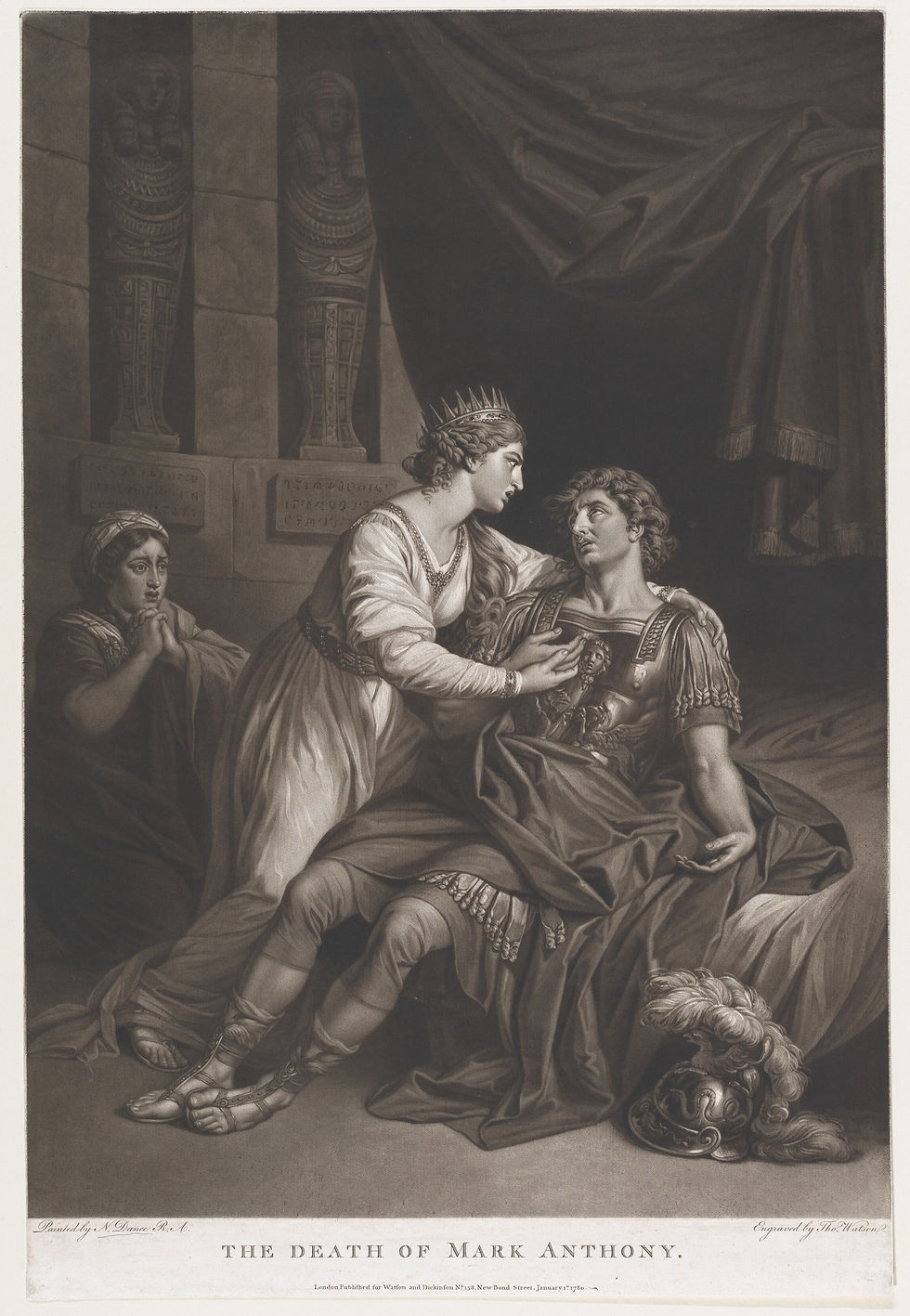
His friends found him alive and brought him to Cleopatra's hiding place. He was carried to her and died in her arms. He asked for one last cup of wine, drank it, and was gone. He was 53 years old. The date was 1 August, 30 BC.
Cleopatra survived him by about ten days before taking her own life, most likely via a venomous snake brought to her concealed in a basket of figs, though the exact method has never been established with certainty.
What Came After
Octavian had Caesarion, the last legitimate heir of Julius Caesar, tracked down and killed. Antony's older son by Fulvia, Antyllus, was also executed. His images and statues were torn down across the Roman world. Cicero had already decreed, before his own death, that no one in Antony's family should ever again bear the name Mark Antony. Antony's legacy was systematically erased by the man who had destroyed him.
And yet the irony of history is pointed here. Three of the five emperors who immediately followed Augustus, the man who had built his career on destroying Antony, were Antony's direct descendants. Caligula, Claudius, and Nero all came from his bloodline. The dynasty that Augustus founded carried the genes of the man he spent decades trying to obliterate.
There's also the question of what no one can know: Antony's actual appearance. Octavian made sure that no confirmed image of his enemy survived. Every statue and portrait that might have shown what he actually looked like was removed or destroyed. The busts traditionally attributed to him have never been definitively authenticated. Plutarch described him as broad-shouldered, bull-necked, and powerfully built, with a face that resembled depictions of Hercules, from whom the Antony family claimed descent. But the face itself is lost.
What remains is the story: the wild youth, the brilliant soldier, the flawed administrator, the man who stood at the centre of Roman history for thirty years and then fell, spectacularly and entirely, in love.
Sources
Wikipedia: Mark Antony — https://en.wikipedia.org/wiki/Mark_Antony
History Hit: 10 Facts About Mark Antony — https://www.historyhit.com/facts-about-mark-antony/
History.com: Mark Antony — https://www.history.com/articles/mark-antony
Britannica: Mark Antony — https://www.britannica.com/biography/Mark-Antony-Roman-triumvir
World History Encyclopedia: Mark Antony — https://www.worldhistory.org/Mark_Antony/
National Geographic History: Antony and Cleopatra's Love Affair — https://www.nationalgeographic.com/history/history-magazine/article/antony-and-cleopatra
Barry Strauss: Cleopatra's Grandest Entrance — https://barrystrauss.com/cleopatras-grandest-entrance/
Biography.com: Cleopatra and Mark Antony Romance — https://www.biography.com/royalty/a70113031/cleopatra-mark-antony-romance
School History: Mark Antony Facts and Biography — https://schoolhistory.co.uk/ancient-world/mark-antony/
History Collection: 5 Interesting Facts About Mark Antony — https://historycollection.com/really-romes-womanizer-chief-5-interesting-facts-mark-antony/
Penelope/University of Chicago: Antony and Cleopatra at Cydnus — https://penelope.uchicago.edu/encyclopaedia_romana/miscellanea/cleopatra/alma-tadema.html
Turkish Archaeological News: Cleopatra's Gate in Tarsus — https://turkisharchaeonews.net/object/cleopatras-gate-tarsus


