

Harvey Glatman: The Glamour Girl Slayer's True Crimes
Updated: Sep 18

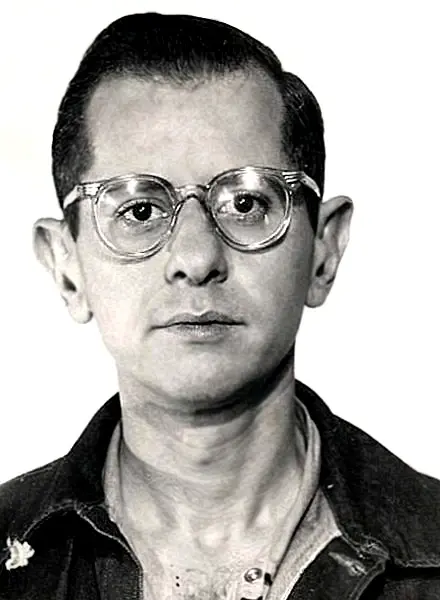
In the summer of 1957, an unremarkable television repairman in Los Angeles started telling young women he was a photographer for pulp detective magazines, offering them modelling work that would pay real money for a couple of hours of their time. Three of them never made it home. Harvey Glatman's crimes are well known enough that true crime writer Robert Keppel later called him the first documented case of a modern serial killer's signature, a psychological fingerprint distinct from mere method. What's less well known, and what most retellings of his story get flatly wrong, is what happened to him a decade earlier, when a much longer and messier criminal record than the one usually told got smoothed down into a single word: Elmira.
Quick answers
• Who was Harvey Glatman? A Los Angeles TV repairman who posed as a magazine photographer between 1957 and 1958 to lure young women to remote desert locations, where he bound, photographed and strangled them.
• How many people did he kill? He confessed to three murders, Judith Dull, Shirley Ann Bridgeford and Ruth Mercado, and is the leading, though never forensically confirmed, suspect in a fourth 1954 killing in Colorado.
• How was he caught? A fourth intended victim, Lorraine Vigil, fought him for his gun during an attempted kidnapping on the Santa Ana Freeway in October 1958, and the struggle was interrupted by a passing motorcycle officer.
• What happened to him? He pleaded guilty, told the court he thought the death penalty was justified, and was executed in the gas chamber at San Quentin on September 18, 1959.

A childhood built around secrecy and self-harm
Harvey Murray Glatman was born December 10, 1927, in the Bronx, New York, and moved with his family to Denver as a child, around age nine or ten. Several biographical accounts, drawing on later popular-crime writers rather than any surviving medical file, describe him experimenting with self-strangulation using rope and twine from an early age, behaviour his parents reportedly took him to a doctor about, only to be told it was nothing to worry about. It's worth being honest about the limits of this part of his story: no named physician, hospital record or contemporaneous case file has surfaced anywhere to confirm the specific ages or details usually repeated, so treat the broad pattern, early and secretive rope-related behaviour that alarmed his parents, as more solidly established than any of the specific ages attached to it.
The part of the story almost everyone gets wrong: not Elmira, but Sing Sing
Nearly every existing account of Glatman's life, this one included until now, states that a 1945 conviction sent him to Elmira Reformatory, followed by a 1948 parole and roughly a decade before he resurfaced in Los Angeles in 1957. Digging into the actual period newspaper coverage tells a longer and considerably darker story. In May 1945, at seventeen, he was arrested in Denver for attempted robbery, and that July he abducted a young girl in Boulder, drove her to Sunshine Canyon, tied her up and released her unharmed the next morning, an offence that got him probation rather than any custodial sentence at all.
The real institutional sentence came the following year, and it came in New York, not Colorado. In August 1946, while staying with relatives in the Bronx, Glatman went on a robbery and bondage spree across Yonkers and Albany, tying up at least half a dozen named victims with clothesline and threatening them with a 35-cent toy gun, and stabbing a man named Thomas Staro who tried to intervene. Arrested in Albany, he waived a grand jury hearing, was convicted and was sentenced to five to ten years at Sing Sing, the maximum-security New York prison, not the reformatory his story is usually pinned to. He was released in 1951, not 1948, immediately re-arrested by Yonkers police over the Staro stabbing, then handed over by a sympathetic judge to his father's custody in Colorado for psychiatric treatment rather than more prison time. He wasn't formally discharged from parole until 1956, a full eight years after the date most retellings, including generic listicle sites, use as his release. It was during this Sing Sing sentence, not a later Elmira stint that never happened, that a prison psychiatrist diagnosed him, in the language of the era, with a "psychopathic personality, schizophrenic type" involving "sexually perverted impulses," a diagnosis several retellings misdate to 1948 along with the rest of the Elmira myth.
A gap that was really about half as long, then a new identity in Los Angeles
With the corrected timeline, the supposed decade of mystery between his release and his move to Los Angeles shrinks to roughly five or six years, most of it spent doing odd jobs around Denver while nominally still on parole. His father, Abe, is reported to have died in 1952, though this detail rests on a single secondary source and isn't independently confirmed elsewhere. In January 1957, Glatman relocated to Los Angeles, opened a small television repair business, and started moonlighting with a camera, selling bondage-themed photographs to pulp detective magazines under names including Johnny Glinn and Frank Johnson. It was a modest, almost forgettable cover story, which was exactly the point.
"Johnny Glinn" and the disappearance of Judith Dull
His first known victim was Judith Dull, a 19-year-old aspiring model living on North Sweetzer Avenue in West Hollywood with two roommates. Dull was in the middle of a custody dispute over her one-year-old daughter and had a hearing scheduled for early August 1957, part of why she needed steady income. Posing as photographer Johnny Glinn, Glatman first approached her in late July, offering forty dollars, worth roughly $286 today, for two hours of modelling work. He picked her up on August 1, 1957, giving a phone number that traced to nothing more than a machine shop. Her body was found in a shallow desert grave more than four miles outside Indio, just off the highway.
Shirley Ann Bridgeford and the Lonely Hearts Club
Glatman's second confirmed victim, Shirley Ann Bridgeford, was a recently divorced mother of two from Kansas who he found through an entirely different route: a real-world lonely hearts club, reportedly run by a woman named Patty Sullivan, though that specific name isn't independently confirmable beyond secondary retellings. It was a far more mundane recruitment method than the modelling scam, and a reminder that his cover stories changed to fit whoever he was targeting. Bridgeford was bound hand and foot and strangled with a rope looped around her neck. Her body was recovered from the San Diego County desert only because Glatman personally led police to the spot after his arrest.
Ruth Mercado, the neglected parakeets, and the tightening rope
His third confirmed victim, 24-year-old Ruth Mercado, worked under the stage name Angela Rojas and was a Women's Air Force veteran originally from Plattsburgh, New York. She disappeared in the last days of July 1958, after being contacted through a newspaper employment advertisement. Her absence was first noticed not by a person but by her pets, her landlord found her dog and parakeets nearly dead of neglect in her room at the Shari Hotel on West Pico Boulevard. According to the California Supreme Court's own account of the case, Glatman used a single length of rope to bend her legs back toward her neck, pressing his knee into her back as he pulled it tight. Her body, like Bridgeford's, was recovered from the San Diego County desert only after Glatman directed investigators there himself.
The struggle that almost became a fourth murder
On October 27, 1958, using the alias Frank Johnson, Glatman picked up 28-year-old Lorraine Vigil for a supposed modelling job and drove her onto the Santa Ana Freeway at high speed before pulling off the road and producing a gun. What happened next is the reason he's remembered as a captured killer rather than one who vanished into legend: Vigil fought back, grabbing for the gun herself. During the struggle it discharged, the bullet passing through her skirt and burning her thigh, a detail almost never mentioned in shorter retellings of the case, before a passing California Highway Patrol motorcycle officer spotted the struggle and intervened.

A guilty plea, an appeal he never wanted, and the gas chamber
Glatman pleaded guilty to two counts of first-degree murder, for Bridgeford and Mercado, and waived a jury trial on the question of degree and sentence, after a court-appointed psychiatrist found him sane enough to stand trial. California law made an appellate review of any death sentence automatic regardless of a defendant's wishes, so it's not quite accurate to say he waived his right to appeal, since he had no legal power to skip it. What is true, and well documented, is that he wanted no part of contesting the outcome and pushed to have the process finished as quickly as possible.
At sentencing in December 1958, Judge John A. Hewicker told him plainly that some crimes were so serious only the death penalty would do, and Glatman's own reply, recorded by TIME magazine at the time, was simply, "I think my actions justify that." He was executed in the gas chamber at San Quentin on September 18, 1959, under Warden Fred R. Dickson, and contemporary reporting says he told an unnamed associate warden beforehand that he wanted nothing done to stop it. While several accounts attribute a version of the phrase that he thought death was for the best to Glatman's own final words, the exact wording varies enough between sources that it's fairer to say he accepted his death than to present any single quote as certain.

Boulder Jane Doe: a solved identity, and a killer who was never proven
For decades before his California crimes, investigators suspected Glatman in the 1954 death of an unidentified young woman found in Boulder Canyon, Colorado, a case that became known as Boulder Jane Doe. That mystery was actually solved in 2009, when mitochondrial DNA extracted from the victim's remains was matched to a surviving sister of Dorothy Gay Howard, closing a decades-old identification case through the combined work of historian Silvia Pettem and Boulder County Sheriff's Detective Steve Ainsworth. What's still unresolved, even now, is Glatman's own connection to it. The case against him has always been circumstantial, ligature marks resembling his later victims, injuries consistent with the bumper height of the car he owned at the time, and his documented presence in the Denver neighbourhood where Howard lived. He was never charged, and no DNA or physical evidence has ever tied him directly to her death, so the accurate framing is prime suspect rather than confirmed killer.

The first "signature killer": Glatman's place in the history of profiling
Glatman is sometimes described as an FBI case study in the origins of criminal profiling, but that particular claim doesn't hold up under scrutiny. No FBI document or retrospective on the Behavioral Science Unit's founding actually names him. The real, citable connection runs through a different figure entirely: Robert Keppel, the detective and criminologist who helped investigate Ted Bundy and later developed the concept of an offender's psychological "signature" as distinct from simple method of operation. Keppel's 1997 book on the subject treats Glatman's need to bind, photograph and pose his victims, behaviour that served no practical purpose in the crime itself, as close to the founding case study of the idea, which is a narrower but better-documented legacy than the vaguer claim that the FBI itself studied him directly. It's also worth being clear that Bundy and Glatman's connection runs only through Keppel, not each other. Despite Bundy's well-documented habit of discussing other killers at length with the detectives who investigated him, no record of Bundy ever actually referencing Glatman by name has surfaced anywhere.
A case true crime keeps returning to
Glatman's story has had a steady afterlife in true crime media rather than a single big adaptation. Two major true crime podcasts have covered it under its old tabloid nickname, Serial Killers in 2022 and Morbid across a two-part episode in 2023, and a brand new book landed just days before this piece went up: Richard L. Carrico's Bound to Die, published by WildBlue Press on September 15, 2026, which draws on court records and period newspapers and gives real weight to Lorraine Vigil's own role in stopping him rather than treating her as a footnote to the three women he killed.

Further reading on the site
Glatman wasn't the only killer to use a fake profession as bait, or the only one whose crimes shaped how later investigators thought about catching people like him. William Bradford ran a strikingly similar photography-based scam decades later in the same city, while Raymond Fernandez and Martha Beck worked the lonely hearts angle Glatman also briefly used, to even deadlier effect. For more on how cases like this one reshaped the way police think about offenders, there's The Mad Bomber of New York, the case that's usually credited with starting modern criminal profiling in the first place.


