


The Wildly Unlikely Story Behind the French Communist Party's Headquarters
Updated: Oct 6
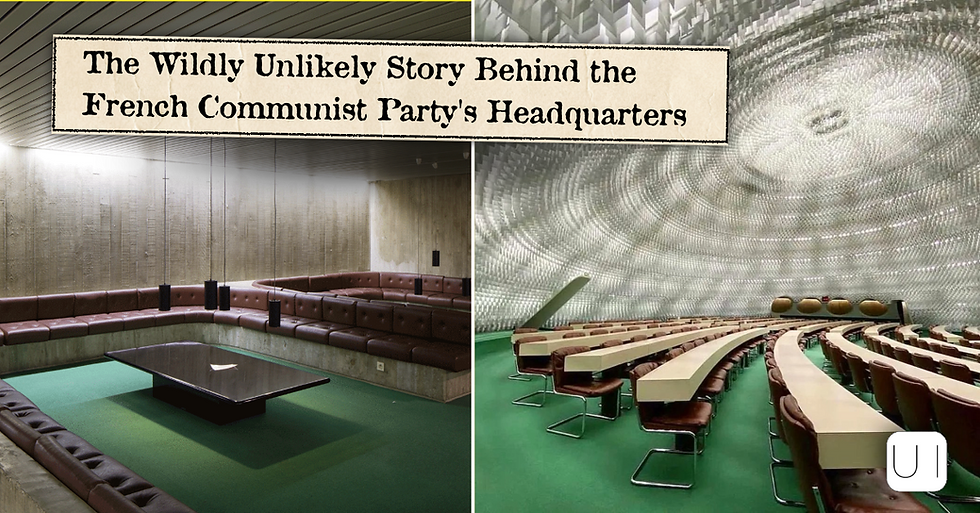
At Place du Colonel Fabien in Paris's working class 19th arrondissement sits one of the strangest buildings in the city, a rippling white and glass structure that looks more like something from a science fiction film than the administrative home of a political party. It was designed for free by an exiled Brazilian communist, took thirteen years to finish, and now spends more time hosting fashion shows than party congresses. It's also one of the more unexpected results of a military coup on the other side of the Atlantic.
Quick Answers
Who designed the French Communist Party headquarters? Brazilian architect Oscar Niemeyer, best known for designing Brasília, designed the building while living in political exile in Paris. He waived his usual fee entirely as a gesture of solidarity with the party.
Where is the French Communist Party headquarters located? At Place du Colonel Fabien in Paris's 19th arrondissement, a working class district in the northeast of the city. It's been a listed historic monument since 2007.
Why did it take so long to build? Construction ran from 1967 to 1980, delayed by financial constraints. The main office block opened in 1971, but the building's underground domed auditorium wasn't completed for another nine years.
An Architect Without a Country
Oscar Niemeyer had already built one of the twentieth century's most famous cities by the time any of this started. Alongside urban planner Lucio Costa, he'd designed the great public buildings of Brasília, Brazil's brand new capital, inaugurated in 1960 after barely three and a half years of construction. He was, by any measure, one of the most celebrated architects alive, and he'd also been a card carrying member of the Brazilian Communist Party since 1945.

That second fact caught up with him fast. In 1964, a right wing military coup, backed by the United States, overthrew Brazil's government. Niemeyer, well known and well documented as a committed leftist, found his work drying up almost overnight under a regime that considered him a subversive. His office was ransacked in 1965. He left unfinished projects behind, including Brasília's cathedral and the Itamaraty Palace, and fled to Paris, setting up a new office on the Champs-Élysées. He'd already been refused entry into the United States twice over his party membership, so France, at least, was willing to have him.
Two Sketches on a Single Sheet of Paper
Niemeyer's timing turned out to be useful. A 1965 exhibition of his Brasília work at the Musée des Arts Décoratifs drew record crowds in Paris and put him firmly back in the public eye just as the French Communist Party, the PCF, was looking to consolidate its scattered Paris offices into a single, purpose built headquarters. Given his politics and his reputation, Niemeyer was the obvious choice, and when the party approached him, he didn't just accept the commission, he waived his fee entirely. As he later put it in his memoir, their shared political struggle mattered far more to him than architecture.
What he actually handed over to the project's French execution team was almost comically minimal: two elegant sketches on a single sheet of paper roughly the size of a magazine page, plus a tiny scale model. From that, architects Paul Chemetov and Jean Deroche, engineer Jacques Tricot and designer Jean Prouvé, who built the building's distinctive tinted glass curtain wall, turned Niemeyer's sketches into an actual, standing building.
Thirteen Years to Build
Construction dragged on from 1967 to 1980, well past anyone's original expectations. The six storey main office block, a serpentine curve of glass supported on paired columns that double as service ducts, opened first in 1971. Underground, the site holds a large auditorium seating around 450 people, its presence marked at ground level only by a white dome sheathed in anodised aluminium blades, reached by sloping ramps rather than stairs. Money problems repeatedly stalled that second phase, and it wasn't finished until 1980, meaning the full building took roughly as long to complete as the entire city of Brasília had, for a fraction of the size.
The Worker's House
Niemeyer refused to put a grand staircase anywhere near the entrance, a deliberate choice for a party that was supposed to represent working people rather than impress them. Visitors instead take a modest flight of steps down into roughly 1,000 square metres of underground hall, where the floor itself rolls and dips like open countryside rather than sitting flat, a piece of structural theatre so aggressive that modern building codes would likely never allow it today. Niemeyer called this space the worker's house, and left the raw, board formed concrete on its walls entirely exposed, plank impressions, nail heads and casting imperfections included, rather than smoothing any of it away.
The green carpet running through the building was Niemeyer's own quiet nod to the colours of the Brazilian flag rather than anything specifically French, and the low, sculptural Alta lounge chairs scattered through its lobby areas were designed specifically for the building in 1971, in collaboration with his daughter Anna Maria. Decades later, original examples of those same chairs have become sought after design pieces in their own right, occasionally turning up at auction for many times what the party is likely to have paid for the originals.
A Building Bigger Than Its Party
There was something almost defiant about the timing. The PCF had once commanded well over 20 per cent of the national vote, but by the time ground was actually broken on its striking new headquarters, the party had suffered real losses in the 1968 legislative elections and was already sliding toward the political irrelevance that would define its remaining decades. Building one of the most talked about structures in Paris while your actual electoral support keeps shrinking is, at the very least, a bold piece of messaging.
Whatever people made of the politics, the architecture won over critics who had no particular sympathy for communism at all. Conservative French president Georges Pompidou was reportedly among its admirers, and a March 1972 review in The Architectural Review called it probably the best building in Paris since Le Corbusier's Cité de Refuge for the Salvation Army, a genuinely enormous compliment from a British publication with no obvious reason to flatter the French Communist Party.
The party's finances never really caught up with its architectural ambitions. By 2008, running the building was costing around 12 million euros a year, and the PCF made the pragmatic decision to rent out the top two of its six office floors to outside companies under the Espace Niemeyer name, saving roughly 3 million euros annually in the process. Its first paying tenant was, fittingly for a building this strange, a comics and animation studio rather than another political organisation.
From Party Headquarters to Fashion Runway
The PCF still uses the building as its actual headquarters today, but it's picked up an unlikely second life alongside that. Operating under the name Espace Niemeyer, the site is rented out for exhibitions, conferences and, increasingly, Paris Fashion Week runway shows, with Chanel, Louis Vuitton, Prada, Pierre Cardin and Stella McCartney all having staged presentations inside a building originally meant to project revolutionary confidence rather than sell handbags. It was formally listed as a historic monument in 2007, and the public can otherwise usually only get inside during France's annual European Heritage Days.
Niemeyer himself eventually went home. He returned to Brazil in 1985 once the military dictatorship had loosened its grip, and kept working for almost three more decades, dying in Rio de Janeiro in 2012 at the age of 104. The building he designed for free, sketched on a single sheet of paper for a party that never fully recovered its old influence, has outlasted almost everyone involved in commissioning it, and today draws more visitors for the clothes on its runway than the politics in its committee rooms.
You Might Also Like
For another leftist government toppled by a Cold War era coup, read The Chilean Coup of 1973: The Rise of Pinochet and the Shadows of CIA Involvement.


