


Barbara Daly Baekeland: The Bakelite Heiress Killed by Her Son in Chelsea
Updated: 3 days ago
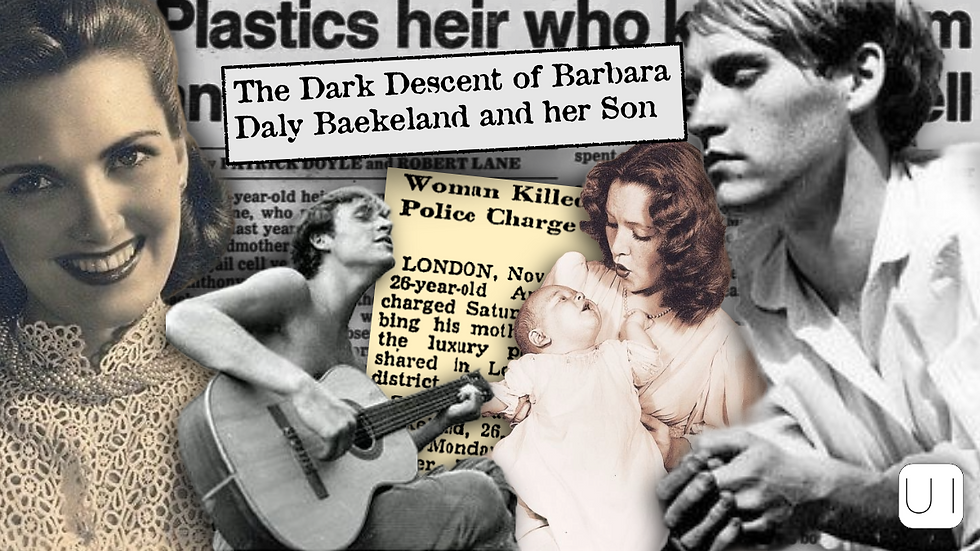
On the afternoon of 17 November 1972, Barbara Daly Baekeland left a long lunch in Belgravia and told her hosts she had to get home because her son was cooking dinner. A few hours later she was lying dead on the kitchen floor of her Chelsea penthouse, and 26-year-old Antony Baekeland, Tony to everyone who knew him, was in a bedroom ringing round Chinese restaurants.
It's a story that usually gets told as a lurid one-liner: Vogue model, plastics fortune, incest, murder. The real thing is messier and sadder than that. There were warnings, some of them blunt. There was an arrest for attempted murder less than four months earlier. And after Tony was locked up, a group of well-meaning friends got him out, with results that were every bit as predictable as the first time.
Quick Answers
Who was Barbara Daly Baekeland? An American model and socialite who married Brooks Baekeland, grandson of the man who invented Bakelite.
How did she die? Her son Tony killed her with a single stab wound from a kitchen knife at 81 Cadogan Square, Chelsea, on 17 November 1972.
What happened to Antony Baekeland? He was convicted of manslaughter on the grounds of diminished responsibility in June 1973 and sent to Broadmoor.
Was he ever released? Yes, in July 1980. Six days after reaching New York he stabbed his 87-year-old grandmother eight times. She survived.
How did Tony Baekeland die? He was found suffocated with a plastic bag in his cell on Rikers Island on 20 March 1981. He was 34.
Did Barbara really sleep with her son? It's the most repeated claim in the case and it has never been proved. People who knew them disagreed about it.
What was Brooks Baekeland's net worth? Nobody has ever published a reliable figure. The family business sold for $16.5 million in 1939 and Brooks wasn't the only heir.

Brooks Baekeland and the Bakelite Fortune
The fortune started with Leo Baekeland, a Belgian chemist from Ghent who sailed to America in 1889. He made his first pile with Velox, a photographic paper you could print under artificial light, which he sold to Eastman Kodak in 1899 for a reputed $750,000. He then went looking for a substitute for shellac and came up with Bakelite, one of the first fully synthetic plastics, which he showed to the public in 1909. It ended up in telephones, radios, light fittings and jewellery.
Leo's son George didn't want to run the company, so in 1939 Leo sold it to Union Carbide. PBS puts the price at $16.5 million, which it reckons was worth a little over $200 million by the early 2000s. Leo died in 1944.
That sale is the nearest thing there is to a hard number for the Baekeland money. You'll see confident figures online for Brooks Baekeland's net worth, but none of them comes with a source. He wasn't the only heir. He lived off inherited capital and never published accounts. What's certain is that the family didn't need to work and Brooks was perfectly happy with that arrangement. He had a line for it, borrowed from the novelist James Clavell, which was that he had the kind of money that meant he never had to please anyone. He meant it as a boast. Reading it now, it sounds more like a diagnosis.
Who Was Barbara Daly?
Barbara Daly was born near Boston in 1922. In 1932, when she was still a child, her father Frank killed himself with carbon monoxide. The family account, as told in the book Savage Grace, is that he arranged it to look like an accident so the insurance would pay out. Her mother Nina, known as Nini, moved the two of them to New York.

Barbara grew up into the sort of looks that got her noticed. She modelled, appeared in Vogue and Harper's Bazaar and had a go at acting, moving through the same New York society world that had been chewing up well-dressed young women for decades. Like Audrey Munson a generation earlier, she found that being admired and being looked after were two different things.
She met Brooks through his sister. He was training as a pilot with the Royal Canadian Air Force and they married in 1942. Savage Grace reports that she told him she was pregnant when she wasn't. Their only child, Antony, was born in Manhattan on 28 August 1946.

A Family With No Fixed Address
For a while the Baekelands held court on the Upper East Side. From the mid-1950s they drifted: Paris, London, Zermatt, Antibes, the Italian coast and the Spanish fishing village of Cadaqués, which was Salvador Dalí's patch. Their dinner tables pulled in writers and painters, with Greta Garbo and Tennessee Williams among the names that turn up in accounts of the guest lists. Tony was shown off to all of them as a prodigy. He drew and he wrote, and the novelist James Jones, of From Here to Eternity, thought he had real promise.
He never really got the chance to find out what. He had almost no settled schooling and no friends his own age who stayed put. Barbara, who drank heavily and could turn on a room without warning, treated him as her closest companion. Brooks was mostly somewhere else, at one point planning an expedition to Peru.
Things came apart in the late 1960s. In 1967 Tony, then 20, fell in with an Australian called Jake Cooper in Cadaqués, got into hallucinogens and took off to Morocco. Barbara went to Spain to haul him back. Around the same time Tony was seeing a young Spanish woman called Sylvie. In 1968 Brooks left Barbara for her.
Barbara tried to kill herself four times over the course of the marriage, the last when Brooks walked out. Brooks, for his part, wouldn't hear of psychiatric treatment for his son. He thought the whole profession was "professionally amoral".

Did Barbara Baekeland Sleep With Her Son?
What's well attested is that Barbara couldn't accept that Tony was gay and tried to change it. She's reported to have paid women to sleep with him. The further claim is that, in Mallorca in the late 1960s, she took him to bed herself to "cure" him. That allegation runs through Savage Grace. The Washington Post's review repeated it as fact in 1985 and the 2007 film built its most notorious scene on it.
But the evidence is second-hand. It comes from friends who say Barbara told them, and Barbara liked to shock. Sam Green, the art curator who had a brief affair with her in 1969 and stayed at the Mallorca house, didn't buy it. He said later that as far as he knew she never slept with Tony. Neither of the two people who could have settled it is on record doing so. The honest position is that it's unproven.
What Green did see was bad enough. He described a dinner where Tony got up, walked round the table, pulled his mother backwards off her chair by her hair and started dragging her to the door.
The Warnings Nobody Acted On
By 1972 Barbara and Tony were living at 81 Cadogan Square, in a duplex penthouse with a Spanish maid and a Siamese cat called Worcester, known as Mr Wuss.
In late July, Tony tried to shove his mother into the traffic outside the flat. A friend who was with them pulled her back. The Metropolitan Police arrested him for attempted murder. Barbara refused to press charges, so there was nothing to hold him on. He went into the Priory for a short stay and came out again.
On 30 October he saw a psychiatrist, Dr W. Lindsay Jacobs, for the first time. Jacobs didn't dress it up. Afterwards he told Barbara straight: "Your son is going to kill you." Her answer, which the Washington Post later picked out, was "He's been murdering me since he was born." Jacobs told her he wasn't speaking in metaphors. She said she didn't think she was at risk.
That was eighteen days before she died.
17 November 1972
The opening chapter of Savage Grace, which is available to read online through the Library of Congress, pieces the day together from the people who were there.
Barbara had lunch at about one o'clock with her friend Missie Harnden in Chapel Street. Harnden's teenage son cooked: fillet steak wrapped in bacon, green beans, salad and a bottle of Spanish red. Barbara left at around half past three and mentioned that Tony was making dinner.

At about seven that evening Chelsea police station rang the Harndens to ask about the lunch and wouldn't say why. Detective Superintendent Kenneth Brett had found Barbara on her back on the kitchen floor with one small wound to the chest. The knife had cut an artery. It was lying on the worktop.
Tony was in a bedroom on the phone to Chinese restaurants. He first suggested his grandmother had done it, which she couldn't have, since she was in New York. When he did give a statement, he said it had all begun when he fell off his pogo stick as a small boy. In a letter to Nini afterwards he wrote, "I felt as though she were controlling my mind."
A friend remarked of the Chanel dress Barbara had been wearing that it was just the sort of thing you'd put on to be stabbed in. That one is recorded in the London Review of Books, and it tells you a fair bit about the crowd.
The Old Bailey and Broadmoor
Tony was held on remand at Brixton and tried at the Old Bailey on 6 June 1973. His barrister was John Mortimer, who'd defended the editors in the Oz obscenity trial in the same building two years earlier and would go on to write Rumpole. Tony had been diagnosed with schizophrenia. The jury returned a verdict of manslaughter on the grounds of diminished responsibility, and he was sent to Broadmoor with no release date.
It was a busy couple of years for well-heeled violence in that corner of London. Cadogan Square is a ten-minute walk from Lower Belgrave Street, where Lord Lucan's nanny was killed in 1974.
By most accounts Tony settled at Broadmoor. He painted, worked in the handicrafts shop and had visitors. Nini stayed loyal and wrote to him. Brooks stayed away and regarded his son as evil.
One detail you won't find in most versions of this story: the official files on the case are held at the National Archives in Kew and are closed until 2047.

What Happened to Tony Baekeland After Broadmoor?
Towards the end of the 1970s a group of family friends started lobbying to get Tony out. The best connected of them was Hugo Money-Coutts, of the Coutts banking family. The deal they got was that he'd be released on condition he went back to the United States.
He was let out in July 1980 and flew to New York to live with Nini, who was 87, in her flat on the Upper East Side. On 27 July, six days after he arrived, he stabbed her eight times with a kitchen knife and broke several of her bones. When police got there he was complaining that "she won't die". He later said he'd thought it would be kinder to kill her. A Broadmoor consultant reportedly summed up the decision to free him as a blunder.
Nini survived. Tony was charged with attempted murder and sent to Rikers Island, where he spent eight months.
On 20 March 1981 he was taken to court for a hearing that was adjourned, because his medical records still hadn't arrived from Britain. He was back in his cell by mid-afternoon. At half past three, about thirty minutes later, he was found dead with a plastic bag over his head. It's generally treated as suicide, though the circumstances were never fully cleared up. He was 34.
The great-grandson of the man who invented plastic had died by plastic, and his father noticed. Brooks is quoted calling it "a beautiful ending".
What Happened to Brooks Baekeland?
Brooks had built a new life well before any of this. He stayed with Sylvie, had another child and kept his distance from both the trial and Broadmoor. He outlived his first wife and his son, and he was still around to give long, unsparing interviews to the authors of Savage Grace in the 1980s.
The Book, the Film and the Lawsuit
Savage Grace by Natalie Robins and Steven M.L. Aronson came out in 1985. It's an oral history, close to 500 pages of interviews, letters and hospital notes laid side by side with very little commentary, and it's still the main source for nearly everything written about the family, this piece included. William Styron thought the story was pure Greek tragedy.
The film followed in 2007, directed by Tom Kalin from a script by Howard A. Rodman, with Julianne Moore as Barbara, Stephen Dillane as Brooks and a 25-year-old Eddie Redmayne as Tony. It took about six years to finance and five weeks to shoot, in Barcelona, and it opened in the Directors' Fortnight at Cannes. Reviews were lukewarm. Roger Ebert gave it two stars and wanted more insight into why any of it happened. Moore told Salon she'd felt a lot of empathy for Barbara.
Sam Green felt rather less for the film-makers. The script put his character, played by Hugh Dancy, in bed with both Barbara and Tony. Green's response was flat: "I certainly never slept with her son". In September 2008 he sued the production and distribution companies for defamation in New York. He died in March 2011.
So the best-known scene in the best-known version of the Baekeland story was disputed, in court, by the one person in it who was still alive.
What It Adds Up To
It's tempting to treat this as a morality tale about money, and the money mattered. It bought the flats and the freedom from consequences, and it meant nobody ever had to stay anywhere long enough to deal with anything. But the thing that actually killed Barbara Baekeland was simpler. A seriously ill young man went untreated, because his father didn't believe in psychiatry and his mother couldn't bear to let him go. Then the police, a doctor and her own friends each told her what was coming, and she didn't believe them.
Eight years later the people who campaigned for Tony's release made the same misjudgement Barbara had. They didn't think he was dangerous either, and it nearly cost Nini her life.
You Might Also Like
Sources
Robins, Natalie and Aronson, Steven M.L. Savage Grace. William Morrow, 1985. Opening chapter via the Library of Congress
Crime+Investigation UK: Death of a Socialite: The Barbara Baekeland Case
The Washington Post: The Fall of the House of Baekeland, 15 September 1985
London Review of Books: Gabriele Annan on Savage Grace, 1985
The Steeple Times: Manacled to Mummy, 8 March 2014
History.com: A Wealthy Heiress Is Murdered by Her Son
Warholstars: Sam Green obituary
Courthouse News Service: Art Dealer Says 'Savage Grace' Defamed Him, September 2008
Science Museum Group: Leo Hendrik Baekeland 1863 to 1944
Time: Books: Cesspool, review of Savage Grace by William A. Henry III
PBS, They Made America: Leo Baekeland
RogerEbert.com: Savage Grace review
Salon: Julianne Moore interview, 29 May 2008


