


Alfred Gwynne Vanderbilt: The Gilded Age Millionaire Who Died a Hero on the Lusitania
Updated: Nov 10
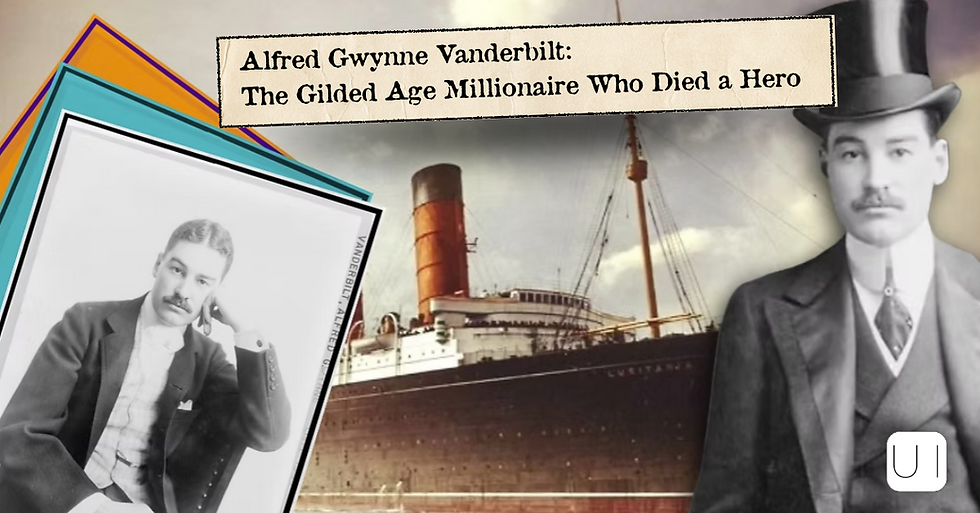
Alfred Gwynne Vanderbilt couldn't swim. He was one of the richest men in America, he'd spent years splashed across the gossip pages and he'd crossed the Atlantic more times than most sailors. But when a German torpedo hit the Lusitania off the south coast of Ireland on 7 May 1915, he did something nobody expected of a millionaire playboy. He handed over his lifebelt.
The ship went down in 18 minutes. Vanderbilt spent them helping women and children towards the boats, and he was last seen giving his lifebelt to a young nurse called Alice Middleton. She lived. He didn't, and his body was never found. It's a story that gets told a lot, but the version you usually hear leaves out the best bits: the coach he drove to Brighton for fun, the divorce that ended in a death, a Titanic legend that probably belongs to someone else and a famous tribute that the woman supposedly behind it said she never gave.
Quick Answers
Who was Alfred Gwynne Vanderbilt? An American millionaire and sportsman, born in 1877, who inherited the biggest share of the Vanderbilt railroad fortune.
How did Alfred Vanderbilt die? He drowned when the RMS Lusitania was torpedoed by the German submarine U-20 on 7 May 1915. He was 37.
Did he really give his lifebelt away? Witnesses say he did. Nurse Alice Middleton is thought to have been the woman who took it.
Was his body ever found? No, despite a reward being offered for it.
Was Alfred Vanderbilt booked on the Titanic? That's a family story, but it's often confused with his uncle George, who did book and then cancel.

The Son Who Got Almost Everything
Alfred was born in New York on 20 October 1877, the third son of Cornelius Vanderbilt II and Alice Claypoole Gwynne. He grew up between the family's chateau on Fifth Avenue and The Breakers in Newport, went to St Paul's School in New Hampshire and then to Yale, where he joined Skull and Bones and graduated in 1899.
That was the year everything changed. His eldest surviving brother, Cornelius, known as Neily, had married Grace Wilson against their father's wishes, and when Cornelius II died later in 1899 he got his revenge from beyond the grave. Alfred, not Neily, inherited the bulk of the $72 million estate. Neily got a fraction of it.
Alfred tried to put it right by handing his brother millions of his own money. It didn't work. The two never made up.
A Scandal Nobody Could Ignore
In January 1901 Alfred married Ellen "Elsie" French in Newport and their son William Henry was born in November that year. For a while they looked like the perfect society couple. Then, in 1908, Elsie filed for divorce on the grounds of adultery.
The other woman was Agnes O'Brien Ruiz, the wife of a Cuban diplomat. It was the kind of Gilded Age scandal the papers lived for, not far off the Evelyn Nesbit affair for column inches, and one cable even claimed Alfred had offered his wife £300,000 to settle it. The divorce went through in May 1908.

It ended far worse for Agnes than it did for Alfred. Society split over who to blame, and the following year she was found shot dead in her bed, a death reported as suicide. Alfred, meanwhile, left for London and threw himself into the thing he loved most.
The Millionaire Who Drove the Brighton Coach
That thing was coaching. Alfred was obsessed with old-fashioned four-in-hand driving, and in England, where rich gentlemen still did it for sport, he found his people. In 1907 he shipped 26 coaching horses over from his Oakland Farm for the first International Horse Show in London.

His coach was called the Venture, built for him in 1903 by Brewster and Co. From 1908 he ran it as a proper public service between London and the Hotel Metropole in Brighton, going down one day and back the next. It wasn't quick. The trip took about seven hours, leaving London at 11am and getting in at 6pm with nine stops along the way, but nobody bought a ticket for the speed.
Alfred often drove it himself, dressed as if he were off to Ascot in a grey top hat, while his guard Walter Godden played a century-old bugle as they came through Brighton. Crowds lined the road at Preston Park to watch him go past. There's even a 1909 photo in the Historic England archive of him driving the Venture along Putney High Street.
One of his favourite stops was the Burford Bridge Hotel near Box Hill, and the stretch of road through Dorking and Holmwood in Surrey became his favourite of all. That detail matters later. When war broke out in 1914, the Army commandeered the horses from his coaches, which must have hurt a man who knew every one of them by temperament.
A Second Marriage and a New Start
In December 1911 Alfred married again, in London, to Margaret Emerson McKim. She was a wealthy American divorcée and the daughter of the man behind Bromo-Seltzer. They shared a love of horses, and the Vanderbilt estate in Newport boasted the largest private riding ring in the world.

Two sons followed, Alfred Jr in 1912 and George in 1914. Alfred Jr would later become one of the biggest names in American horse racing, which is why a lot of what you find online about "Alfred Vanderbilt" is actually about him. The family split its time between New York, Newport, London and Sagamore, their great camp in the Adirondacks.
Was He Really Meant to Be on the Titanic?
There's a story that's been attached to Alfred for more than a century. In April 1912, it goes, he was booked on the Titanic's maiden voyage and cancelled at the last minute because his mother had a bad feeling about it.
It's a great story, but it probably isn't his. A correction on the Lusitania Resource's page points out that it was his uncle George who booked and then cancelled. George Washington Vanderbilt II, the man behind the Biltmore estate, did hold tickets for the Titanic and changed his plans, and his luggage and his valet went on without him. Somewhere along the way the two Vanderbilts seem to have got mixed up.
Alfred wasn't short of experience on the big liners, though. He'd watched the Lusitania arrive in New York on her maiden voyage in 1907 from his yacht and some years made as many as seven crossings, on the Olympic and the Mauretania as well as the Lusitania. The Olympic had its own share of drama, as stewardess Violet Jessop could tell you. If you want to know more about the Titanic's other famous survivors, the story of Margaret "Molly" Brown is a good place to start.
Why He Sailed in 1915
By the spring of 1915 the war in Europe was nine months old. America was still neutral, but Germany had declared the waters around Britain a war zone. Alfred had two reasons to cross anyway. He was due to direct a meeting of the International Horse Breeders' Association in England that had been put off in 1914. He also planned to give the British Red Cross a fleet of wagons and offer himself as a driver.

On the morning the Lusitania sailed, 1 May 1915, the Imperial German Embassy's warning appeared in American newspapers, in some cases right next to Cunard's own advert for the voyage. It told travellers that ships flying the British flag were liable to be destroyed and that anyone sailing on them did so at their own risk.
Margaret and the boys stayed behind at the Vanderbilt Hotel in New York. Alfred boarded with his valet Ronald Denyer and settled into Parlour Suite B-65 and B-67. Before the ship left, he was handed a telegram warning him not to sail. In Erik Larson's account in Dead Wake, it was signed "Mort", and Alfred wondered aloud whether that was meant to be a nod to death. He brushed it off. Asked about the danger, he laughed and said "Why should we be afraid of German submarines", adding that the liner could outrun them.

Six Days at Sea
The crossing itself was pleasant enough. Alfred spent his time with the theatre producer Charles Frohman, the actress Rita Jolivet, George Vernon and his old friend Thomas Slidell. On 6 May he went to Frohman's party and then to the ship's concert for seamen's charities, where he paid five dollars for a programme that cost ten cents.
On the last day he lunched with Staff Captain James Anderson. A few hours later, the Lusitania was off the Old Head of Kinsale.
Eighteen Minutes
At around 2.10pm on 7 May 1915, the German submarine U-20, commanded by Walther Schwieger, fired a single torpedo into the Lusitania's starboard side. A second explosion followed from somewhere inside the ship. She listed so badly that many of the lifeboats on one side couldn't be launched at all.

The survivors' accounts of Alfred in those minutes are remarkably consistent. Oliver Bernard almost ran into him at the saloon entrance and remembered him grinning. Second Steward Robert Chisholm saw him trying to help a hysterical woman and shouted at him to hurry. Slidell later said he watched Alfred put a lifebelt on a woman's shoulders and walk off without a word, and that Vanderbilt, who couldn't swim, took off his own belt to do it.
Alfred and Denyer went looking for children and loaded them into whatever boats they could. Neither of them pushed towards a place for themselves.
His last known act was near the verandah café. Alice Middleton, a 25-year-old British nurse travelling in second cabin, accepted a lifebelt from a man who helped her into it. Before he'd finished doing up the straps, the ship took her final plunge and they were both swept off the deck. Underwater, Alice's head got stuck in an open porthole. She somehow freed herself and survived.
Denyer jumped with another passenger, Owen Kenan, right at the end. He didn't make it either.
The Woman Who Didn't Know Who Saved Her
Here's the bit that gets left out. Alice Middleton had no idea who'd given her the lifebelt. She'd never spoken to the man before that moment.
It was only in the 1930s, during the early salvage work on the wreck, that she met Robert Chisholm, the steward who'd seen Alfred on deck. He told her the story of Vanderbilt giving away his lifebelt and showed her a photograph. She was convinced it was him.
Alice went on to live in the United States and died in Michigan in 1964, almost half a century after the man she'd only just met gave her the chance to grow old.
The Children's Hero, and a Tribute That May Not Be Real
Nearly 1,200 people died in the sinking, more than 120 of them American. Alfred's name was one of the first anyone looked for. Margaret refused to believe he was gone without proof, and a $5,000 reward was put up for anyone who found his body. Nobody ever did.

The newspapers quickly made him "the children's hero". The line that did the most to stick came from a survivor called Mrs Lines, quoted as saying people would no longer talk of "the millionaire sportsman and man of pleasure", and it was reprinted around the world.
The twist is that Ethel Lines later said she never said it. According to the Lusitania Resource, she claimed a reporter had invented the tribute, and she'd left the ship in a starboard boat while Alfred was on the port side. It doesn't change what the other witnesses saw. It does show how fast the press turned him from a scandal into a saint.
Oddly, the family didn't lean into it. His funeral notices and obituary left out the Lusitania altogether, and his Who's Who entry gives only the date of his death.
What He Left Behind
Alfred's estate was valued at over $26 million. William, his son from his first marriage, got $5 million and the Congressional Gold Medal awarded to his great-great-grandfather, Commodore Cornelius Vanderbilt. Margaret received around $8 million in property in Britain and America, and the two younger boys shared the rest.
William went on to become Governor of Rhode Island. Alfred Jr became a giant of American racing. And in England, Alfred's coaching friends didn't forget him.
On the A24 between South and Mid Holmwood, just south of Dorking, there's a stone that reads, in part, that it was erected "on his favourite road by a few of his British coaching friends". It's still there, on the road he used to drive with the Venture.
His grandson, Alfred Gwynne Vanderbilt III, has a sharper view of the sinking than most. Speaking to the Irish Times on the centenary in 2015, he called it an act of international terrorism and argued that his grandfather died as he'd lived. Whether you see Alfred as a playboy who found his moment or a decent man who'd always been more than the gossip columns made out, his last 18 minutes are the reason anyone still remembers his name.
Suggested Reading
If you want the full story of Alfred and the Lusitania, these two are well worth your time.
Alfred Gwynne Vanderbilt: The Unlikely Hero of the Lusitania by Steven and Emily Gittelman. The only full biography of Alfred, from the inheritance and the scandal to his final hours.
Dead Wake: The Last Crossing of the Lusitania by Erik Larson. A gripping, hour-by-hour account of the voyage, with Alfred among its cast.
As an Amazon Associate, Utterly Interesting earns from qualifying purchases.
You Might Also Like
Sources
Alfred Vanderbilt, Saloon Passenger, Lost, The Lusitania Resource
Alice Middleton, Second Cabin Passenger, Saved, The Lusitania Resource
Robert Daniel Fletcher Chisholm, Second Steward, The Lusitania Resource
Alfred Gwynne Vanderbilt, Dorking Museum
Alfred Vanderbilt and his Horses, Hove in the Past (Judy Middleton)
London to Brighton Coach, Epsom and Ewell History Explorer
Alfred Vanderbilt driving his coach 'Venture' along Putney High Street, Historic England Archive
Coaching Glories: Alfred Vanderbilt's Scheme (1908), Papers Past
"The Children's Hero" (1915), Papers Past
Newspaper report on the Lusitania sailing, 8 May 1915, Pennsylvania Newspaper Archive
Morning Oregonian, 10 May 1915, Historic Oregon Newspapers
One of the US's richest men among victims of Lusitania, The Irish Times


