


Enchanting Beauty: The Private Art and Hidden Life of Alfred Cheney Johnston
Updated: Oct 6

If you've ever come across a strikingly sharp, glamorous photograph of a near-nude showgirl draped in pearls or feathers and thought it looked almost too beautiful to be real, there's a good chance you were looking at the work of Alfred Cheney Johnston. He wasn't the most famous photographer of his era, and he wasn't trying to be an artist in the fine art sense. What he was doing was something arguably more interesting: turning the women of the Ziegfeld Follies into icons before anyone had really figured out how to do that with a camera.
Johnston was born in 1884 and spent much of his career working closely with Florenz Ziegfeld Jr., the Broadway impresario whose Follies revues ran from 1907 right through to 1931. The Follies were America's answer to the Moulin Rouge, a spectacular mix of comedy, music, and chorus girls that defined a certain idea of glamour and excess. Ziegfeld had a gift for finding beautiful women, but it was Johnston who gave them a lasting visual presence. His portraits of the Follies girls became the standard image of Jazz Age beauty, and many of them are still circulating today, over a century later.
Johnston was born on 8th April, 1885, in Westchester County, New York, and spent much of his career working closely with Florenz Ziegfeld Jr., the Broadway impresario whose Follies revues ran from 1907 right through to 1931. If you want the full story of how Johnston came to work for Ziegfeld, and what happened to him in the decades that followed, our companion piece, Alfred Cheney Johnston and the Artistry Behind the Ziegfeld Follies' Golden Era, covers his biography, his technical process, and his rediscovery in detail. This piece is about something different: who Johnston was as an artist outside the Follies contract, and where his work sits in the wider story of early 20th-century nude photography.
The Technical Approach
Johnston worked with large format glass plate cameras, which gave his images an exceptional clarity and tonal richness that smaller formats simply couldn't match. His work is often filed under "soft-focus" glamour photography, and in terms of overall mood and the gentleness of his lighting, that's a fair description. But it's worth being precise about where the softness actually comes from. It isn't a blurred lens or an out-of-focus negative. His glass plates are, if anything, remarkably sharp.
The dreamlike quality comes from his platinum printing process, his careful control of shadow and highlight, and his skill at positioning light to flatter rather than expose. For a sense of how a genuinely soft-focus, blurred-lens approach worked in contrast, our piece on Arthur Kales and the Pictorialist tradition is worth a read. Kales was chasing atmosphere through the lens itself. Johnston got there through print technique and lighting while keeping his negatives razor sharp, which is part of what separates his work from much of the commercial portrait photography of the same period.
The lighting was always considered, always flattering, picking out the contours of a face or the curve of a shoulder without ever feeling harsh or clinical. His subjects look at the camera with a kind of serene confidence. They aren't passive objects; they're participants in the image. That's rarer than it sounds for this era, especially in work that was essentially promotional.
The Ziegfeld Girls and What They Meant
The Ziegfeld Follies girls occupied a strange cultural space. They were celebrated for their beauty, photographed constantly, written about in the press, but they weren't quite respectable in the way that stage actresses were. They existed somewhere between art and entertainment, between admiration and scandal. Johnston's portraits navigated this carefully. Many of his images are nudes, or close to it, but they never feel exploitative. There's always a sense of artistry, of deliberate composition. A woman with a veil, a woman reclining on a patterned carpet, a figure posed against a simple backdrop. The nudity feels incidental to the beauty rather than the point of it.
Drucilla Strain
Among his subjects were some remarkable women. Carolyn Nunder, a flapper and Follies girl whose portrait from the 1920s captures everything that word meant. Drucilla Strain, photographed in 1928 and 1929, appearing veiled and composed. Renée Adorée, the actress and dancer, caught in a playful image with a parrot. And then there's Adrienne Ames, whose portraits from around 1920 to 1925 show Johnston's range, working with a slightly more conventional approach that still manages to feel entirely his own.
The Follies girls weren't the only subjects in Johnston's lens. He shot a wide range of performers, socialites, and actresses. Marion Davies, Alice Brady, and Marjorie Leet all sat for him. What's striking about his non-Follies work is how consistent his eye remained. Whether he was shooting a movie star or a chorus girl, the same patience, the same attention to light, and the same respect for his subject comes through.
Enchanting Beauty and the Book That Collected It All
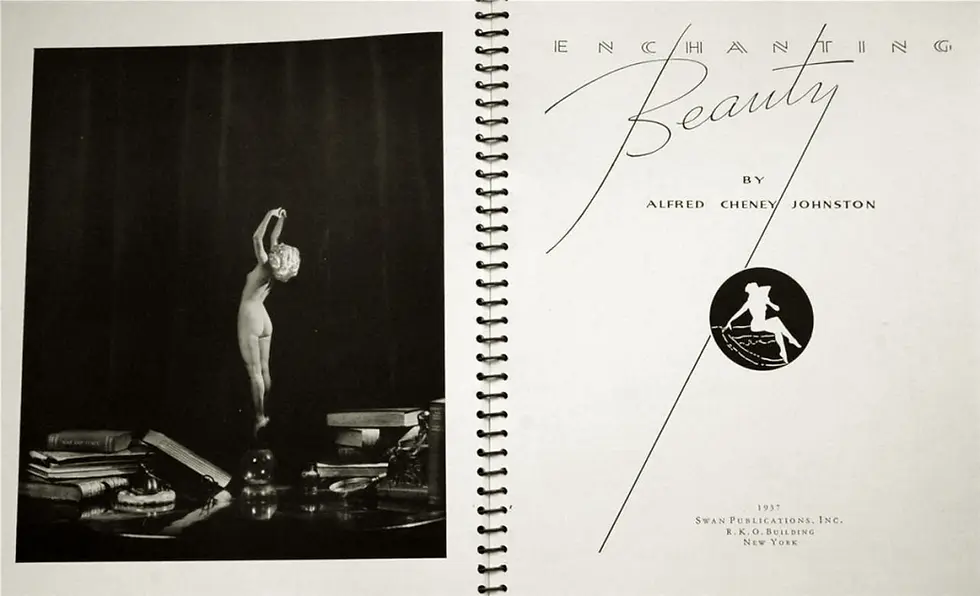
In 1937, Johnston published Enchanting Beauty, a collection of his nude studies gathered from across two decades of work. The images in the book date from the 1920s through to the 1930s, and it's one of the most complete records of his mature style. Among its subjects was Tilly Losch, the Austrian dancer and actress, who appears in several of the plates in poses that show Johnston at his most formally ambitious. Losch was already famous by then, and the pairing of Johnston's camera with her expressive physicality produced some of his most memorable work.
Enchanting Beauty wasn't a mass market publication. It was the kind of limited edition book that circulated among collectors and photography enthusiasts rather than sitting on a newsstand. That's partly why Johnston's reputation faded so quickly after his death in 1971. Without mass circulation, without a major retrospective or museum collection, his work slipped out of common knowledge even as the images themselves kept turning up on Tumblr blogs, vintage photography sites, and art auction catalogues.
Where Johnston Sits in the Bigger Picture
Johnston was working during a period when the photograph of the female nude was undergoing enormous changes. The kind of work being produced by photographers like E.J. Bellocq in the brothels of Storyville, or the vintage French nude photography of the 1920s that was being produced for postcards and prints, represented very different approaches to the same subject. Johnston's work sits somewhere in the middle. It was too artistic to be dismissed as merely commercial, and too commercially oriented to be taken seriously by the art photography establishment of the time.
That ambiguity is actually what makes him interesting now. He wasn't constrained by either category. He could make a portrait of a nude woman that was genuinely beautiful without worrying too much about whether it met the standards of the Photo-Secession movement, and he could produce commercial work for Ziegfeld's promotional machine without letting it become purely transactional.
It's worth putting his work alongside others who occupied similar territory. Kiki de Montparnasse, the model and artist's muse who defined bohemian Paris, was being photographed at almost exactly the same time as Johnston's Follies portraits, but in a completely different context and with completely different results. The contrast between Johnston's composed, studio-lit glamour and the looser, more contingent energy of the Paris scene says a lot about how ideas of beauty and the body differed on either side of the Atlantic.
A Legacy That's Still Being Discovered
Johnston died in 1971 having outlived his moment of fame by decades. He'd essentially retired from professional photography in the 1940s, and the work he'd done for Ziegfeld had been largely forgotten outside of specialist circles. The rediscovery of his photographs has been slow and mostly driven by collectors and enthusiasts rather than institutions, which gives it a slightly underground quality that suits the work rather well.
The La Petite Mélancolie archive of Johnston's work is one of the better places online to see a substantial selection of his images gathered in one place, including multiple entries from Enchanting Beauty and portraits of his named subjects. If Johnston is new to you, it's a good starting point. If you already know his work, it'll give you the chance to see pieces you might have missed.
Photography at this level is also closely connected to broader traditions of figure work. Our articles on Alfred Cheney Johnston and his exquisite images of Ziegfeld Follies showgirls go into more detail on the Follies context, and if you're interested in the world he was part of, pieces like our look at Studio Manassé and Vienna's glamorous photography revolution and le stéréo nu and boudoir photography in Belle Époque Paris help fill out the international picture of what was happening in this period.
Johnston deserves to be talked about in the same breath as the other great photographers of the interwar period. He had a distinctive eye, a real technical command of his medium, and an unusual ability to make his subjects look both beautiful and fully present. That's a harder combination to achieve than it looks, and it's why his images have lasted.
Sources:
1. Daily Art Fixx: Alfred Cheney Johnston, 1885–1971. https://dailyartfixx.com/2016/04/08/alfred-cheney-johnston-1885-1971/
2. MONOVISIONS: Biography, Photographer of Nudes, Alfred Cheney Johnston. https://monovisions.com/alfred-cheney-johnston-biography-photographer-of-nudes-ziegfeld-girls/
3. Northlight Gallery Research: Alfred Cheney Johnston. https://northlightgalleryresearch.com/alfred-cheney-johnston/
4. Johnston, Alfred Cheney. Enchanting Beauty. Swann Publications, 1937.
5. Travalanche: The Images of Alfred Cheney Johnston. https://travsd.wordpress.com/2026/04/08/the-images-of-alfred-cheney-johnston/


