The Last Days of Jack Kerouac: How the King of the Beats Drank Himself to Death in Florida
Updated: Oct 19

On the morning of 20 October 1969, a bloated, unhappy 47-year-old sat in a ranch house on 10th Avenue North in St Petersburg, Florida, with a drink and a notebook. Twelve years earlier On the Road had made Jack Kerouac the most famous young writer in America. By the following morning he was dead, almost every one of his books was out of print, and he had about $91 in the bank, the Allen Ginsberg Project notes.
Here's how the man who invented the open road ended up drinking himself to death in a retirement town, living with his mother and a wife he'd married mostly to look after her, and what's happened to his legacy since. That last part has a twist nobody saw coming, involving a country singer and $12 million.
Quick Answers
When did Jack Kerouac die? At 5.15am on 21 October 1969 at St Anthony's Hospital in St Petersburg, Florida. He was 47.
What did he die of? A massive internal haemorrhage caused by cirrhosis of the liver, the result of decades of heavy drinking.
Did a bar fight kill him? Not on its own, but he'd been badly beaten outside a St Petersburg bar about a month earlier, and the injuries probably didn't help.
Where is Jack Kerouac buried? Edson Cemetery in his home town of Lowell, Massachusetts, after a funeral at St Jean Baptiste Church on 24 October 1969.
Can you visit his last house? Yes. The house at 5169 10th Avenue North is now the Jack Kerouac House, with tours, events and overnight stays.
From the Open Road to a Ranch House in Florida
Kerouac was born in Lowell, Massachusetts, in 1922 to French-Canadian parents, and he spoke French at home before he learned English. He went to Columbia on a football scholarship, dropped out and fell in with Allen Ginsberg, Neal Cassady and William S. Burroughs, whose own life would be wrecked a few years later by the shooting of Joan Vollmer. On the Road came out in 1957 and made him the reluctant face of a generation.

Fame never suited him. He was shy, Catholic, devoted to his mother and drinking harder every year. Florida was Gabrielle Kerouac's idea. They'd first lived in a bungalow in College Park, Orlando, where he typed The Dharma Bums in twelve days on a long roll of teletype paper, Florida Humanities records. From 1964 they lived on and off in St Petersburg, a town full of pensioners where nobody much cared who he was. He's said to have joked that it was a good place to come and die, Patch recalls.
The Sports Columnist Nobody Remembers
One of the oddest footnotes to his Florida years is that he briefly became a local sportswriter. A friend, Cliff Anderson, introduced him to Mike Fowler, the assistant sports editor of the city's afternoon paper, The Independent. One summer night in 1965 Kerouac knocked out a column in about three minutes, after a few beers, and Fowler ran it. The columns appeared in June and July 1965, with Fowler billing him as one of America's foremost sports experts, Rebecca Kielty writes in the Journal of Florida Studies. Apart from that, he wrote very little poetry or fiction in St Petersburg.
The Last of Dean Moriarty
The friendship that made On the Road had been fading for years. In 1964 Neal Cassady, the real Dean Moriarty, rolled into New York with Ken Kesey and the Merry Pranksters on their psychedelic bus and drove out to Northport to fetch Kerouac for a party at a Park Avenue flat. The Pranksters were tripping, the room was full of lights, cameras and tape machines, and Kerouac sat there sick, sweating and miserable. Before he'd sit on the sofa he carefully folded up an American flag that had been draped over it, Allen Ginsberg remembered. Cassady, speeding on amphetamines, talked non-stop. Kerouac barely responded, and Cassady drove him home that night. The footage finally surfaced in the 2011 documentary Magic Trip.
On 4 February 1968 Cassady left a wedding party in San Miguel de Allende, Mexico, and set off alone along the railway line in a short-sleeved shirt and a thin windbreaker on a cold, wet night. Friends found him by the tracks at dawn, barely alive, and he died later that day, four days short of his 42nd birthday, Live for Live Music recounts. Most accounts put it down to exposure, while others call it an overdose, EBSCO notes. Kerouac outlived the man who'd given him his greatest book by less than two years.

Gabrielle, Stella and the Move Back South
In 1966 Gabrielle had a stroke that left her paralysed. That same year Kerouac married Stella Sampas, the sister of a childhood friend from Lowell who'd been killed in the Second World War. It was a marriage of loyalty more than romance, largely so there'd be someone to care for his mother, Jeff Weiss writes in County Highway.
After a spell back in New England, the three of them returned to St Petersburg in November 1968. They moved into 5169 10th Avenue North, right next door to the house they'd lived in before. By then Kerouac's days had a grim routine: Johnnie Walker chased with beer, black and white television with the sound turned down, shouting matches with his bedridden mother, and long stretches at the typewriter that produced less and less.
Drunk on Firing Line
The whole country got a look at the state he was in during 1968, when he turned up to William F. Buckley's TV show Firing Line for an episode about the hippies, alongside the sociologist Lewis Yablonsky and the poet Ed Sanders of the Fugs. Kerouac was plainly drunk. He heckled, gave thumbs-downs, blew a raspberry and stamped his feet, and much of what he said is marked unintelligible in the transcript. In the middle of it, though, he insisted "The hippies are good kids, they're better than the Beats". Open Culture has the clip, and it's painful to watch.
Within a year his mood had soured completely. His last essay, After Me, the Deluge, is a bitter, sarcastic attack on the hippie-yippie crowd he'd supposedly inspired, mocking the young imitators as parasites, Beatdom notes. The man the counterculture saw as its grandfather wanted nothing to do with it.
Pic and the Cactus Bar
In his last months Kerouac was working on Pic, a short novel narrated by a young Black boy, written in a dialect that reads now as a crude caricature. It was the last book he finished, and it came out after he died.

He'd taken to drinking at the Cactus Bar on 18th Avenue South, in a mostly Black part of St Petersburg. The building is still there, though it's long since stopped being a bar, Patch reports. About a month before he died he was beaten up in or outside the bar. The most widely told version, passed on by the current owner of his house, is that he'd been slipping into the voices of his Pic characters while drunk, and the regulars took it as mockery. He ended up with broken ribs and black eyes, and because he was scared of hospitals he treated himself with whiskey, County Highway reports. He was also arrested and spent time in jail, and his mother put up $25 for his bail, Florida Humanities adds. Ann Charters's early biography told the story differently, and nobody's ever pinned down exactly what was said that night.
20 October 1969
On the last day he was at home drinking and reportedly making notes for a book about his father's old print shop in Lowell. Some time that morning he started vomiting blood in the bathroom. An ambulance took him to St Anthony's Hospital, where doctors gave him transfusion after transfusion and then tried to operate, but his liver was so far gone that his blood wouldn't clot. He never woke up after the surgery.
He died at 5.15am on 21 October 1969. The cause was a haemorrhage from swollen veins in his oesophagus, brought on by cirrhosis. His biographer Gerald Nicosia called it "the classic drunkard's death". Stella told The New York Times simply that "He was a very lonely man."
It's hard not to think of Dylan Thomas, who'd urged his father to rage against the dying of the light and then drunk himself to death in New York in 1953, at just 39. Neither man made it to fifty.
The Funeral in Lowell
They buried him back home. On Friday 24 October his body went from the Archambault funeral home to St Jean Baptiste Church, the French-Canadian church in Lowell where he'd been an altar boy, and then to Edson Cemetery. It was bitterly cold. He lay in an open casket in a grey houndstooth jacket, a yellow shirt and a red bow tie, with a rosary in his hands and his face caked in make-up, the Allen Ginsberg Project recounts.
Allen Ginsberg, Peter Orlovsky, Gregory Corso and John Clellon Holmes all came. Ginsberg read from Mexico City Blues over the body and invited people to touch him, telling them "There's really nothing inside." Holmes laid a white rose on the coffin. Corso filmed the whole thing, burial included, on a 16mm camera, and Ginsberg helped carry the casket down the church steps before throwing a handful of earth into the grave. The day after Kerouac died, Ginsberg had started the poem that became Memory Gardens.
The grave is near the gatehouse at Edson Cemetery, and so many people come looking for it that the caretaker printed a map. The flat stone gives his name as John Kerouac, with his childhood nickname Ti Jean above it, and the line He Honored Life. In 2014 a taller granite stone went up behind it with his signature and the words The Road is Life, Atlas Obscura notes. Fans still leave cigarettes, pens, poems and open bottles of whiskey and wine, Fifty Plus Advocate reports.
$91 and a Forged Signature
Kerouac died close to broke, but his work didn't stay that way. Everything went to his mother. When Gabrielle died in 1973 her will left it all to Stella, and when Stella died in 1990 control passed to her brother, John Sampas, who became Kerouac's literary executor, County Highway explains. By then the estate was worth millions.

Kerouac's daughter, Jan, born in 1952 to his second wife, Joan Haverty, never believed her grandmother had signed that will. Kerouac never publicly accepted she was his, even after a court-ordered paternity test in 1961 showed she was, and she met him in person only twice. She became a writer herself, with the autobiographical novels Baby Driver (1981) and Train Song (1988), and New York Review Books reissued Baby Driver in 2025, The Paris Review notes. She sued over the will in 1994 and died of kidney failure two years later, aged 44, and Kerouac's nephew, Paul Blake Jr, took up the case. In July 2009 a Florida judge, George W. Greer, ruled that the signature was a forgery, writing that Gabrielle Kerouac was "physically unable to sign the document". It didn't hand the estate back to Kerouac's blood relatives, and the Sampas family still controls it. It's now thought to be worth around $20 million.
The Scroll, the Church and a Country Star
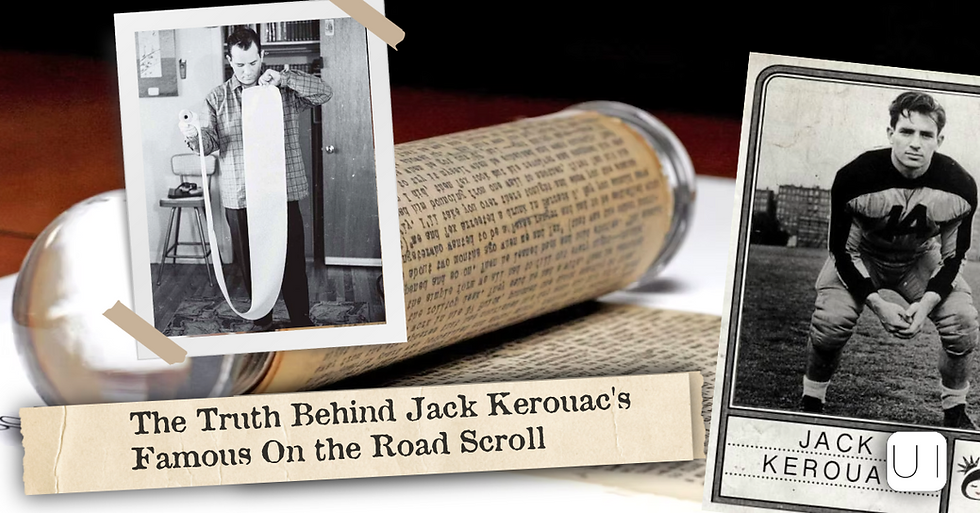
The most valuable thing he left behind is the 120-foot roll of taped-together paper he typed On the Road on in 1951. The truth about how it was written is a story in itself. Indianapolis Colts owner Jim Irsay bought it for $2.43 million in 2001. In March 2026, after Irsay's death, it went up for auction at Christie's in New York, and the country singer Zach Bryan paid $12.1 million for it, along with the typescript scroll of The Dharma Bums, The Boston Globe reported. The estimate had been $2.5 million to $4 million.
Here's the part that brings the story full circle. The year before, Bryan had bought the old St Jean Baptiste Church in Lowell, the church where Kerouac served as an altar boy and where his funeral was held, for a reported $3.4 million. The plan is to turn it into the Jack Kerouac Center, with a museum for the scrolls, a 1,200-capacity music venue, a recording studio and poetry spaces. It could cost $25 million to $30 million and take two or three years, Boston.com reports. Jim Sampas, who now runs the estate, called the scroll purchase "a game changer".
The House on 10th Avenue North Today
The ranch house where Kerouac spent his last year is still standing. Ken Burchenal bought it in 2020 for $360,000, and it's now a protected landmark run as a non-profit, County Highway reports. Some of Kerouac's clothes and unfinished work are still there, his 1957 Royal typewriter sits in the writing room with a blank sheet of paper in it, and you can stay the night. In 2026 it's been hosting storytelling nights and poetry readings, and it started its first artist residency at the end of July, together with the Kerouac Project in Orlando, the house's own newsletter says.
A few streets away, the Flamingo Bar has a mural of him on the wall and still pours a Kerouac Special: a shot of Canadian Club with a beer to wash it down, Florida Humanities notes.
A Death That Fits Too Neatly
It's tempting to read Kerouac's end as the inevitable last chapter of On the Road, the wild young man burning out exactly as everyone expected. The truth is sadder and smaller than that. He died in a sleepy suburb, angry at the world that had made him famous, looking after a sick mother and writing a book about his dad's print shop. Like Hemingway in Ketchum eight years earlier, he spent his last days a long way from the legend.
Further Reading
For the full story of his life and his slide in Florida, Gerald Nicosia's Memory Babe: A Critical Biography of Jack Kerouac is still the deepest dig into his life. Ann Charters's Kerouac: A Biography, the first biography, was written while he was still alive, and Charters was at his funeral.
As an Amazon Associate, Utterly Interesting earns from qualifying purchases.
You Might Also Like
Sources
On the Anniversary of the Death of Jack Kerouac, The Allen Ginsberg Project
Jack Kerouac's Florida, Florida Humanities
Kerouac Dreams (Jeff Weiss), County Highway
Kerouac in Florida (Rebecca Kielty), Journal of Florida Studies
In Conversation: Buckley, Kerouac, Yablonsky & Sanders, Lemon Hound
William F. Buckley Meets (Possibly Drunk) Jack Kerouac, 1968, Open Culture
After Me, the Deluge: Considering Kerouac's Final Statement, Beatdom
Jack Kerouac's Funeral, The Allen Ginsberg Project
Signature on Kerouac's Will Ruled a Forgery, Poets & Writers
Zach Bryan buys Kerouac's On the Road scroll, The Boston Globe
Everything you need to know about Zach Bryan's planned Jack Kerouac Center, Boston.com
Ginsberg on Kerouac and Kesey and Cassady, The Allen Ginsberg Project
Remembering Neal Cassady on the anniversary of his death, Live for Live Music
Neal Cassady, EBSCO Research Starters
Jan Kerouac's Baby Driver (Amanda Fortini), The Paris Review
Jack Kerouac's Grave, Atlas Obscura
The road ended where it began for the father of the Beats, Fifty Plus Advocate
June 2026 newsletter, The Jack Kerouac House of St Petersburg