


The Discovery of the Lascaux Caves: Four Teenagers, a Dog, and 17,000 Years of Art
Updated: 5 days ago
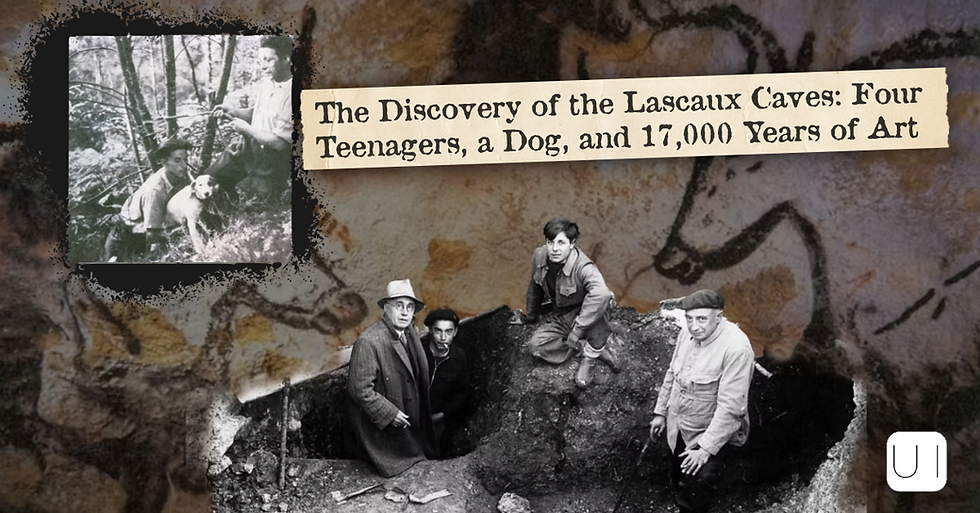
On 12 September 1940, four teenagers went looking for a dog and a local legend, and found neither. What they found instead, at the bottom of a narrow shaft in the French countryside, was a gallery of animals painted roughly 17,000 years ago, so vivid that the men who first properly studied it assumed at first they had to be looking at a hoax. The cave they'd stumbled into, Lascaux, would go on to survive a world war, a tourism boom that very nearly destroyed it, and a genuine disease outbreak inside its own walls.
Quick answers
Who discovered the Lascaux caves?
Four teenagers from Montignac, France, Marcel Ravidat, Jacques Marsal, Georges Agnel and Simon Coencas, found the entrance on 12 September 1940, with Ravidat's dog Robot leading the way.
How old are the Lascaux cave paintings?
Roughly 17,000 years old, dating to the early Magdalenian period of the Upper Palaeolithic.
Can you still visit the real cave?
No. The original cave has been closed to the public since 1963 to protect the paintings. Visitors today see full-scale replicas instead.
Why was the cave closed?
Thousands of daily visitors raised humidity and carbon dioxide levels inside the cave, causing algae, mould and mineral deposits to spread across the paintings.

Four teenagers, a dog, and a local legend
Marcel Ravidat was eighteen, an apprentice mechanic from Montignac in the Dordogne region of southwestern France. On 12 September 1940, he was out with his dog, Robot, on land belonging to the La Rochefoucauld-Montbel family when Robot took an interest in a hole left by an uprooted tree. The often-repeated version of the story has Robot falling into the hole; Ravidat himself is thought to have added that detail in later retellings to sharpen a good story, and the more measured accounts simply have the dog sniffing at the gap in the ground.
Ravidat came back the following day with three friends: Jacques Marsal and Georges Agnel, both fifteen or sixteen, and Simon Coencas, who was fifteen and had recently taken refuge in Montignac with his family. The four believed the shaft might be the entrance to a legendary secret tunnel said to lead to the nearby Lascaux manor house. They widened the opening and lowered themselves roughly fifteen metres down into the dark.
What four teenagers with an oil lamp actually found
What they found instead of a tunnel was a network of chambers now known by names like the Hall of the Bulls, the Passageway, the Shaft, the Nave, the Apse and the Chamber of Felines, their walls and ceilings covered in painted animals rendered with a confidence and scale that looked, to the boys crouched below with a failing oil lamp, almost alive. One of the largest images in the entire cave, a bull in the Hall of the Bulls, stretches more than seventeen feet across, making it the largest known animal figure from this period anywhere in the world.
Word reached Léon Laval, a local schoolteacher, who recognised straight away that this wasn't a hoax or a piece of recent graffiti, and contacted the prehistorian Abbé Henri Breuil, already well known for his work on other decorated caves. Breuil confirmed what Laval suspected: the paintings were genuinely ancient, and genuinely important.

A cave under guard through a hard winter
Jacques Marsal, only fifteen, took the responsibility of protecting the find seriously. With his parents' support, he camped by the cave entrance through the harsh winter of 1940 into 1941, guarding it from anyone who might damage it before it could be properly studied. That commitment lasted the rest of his life. Marsal became the cave's official warden once it opened to the public in 1948, and remained its guardian until his death in 1989.
One discovery, four very different wars
For two of the four friends, the adventure ended almost as soon as it began. Simon Coencas was Jewish, and his family had fled to Montignac, then part of the unoccupied southern zone of France, only months earlier. A German ordinance issued just two weeks after the discovery, on 27 September 1940, required all Jews in France to register with the authorities, and it forced Coencas back to Paris. He and his family were later deported. Coencas survived the war, but he didn't return to Lascaux for another forty-six years, and the cave stayed with him regardless. He described it late in life in terms that had lost none of their vividness: he still had, in his own words, the shape of the cave in his head. Ravidat and Marsal, meanwhile, stayed on as the site's earliest guides once it opened, and were the ones who first spotted a worrying patch of green algae creeping across the walls in 1958 and 1959, years before anyone in authority took the threat seriously.
All four discoverers were finally reunited in November 1986, forty-six years after the day they'd gone looking for a dog and found the deep past instead.

17000 years of paint and 250 kilometres of travel
The cave holds more than 600 paintings and around 1,500 engravings, depicting mostly horses, deer, aurochs and stags, alongside rarer human figures, including one strange scene in the Shaft showing a bird-headed man, a wounded bison and a bird perched on a stick, widely regarded as the closest thing to a narrative scene anywhere in Palaeolithic art. Analysis of the pigments found manganese oxide that could only have come from the Pyrenees, roughly 250 kilometres to the south, evidence that the people who painted Lascaux either travelled remarkable distances for their materials or were plugged into trade networks far more extensive than anyone had previously given the Upper Palaeolithic credit for.

The Unicorn, and the tools used to paint it
The very first figure anyone sees on entering the Hall of the Bulls still doesn't have a satisfying explanation. Nicknamed the Unicorn for lack of anything better, it's a roughly five-and-a-half-foot creature with two straight horns projecting from its forehead, a swollen, possibly pregnant-looking belly, a hump on its back and a spotted body unlike any animal in the fossil record. Suggestions over the decades have ranged from a stylised bull drawn in an unusual perspective, to a hunter disguised in an animal skin, to a species that simply doesn't survive anywhere else in the archaeological record. None of the theories has ever won out, and it remains one of the most argued-over images in all of prehistoric art.
The artists who painted it left behind a surprising amount of their own equipment. Archaeologists have recovered flint tools, mixing palettes and more than a hundred stone lamps that burned animal fat for light, including one finely carved sandstone lamp with a decorated handle found specifically in the Shaft. They worked with around a dozen pigments, ground from minerals such as hematite, manganese dioxide, clay and quartz to produce shades from pale yellow through to black, and used a technique now called twisted perspective, painting an animal's head in profile while showing its horns face-on, to make the animals read clearly from a distance in flickering lamplight.

Nearly loved to death
Lascaux opened to the public in 1948 and quickly became one of the most sought-after archaeological sites in the world, drawing more than a thousand visitors a day by the mid-1950s. Every one of those visitors breathed out carbon dioxide and moisture, and the powerful lighting installed to illuminate the paintings added its own heat. Algae and mineral deposits began spreading across the walls within a few years, and in 1963 the French government closed the cave to the public entirely, sealing it to protect the very thing everyone had come to see.

The cave got sick
Closing the cave didn't end its problems. In April 2001, a new air-conditioning system was installed to help regulate the cave's climate, and within months a white fungus, Fusarium solani, erupted across the floor and walls. Art restorer Rosalie Godin, called in urgently that August, later described the scene to TIME in stark terms: “It was as if it had snowed in the cave.” Aggressive treatment with fungicides brought the outbreak under control, but black and grey fungal stains followed in its place over the next several years. In January 2008, the cave was closed even to scientists and conservators for three months, with only a single person permitted inside for twenty minutes a week to monitor conditions. The underlying mould and bacterial issues are still actively managed today, more than two decades after that first outbreak.
The replicas: Lascaux II, then Lascaux IV
Rather than let the world lose access to Lascaux altogether, France built a replica. Lascaux II opened in 1983 just a couple of hundred metres from the original cave, reproducing around 80 percent of the paintings using the same pigments, tools and methods believed to have been used 17,000 years earlier. It remains open today. In December 2016, France went a great deal further, opening Lascaux IV, the International Centre for Cave Art, a complete, full-scale reproduction of the entire cave, built using detailed 3D scans and designed by the architecture firm Snøhetta. Where Lascaux II offers a partial glimpse, Lascaux IV recreates every chamber, right down to the acoustics, and now draws hundreds of thousands of visitors a year, all of them seeing a cave that, in its original form, hasn't been open to the public for more than sixty years.
A find that still shapes how we see the deep past
Lascaux wasn't the first decorated cave ever found, but it did more than almost any other site to convince the wider world that people living seventeen millennia ago were capable of real artistry rather than crude scratching. It sits alongside a small handful of other chance discoveries that rewrote entire fields, from the pyramids that early tourists once clambered freely over before anyone understood how fragile they were, to the very different kind of cave burial tradition still practised today in the cliffside cave tombs of Guizhou, China. And the discovery's own timing, right in the middle of a war that would shortly upend all four of the boys who found it, is a reminder that history rarely waits for a convenient moment, a theme that runs through plenty of other wartime stories too, including some far removed from a cave in the Dordogne.
FAQ
What was the dog's name, and what breed was he?
Robot, generally described as a mixed-breed dog belonging to Marcel Ravidat.
Did the discoverers get anything for finding the cave?
Not financially. Jacques Marsal went on to become the cave's paid warden once it opened to the public, but the discovery itself brought the boys local attention rather than any windfall.
Is the cave still deteriorating today?
Conservators continue to manage ongoing mould, bacterial growth and mineral deposits inside the sealed cave, more than two decades after the first major outbreak in 2001.
What's the difference between Lascaux II and Lascaux IV?
Lascaux II, opened in 1983, reproduces about 80 percent of the paintings in two galleries near the original cave. Lascaux IV, opened in 2016, is a complete full-scale replica of the entire cave.
You might also like
Coffins in the Clouds: The Ancient Burial Traditions of Guizhou's Cave Tombs, Early Tourists Climbing All Over the Pyramids and the Ruins of Ancient Egypt, 1860-1930 and The Night Witches of World War II: How an All-Women Soviet Bomber Regiment Haunted the Nazis


