


The Business Plot: When Wall Street Allegedly Tried to Overthrow FDR
Updated: Oct 6
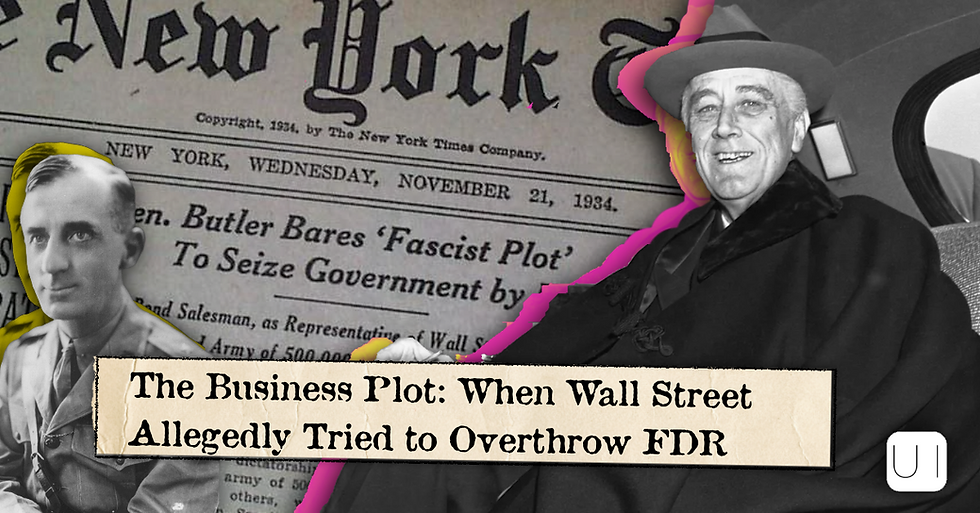
In November 1934, retired Marine Corps Major General Smedley Butler sat down in front of a congressional committee and calmly explained that a group of wealthy businessmen had spent the previous year trying to recruit him to lead a private army of half a million veterans, march on Washington, and turn President Franklin Roosevelt into a puppet figurehead. Congress investigated.
Its final report concluded there was no question the plot had been discussed and planned, and might well have been carried out if the financial backers had thought the moment right. Nobody was ever arrested. Nobody was ever charged. And within a few decades, most Americans had never heard of it at all.
Historians still argue about how close the Business Plot, sometimes called the Wall Street Putsch, actually came to happening. What isn't in dispute is that one of the most decorated soldiers in American history stood up under oath and said Wall Street had tried to buy a coup, that a second high-profile veteran independently corroborated being approached with the same offer, and that a congressional committee believed enough of it to say so in writing.
Quick answers
What was the Business Plot? An alleged 1933 to 1934 scheme by a group of wealthy American businessmen to recruit a private army of veterans, led by General Smedley Butler, to seize power from President Franklin Roosevelt and install a fascist-style government friendlier to business interests.
Was anyone ever charged over the Business Plot? No. Congress's McCormack-Dickstein Committee found Butler's claims credible in its final report, but nobody named in the investigation was ever prosecuted.
The general Wall Street thought they could use
Smedley Butler was an odd choice for a coup and an even odder one to trust with a secret. By 1933 he was one of the most decorated Marines in American history, a two-time Medal of Honor recipient with decades of combat command across the Caribbean, Central America and China. He was also a man with a well-earned reputation for saying exactly what he thought regardless of the consequences. He'd already been nearly court-martialled once for publicly calling Mussolini a hit-and-run driver, sparked a diplomatic incident with Haiti over a fort he claimed to have captured, and resigned from a stint cleaning up Philadelphia's police force after declaring he'd been used as a respectable front for political racketeers. By 1934 his signature lecture was called War Is a Racket, an attack on the businessmen and bankers he believed profited from sending other people's sons to die, built around a line he'd repeat for the rest of his life: that for thirty-three years he'd been "a high-class muscle man for Big Business, for Wall Street and for the bankers."

On paper, none of that made him an obvious recruit for a plot backed by Wall Street money. In practice, it made him exactly the kind of man conspirators wanted: a war hero enormously popular with rank-and-file veterans, someone whose public support could make a private army look like a patriotic movement rather than what it actually was.
A bond salesman starts making calls
The approach began quietly in the summer of 1933, when a bond salesman named Gerald C. MacGuire showed up at Butler's home in Newtown Square, Pennsylvania. MacGuire worked for Grayson M-P. Murphy, a wealthy financier with deep ties to J.P. Morgan interests who had personally bankrolled the founding of the American Legion back in 1919. He wasn't alone. He brought along William Doyle, a Massachusetts commander within the Legion itself, and together the two men's opening pitch was narrow: they wanted Butler to run for national command of the Legion, backed by serious money, and use the position to push for a return to the gold standard, dressed up as a defence of ordinary veterans' pensions against inflation.
Butler turned that down, but MacGuire didn't disappear. He kept coming back, each time revealing a little more of what he actually wanted. He'd recently returned from a tour of Europe, funded by his firm's clients, studying fascist veterans' paramilitary groups like France's Croix de Feu. He wanted to know if Butler thought something similar could work in the United States.
The offer gets specific
By 1934, MacGuire had dropped any pretence of subtlety. At a meeting in Newark, he told Butler he could organise a march of half a million veterans on Washington to force a change of government, with Butler at the head of it. At their final meeting, at the Bellevue-Stratford Hotel in Philadelphia, MacGuire told Butler to expect a powerful new organisation to surface publicly within weeks, one that would present itself as a patriotic society defending the Constitution while quietly bankrolling the whole operation from behind the scenes. "These are to be the villagers in the opera," MacGuire reportedly told him, meaning the public face would just be cover for the real backers underneath.
MacGuire also introduced Butler to Robert Sterling Clark, an heir to the Singer sewing machine fortune whom Butler had known years earlier in China, where Clark's wealth had earned him the nickname the millionaire lieutenant. Clark confirmed the broad shape of MacGuire's proposal, and according to Butler's own account, tried to sweeten the deal with a personal bribe: an offer to pay off Butler's mortgage outright. Clark also revealed who'd actually written the gold-standard speech MacGuire wanted Butler to deliver: John W. Davis, the Democratic Party's 1924 presidential candidate, now working as chief counsel for J.P. Morgan and Company. The plan's logistics went further than speeches. Butler testified that weapons and ammunition for the veteran army would be supplied by Remington Arms, a Bridgeport, Connecticut manufacturer that had recently come under DuPont ownership.

A backup plan in case Butler said no
Butler wasn't the plotters' only option, and that's the part most retellings leave out entirely. MacGuire told him that if he refused, the conspirators had a shortlist of other prominent military figures they could approach instead, including General Douglas MacArthur, Colonel Theodore Roosevelt Jr. and former American Legion commander Hanford MacNider. Roosevelt Jr., told years later that anyone had considered him for the role, was reportedly stunned that anybody would think he'd help unseat his own fourth cousin from the White House.
Butler also wasn't the only veteran leader MacGuire's circle sounded out directly. James E. Van Zandt, the national commander of the Veterans of Foreign Wars, independently told reporters he too had been approached "by agents of Wall Street" to lead a fascist veterans' organisation dressed up in patriotic language, and that the approach was meant to happen at an upcoming VFW convention in Louisville. Butler had actually warned Van Zandt in advance that this was coming, and Van Zandt testified separately to the same committee, giving Congress an independent, corroborating account of the exact same conspiracy from a completely different veteran leader with no connection to Butler's own testimony.
Butler strings them along
Rather than agreeing or refusing outright, Butler played along long enough to gather evidence he could actually use. Worried nobody would believe a story this outlandish coming from him alone, he brought in a Philadelphia Record reporter, Paul Comly French, and had French meet with MacGuire directly under the pretext of reporting a straight news story. MacGuire repeated the same pitch to French almost word for word, telling him a fascist government was the only real answer for America and that Butler was the ideal leader because he could organise a million men practically overnight.
Testimony before Congress
With French's account backing up his own, and Van Zandt ready to testify to a parallel approach, Butler took the story to the House Special Committee on Un-American Activities, chaired by Representatives John W. McCormack and Samuel Dickstein, in a closed session at the New York City Bar Association in November 1934. His testimony alone ran to roughly thirty-eight pages of transcript, laying out the entire sequence of meetings under oath, MacGuire's escalating proposals, the names he'd been given, and the veiled promise of a mysterious organisation waiting in the wings.
The committee spent three months investigating, hearing hundreds of witnesses and gathering more than 4,300 pages of testimony. MacGuire denied everything under oath when questioned directly. The committee didn't simply take Butler's word over MacGuire's, though. Its own final report stated plainly that investigators "was able to verify all the pertinent statements made by General Butler, with the exception of the direct statement suggesting the creation of the organization," and that even that missing piece was independently corroborated through MacGuire's own written correspondence with Clark, sent while MacGuire was touring Europe studying fascist veterans' groups. In other words, the paper trail backed up the general almost as thoroughly as the witnesses did. The committee's final report, delivered to the full House in February 1935, put it even more bluntly: "there is no question that these attempts were discussed, were planned, and might have been placed in execution when and if the financial backers deemed it expedient."

Named, but never charged
MacGuire, under direct questioning, eventually gave up more names. He'd received funds through Robert Sterling Clark and through Murphy's firm, and he pointed toward a wider network of backers connected to the du Pont family, Sun Oil's Pew family, the Pitcairn family at Pittsburgh Plate Glass, and figures tied to J.P. Morgan and Company. Weeks after the hearings became public, an organisation calling itself the American Liberty League announced its formation, funded largely by exactly the same names: Irenee du Pont, General Motors chief Alfred P. Sloan, Grayson Murphy as treasurer, and John W. Davis on its executive committee. Its stated mission was teaching government proper respect for what it called the rights of persons and property, which read to critics as a direct echo of what MacGuire had described to Butler months earlier.
Every man named either denied any involvement or dismissed Butler's account as fantasy. Robert Sterling Clark, conveniently travelling in Paris when the story broke, later insisted through a public statement that he was, in his own words, neither a fascist nor a communist but an American. None of them were ever charged with anything. The committee's public report named MacGuire as the operative figure at the centre of the plot but stopped short of naming anyone above him, even though the fuller names had already come out in the executive-session testimony.
The financier who became a beloved art patron
Robert Sterling Clark's own story afterward is one of the stranger footnotes in the whole affair. The same man Butler accused of trying to bribe him into leading a fascist coup spent the following two decades quietly building one of the finest private art collections in America, more than thirty Renoirs among them, and in 1955 he and his wife Francine opened the Sterling and Francine Clark Art Institute in Williamstown, Massachusetts. It remains one of the most respected small art museums in the country today, and almost nothing written about it mentions that its founder was ever accused, under oath, of helping bankroll a plot to overthrow the President of the United States.
The bond salesman's quiet death
Gerald MacGuire himself didn't get the chance to see how history would eventually judge him. He died in March 1935, just months after his hearings ended, officially of pneumonia that doctors attributed to a constitution weakened by the stress of being publicly implicated. He was in his late thirties. Whatever fuller story he might have told about who exactly was funding him went into the ground along with him, and the surviving record is built almost entirely from what Butler, French and Van Zandt separately said he'd told them.
The press laughed it off
Public reaction split almost immediately along predictable lines. The New York Times ran the story on its front page under the headline Gen. Butler Bares Fascist Plot to Seize Government by Force, then buried most of the substantiating detail deep in an inside page beneath a wall of denials from the men Butler had named. Time magazine went further, running a mocking cover story titled Plot Without Plotters that painted Butler as a serial embarrassment with a habit of picking fights, dredging up his old Mussolini and Haiti controversies as evidence he couldn't be trusted. What most readers at the time had no way of knowing was that Time itself was controlled by financial interests closely tied to J.P. Morgan and Company, one of the very institutions named in the testimony it was mocking.
Buried for decades, then reopened
With the press treating it as a joke and no prosecutions ever filed, the Business Plot faded from public memory almost as quickly as it had appeared, surviving mostly as an odd footnote in Butler's own biography. The committee's full executive-session transcripts, containing the fuller list of names MacGuire had given up, stayed sealed for more than three decades. Journalist John Spivak dug up and published suppressed details from the case in 1967, and historian Jules Archer's 1973 book The Plot to Seize the White House brought the story to a much wider audience for the first time, drawing renewed attention to a conspiracy most Americans had never learned about at all.
How real was it, really?
Even now, historians don't fully agree on how far the plot actually got. Some treat Butler's testimony, backed independently by French's corroborating account, Van Zandt's parallel testimony, and the committee's own conclusions, as solid evidence that a genuine conspiracy existed at a serious level. Others point out that MacGuire was a relatively low-level bond salesman who may have exaggerated his own authority and access to inflate his own importance, meaning the plot could have been more talk than genuine capability, even if the men whose names he dropped really had discussed rolling back the New Deal by whatever means necessary. What nobody seriously disputes is that Butler told the truth as he understood it, under oath, at real personal risk, that a second veteran leader independently backed up the core of his story, and that a congressional committee investigated the claims and found them credible enough to put in writing rather than dismiss outright.
Sources
Rolling Stone: The Business Plot Against FDR and America You Never Heard About: https://www.rollingstone.com/politics/politics-features/coup-jan6-fdr-new-deal-business-plot-1276709/
Libertarianism.org: Smedley Butler and the Business Plot, Part I: https://www.libertarianism.org/publications/essays/smedley-butler-business-plot-part-i
Libertarianism.org: Smedley Butler and the Business Plot, Part II: https://www.libertarianism.org/publications/essays/smedley-butler-business-plot-part-ii
New England Historical Society: The Business Plot, or When J.P. Morgan's Pals Tried to Overthrow FDR: https://newenglandhistoricalsociety.com/the-business-plot-or-when-j-p-morgans-pals-tried-to-overthrow-fdr/
The Saturday Evening Post: The 1933 Business Plot to Overthrow America: https://www.saturdayeveningpost.com/2023/01/considering-history-the-1933-business-plot-to-overthrow-america/
Connecticut History: Gerald MacGuire and the Plot to Overthrow Franklin Roosevelt: https://connecticuthistory.org/gerald-macguire-and-the-plot-to-overthrow-franklin-roosevelt/
Milwaukee Independent: The Wall Street Putsch, When Powerful Bankers Sought to Overthrow FDR With a Fascist Dictator: https://www.milwaukeeindependent.com/syndicated/wall-street-putsch-powerful-bankers-sought-overthrow-fdr-fascist-dictator/
TIME Archive: National Affairs, Plot Without Plotters: https://time.com/archive/6863220/national-affairs-plot-without-plotters/
Bethlehem/BTL: The Connecticut Man Who Led a Plot to Overthrow Franklin Roosevelt: https://btlonline.org/the-connecticut-man-who-led-a-plot-to-overthrow-franklin-roosevelt/
Tales of History and Imagination: Gerald MacGuire: https://historyandimagination.com/tag/gerald-macguire/
Clark Art Institute: About the Clark: https://www.clarkart.edu/about
COAT/Canadians for Action on Tobacco archive: James Edward Van Zandt biographical notes: http://coat.ncf.ca/our_magazine/links/53/vanzandt.html
You might also like
For another mystery from the heart of American finance in this same era, read our story on the Wall Street bombing of 1920, an attack that killed thirty-eight people and was never solved.


