

The Bloody Attempt to Kidnap Princess Anne
Updated: Aug 15
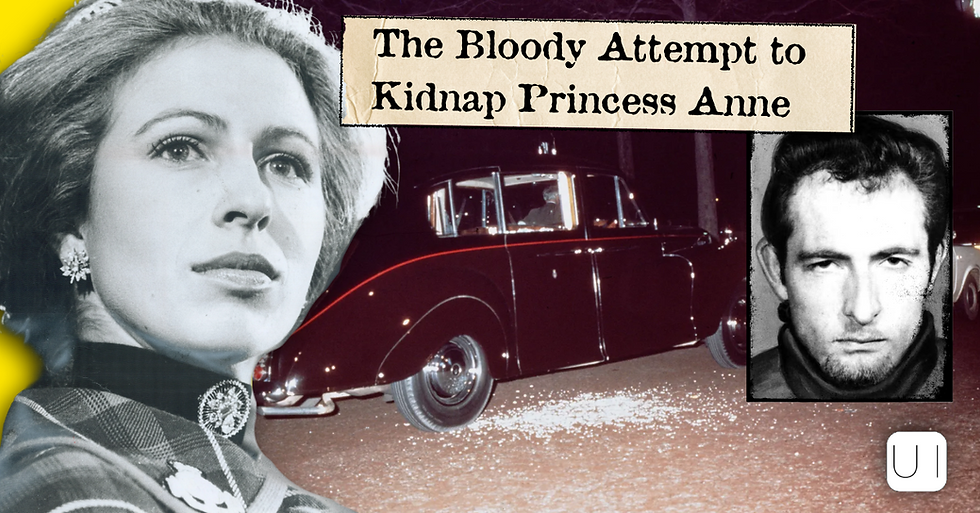
At around 8pm on March 20, 1974, Princess Anne and her husband of four months were being driven back to Buckingham Palace after a charity film screening. Anne's lady-in-waiting rode with them in the back of a maroon Rolls-Royce, while Inspector James Beaton of Scotland Yard's royal protection branch sat up front as their only bodyguard. Along The Mall, a white Ford Escort suddenly cut in front of them, forcing their chauffeur to stop about 200 yards from the palace gates. A bearded, red-haired man got out carrying two handguns and walked toward the back of the car. Beaton, assuming he was just an angry driver, stepped out to deal with him. From six feet away, the man shot him in the shoulder.

A Kidnapper Who Just Phoned the Palace
It sounds almost too easy: block a royal car with your own and you've got the princess. But that's essentially what Ian Ball did. Twenty-six years old and unemployed, Ball had picked Anne as his target after spotting her out riding on previous occasions, and he'd worked out her movements that evening the simple way, by calling the Buckingham Palace press office and asking. The palace had already publicised her appearance at the charity screening, and her limousine was flying the royal standard, which made it easy to spot and follow. Ball wasn't acting on a sudden impulse either. He'd reportedly spent at least two years preparing for the attempt, and had a documented psychiatric history stretching back further still, having been an outpatient at St Mary Abbott's Hospital in London between 1967 and 1972, seven years before the attack, alongside a record of minor burglary. Anne and her husband, Captain Mark Phillips, an Olympic gold medallist in equestrian eventing whom she'd married that January in a wedding with 2,000 guests, were travelling with only Beaton for protection that night, a security setup not unlike the Queen's own habit of keeping just one bodyguard on informal outings.
Ball had rented a car under a false name and packed it with two revolvers, one large-calibre and one small, spare ammunition, gloves and two sets of handcuffs, none of which he had any legal permit to own, along with Valium tablets and a ransom note addressed to the Queen. The note demanded £2 million, oddly specific about wanting it in 400,000 individual £5 notes, packed into 20 unlocked suitcases and flown to Switzerland, with the Queen herself required to be on the plane to verify her own signature on the paperwork. What Ball apparently didn't know was that the Queen wasn't even in the country that week. She was on a state visit to Indonesia, which would have made his own central demand impossible to satisfy even if everything else had gone to plan.

The Shooting on The Mall
Royal protection officers were among the few Metropolitan Police carrying firearms at the time, but when Beaton tried to return fire, his injured shoulder threw off his aim and his gun jammed after a single shot. Ball turned to the rear door, on Anne's side, and started wrenching at the handle. "Open up, or I'll shoot," he shouted. Anne and Phillips held the door shut from inside while her lady-in-waiting scrambled out the other side. Beaton climbed back into the car and put himself between the couple and the gunman. Ball fired again; Beaton got a hand up and deflected the bullet, then took a third shot that put him down on the pavement outside.

The Queen's chauffeur, Alexander Callendar, got out to confront Ball next and was shot in the chest. Ball forced the back door open and grabbed Anne's arm while Phillips held onto her waist. "Please, come out," he told her. "You must come."
Anne's dress tore down the back in the struggle, but she stayed remarkably composed throughout what she later called an irritating argument with her own kidnapper. Asked repeatedly to get out of the car, she simply told him, "Not bloody likely." She gave a more candid account nearly a decade later, telling chat show host Michael Parkinson in 1983 that the torn dress was actually the moment she came closest to losing her temper, more so than at any point involving the gun.
The Bystanders Who Stepped In
Help was slow to arrive largely because nobody wanted to close in on an armed man standing beside the princess. Police Constable Michael Hills, 22, was first on scene, initially assuming he'd stumbled on a car accident. He was shot in the stomach but managed to radio for backup before he went down. Ronald Russell, a company executive on his way home and a former heavyweight boxer standing six foot four, saw Ball reaching into the car and decided, in his own words, that the man needed sorting out. He got out of his own car and walked over. A separate motorist, chauffeur Glenmore Martin, blocked Ball's escape route with his own vehicle and tried briefly to distract him before turning to help the wounded constable instead.

Daily Mail journalist Brian McConnell arrived and, recognising the royal standard on the car, tried to talk Ball down, telling him to put the gun away. Ball shot him too, the fourth man hit that night. With McConnell down, Russell closed in from behind and hit Ball hard in the back of the head. As Ball's attention split, Anne pushed the door open on the far side and got out, only to see Ball come around the car after her, at which point she got straight back in and pulled the door shut. Russell hit Ball again. With more officers now arriving, Anne noticed Ball getting rattled by the growing crowd. "Go on," she told him. "Now's your chance." He ran.
Temporary detective constable Peter Edmonds, responding to Hills' radio call, spotted Ball fleeing through St James's Park, ran him down, threw his own coat over Ball's head to blind him, and tackled him to the ground. Police found more than £300 in £10 notes in his pocket. It later emerged Ball had rented a house in Hampshire, five miles from Sandhurst, where Anne and Phillips actually lived.

A Loner, Not a Plot
With four men shot within sight of Buckingham Palace, the obvious assumption was that this had to be an organised operation, and for a while Scotland Yard genuinely wondered if Ball was connected to the IRA. He wasn't, and said as much to police in a statement that made clear just how solitary his planning had been, insisting he'd worked entirely alone and had no one to help him at the scene even if he'd wanted it. A group calling itself the Marxist-Leninist Activist Revolutionary Movement wrote to The Times claiming responsibility, a claim Scotland Yard dismissed almost immediately. Some newspapers noted Ball's letter had echoes of the Patty Hearst kidnapping a month earlier in the US, where the Symbionese Liberation Army had demanded a food giveaway as part of Hearst's ransom; Ball's own note reportedly promised to give the Queen's money to the National Health Service.
It wasn't the first time a British kidnapping-for-ransom case had gripped the public without any organised group behind it. Just a few years earlier in the US, the kidnapping of Barbara Jane Mackle, buried alive for ransom by a single opportunist rather than any wider conspiracy, had shown how much damage one determined individual could do without any backing at all.

What eventually came out was that Ball was an unemployed labourer with a history of minor crime and serious untreated mental illness, later diagnosed as schizophrenia, a detail that left journalists struggling to square the ambition of the plot with the profile of the man behind it. Home Secretary Roy Jenkins told the House of Commons there was no indication of anything beyond an isolated act by one individual, and asked for the fuller investigation to stay confidential. Buckingham Palace, for its part, said the royal family had no intention of living in what it called bullet-proof cages, and royal protection was quietly increased without officials saying exactly how.
What Ball Said in Court
When Ball appeared in court that April, he said he'd committed the crime to draw attention to the state of NHS mental health treatment. He pleaded guilty to attempted murder and kidnapping and was made subject to a hospital order under the Mental Health Act, detained indefinitely rather than given a fixed sentence, and sent to Broadmoor, England's high-security psychiatric hospital. For decades afterward the public knew almost nothing else about him beyond his date of birth, his hometown, and what witnesses had seen that night. In 1983 he wrote to a member of Parliament claiming the whole kidnapping had been a hoax and that he'd been framed, a claim nobody took seriously at the time.

Released in 2019, Still Talking in 2025
Here's the part most retellings of this story leave out entirely: Ball didn't spend the rest of his life at Broadmoor. After 45 years detained under the Mental Health Act, with a brief hunger strike in 2002 during which he described himself as a political prisoner, he was quietly released in 2019 and has been living in the community on an indefinite discharge ever since. In August 2025, he gave an interview to the Daily Mail maintaining, just as he had in that 1983 letter, that he was innocent. His explanation is genuinely strange: he claims he believed the gunpowder had been removed from his bullets beforehand and that Princess Anne had been swapped out for a body double, meaning nobody was ever really at risk. It's a claim that sits uneasily against the fact that four real men were shot and wounded that night, all of whom recovered, but none of whom were stand-ins for anyone.
Princess Anne talks about the attempted kidnap on Parky
Everyone Else Went Home
Beaton stayed on as Anne's protection officer for another five years before moving into other royal protection roles, eventually becoming the Queen's own police officer in 1982 and retiring as a chief superintendent a decade later. He went on to run security for an oil company in Aberdeen and later chaired the Victoria Cross and George Cross Association, and by his own account still carries a fragment of Ball's bullet in his hand. Anne and Phillips went back to their normal routine the very next day, Phillips out training cadets at Sandhurst, Anne back with her horses. That September, the Queen awarded Beaton the George Cross, Britain's highest civilian award for bravery, with the George Medal going to Hills and Russell and Queen's Gallantry Medals to Edmonds, McConnell and Callendar. Glenmore Martin received a Queen's Commendation for Brave Conduct. Handing Russell his medal, the Queen reportedly told him the medal was from the Queen of England, and the thank you was from Anne's mother.

What Changed Afterward
Less than a decade later, in July 1982, an unemployed man scaled the palace walls entirely undetected and spent ten minutes talking to the Queen in her own bedroom before she managed to raise the alarm, a second embarrassment that led Scotland Yard to formally restructure royal protection the following year, with Beaton appointed its superintendent. Scotland Yard's official file on the Ball case stayed sealed until 2005, released only once the standard thirty-year rule for cabinet papers expired. Royal security spending has swung considerably since; an internal police budget put the figure at around £113.5 million in 2010, dropping to roughly £50 million by 2012, with funding for protecting non-working royals cut back except for official events, prompting Prince Andrew to privately fund security for his own daughters.
Anne herself has spoken about the incident more than once over the years, and has been characteristically blunt about it, noting that having only one attacker actually worked in her favour. As she's put it, a lone attacker with just enough resources to make an attempt is precisely the danger that's hardest to guard against, since anyone truly determined to succeed would find it easy enough to do. The story has stayed current enough to warrant fresh retellings decades on, most recently a 2023 Channel 4 dramatisation, Princess Anne: The Plot to Kidnap a Royal, which revisited the night in detail for a generation who'd mostly heard it as a footnote in royal history rather than the near miss it actually was.


