Milunka Savić: The Most Decorated Female Soldier in Military History

In October 1912, a young woman from a small village in southwest Serbia cut her hair, put on her brother's conscription papers and walked into the First Balkan War under his name. By the time she finally stopped fighting, more than a decade and two wars later, Milunka Savić had been wounded close to a dozen times, had personally marched dozens of enemy soldiers into captivity with nothing but a rifle and her own nerve, and had been decorated more times than almost any soldier of either sex in modern military history. She then spent the second half of her life working as a cleaner, largely forgotten, before Serbia finally got around to giving her a proper send-off decades after her death. Even now, basic facts about her, including her actual birth year, are still argued over.
Quick answers
• Who was Milunka Savić? A Serbian woman who disguised herself as a man to fight in the Balkan Wars and the First World War, and who went on to become one of the most highly decorated combatants, male or female, in military history.
• What is she most famous for? Two solo actions in which she captured groups of enemy soldiers almost entirely by herself, one at the Battle of Kolubara in 1914 and another at the Battle of Crna Bend in 1916, each earning her Serbia's highest military honour.
• How many times was she wounded, and how many medals did she win? Most sources put her wound count at around nine and her decorations at twelve, including two Karađorđe Stars with Swords, two French Légion d'honneur awards and the only Croix de Guerre with gold palm given to a woman during the First World War.
• What happened to her later in life? She married, divorced and raised four daughters on a cleaner's wages, was imprisoned by German occupation forces during the Second World War, then lived in poverty for decades before Yugoslavia finally recognised her again in the 1970s. She died in 1973 and wasn't given a proper state burial until 2013.

A poor village girl who took her brother's name and his rifle
Milunka Savić was born in the village of Koprivnica, near Raška in southwest Serbia, to a poor farming family. Her exact birth year is one of the case's smaller but genuine mysteries: Serbia's own Archives of Yugoslavia lists 1892 in its cataloguing of her later royal petition, France's Historial de la Grande Guerre museum uses 1890, and most English-language military history sites settle on 1888. None of the three has a clean primary record backing it up, so it's fairest to say she was born somewhere in that four-year window rather than pick one date to sound more certain than the sources actually are.
What isn't in dispute is how she ended up in uniform. When the First Balkan War broke out in October 1912, her brother, given in most accounts as Milun Savić, was called up but was too unwell to serve. Rather than let the family go unrepresented, Milunka cut her hair short, put on his clothes and reported for duty using his name and papers, a substitution that would have been easy to pull off given how little formal identity-checking Serbia's rural conscription system did at the time. She fought through the war's opening engagements, including the Serbian victory at Kumanovo in late October 1912, without her commanders realising who she really was.
A shrapnel wound at Bregalnica gave her away
Her secret held through the rest of the First Balkan War and into the Second, which broke out in mid-1913 when Serbia's former allies turned on each other over the spoils of the first conflict. Bulgaria opened that war by attacking Serbian positions along the Bregalnica river at dawn on June 30, 1913, without any declaration of war, and the battle that followed turned into one of the war's bloodiest. A Serbian counterattack the very next day captured 35 Bulgarian officers and 806 soldiers in a single day of fighting, though it cost Serbia roughly 115 dead and close to 700 wounded, and fighting in the area dragged on for weeks afterward. It was somewhere in that fighting that a Bulgarian grenade sent shrapnel into Savić's chest, and the field surgeons treating her wound discovered, for the first time, that the decorated soldier they were patching up was a woman.
Her commanding officer's response has been softened into a few different versions over the years, but the best-supported one has nothing to do with the popular claim, repeated on plenty of generic history sites, that she was given a stark choice between prison and a combat unit. No source behind this article turned up any evidence for a prison threat at all. What actually happened, by the more consistent accounts, is that she was offered a transfer to the nursing corps instead of the infantry. She refused it outright and asked to keep serving as a combat soldier. Told to wait while the officer considered it, she reportedly answered with just three words: "I shall wait." She got her answer, and it wasn't nursing. From that point on she served openly as a woman, under her own name, for the rest of both wars.
Twenty prisoners taken almost single-handedly at Kolubara
When the First World War reached Serbia in the summer of 1914, Savić was already a seasoned combat veteran of two previous campaigns. Her defining moment came that November and December, during the Battle of Kolubara, one of the bloodiest and most desperate Serbian victories of the whole war. In the middle of the fighting, she crossed open ground under fire and threw grenades into an entrenched Austro-Hungarian position, then rounded up the survivors herself. Multiple sources independently converge on a figure of around twenty enemy soldiers captured in that single action, an extraordinary result for one soldier working essentially alone. It earned her the first of her two Orders of the Star of Karađorđe with Swords, Serbia's highest military decoration.

Wounded again in the Albanian retreat, then twenty-three more prisoners on the Macedonian Front
The war nearly ended Serbia's army altogether in the winter of 1915 and 1916, when it was forced into a catastrophic retreat across the mountains of Albania to escape encirclement by Austro-Hungarian, German and Bulgarian forces. One source describes Savić suffering a severe head wound during that retreat, a detail that most shorter retellings of her story skip entirely in their rush to get from her early medals to her later ones.
The survivors of the retreat were evacuated to Corfu, reorganised, and shipped to the Macedonian Front to fight alongside the French-led Army of the Orient. It was there, at the 1916 Battle of Crna Bend, that Savić pulled off her second and even more remarkable solo action, capturing 23 Bulgarian soldiers by herself. That earned her a second Karađorđe Star with Swords, making her one of very few soldiers from any country to receive Serbia's top honour twice. It's worth being precise about that number, because at least one Serbian tourism and culture site has inflated the story into two separate incidents of 43 and 60 captures. No other source checked for this piece corroborates numbers anywhere near that high, so treat the higher figures as exaggeration layered onto an already remarkable true story rather than fact.
Her decorations from the war eventually caught the attention of France's own naval command. According to Colonel Petar Bošković of Serbia's Ministry of Defence, she was formally presented with the French Croix de Guerre with gold palm by Admiral Daniel Guépratte in the Allied naval port of Bizerte, in what's now Tunisia, in 1918, with the assembled Allied forces standing at attention for the ceremony, a specific, verifiable detail that rarely makes it into shorter accounts of her story.
Twelve medals, and a wound count that even Serbia's own records don't agree on
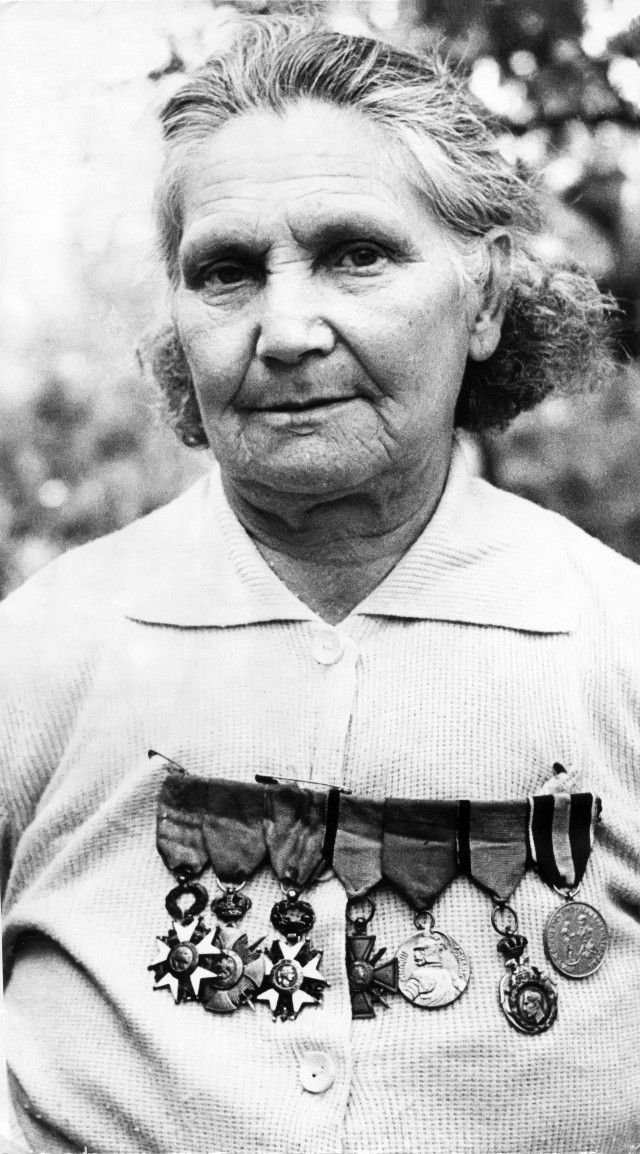
By the war's end, Savić held roughly twelve separate decorations, an extraordinary tally by any standard. The list includes two Orders of the Star of Karađorđe with Swords, two awards of the French Légion d'honneur at different grades, France's Croix de Guerre with gold palm, Russia's Cross of St George, a British order usually rendered simply as the Order of St Michael and St George and Serbia's own Miloš Obilić medal in both gold and silver. She's still commonly described as the only woman awarded the Croix de Guerre with gold palm during the First World War specifically, a narrower and better-supported claim than the broader, unverifiable idea that she's the only woman to ever receive it under any circumstances. Two of these decorations are worth flagging as harder to pin down than the others: a direct search of the London Gazette's own archive turns up no entry for her at all under the British order, and France's Base Léonore database, its own searchable record of Légion d'honneur recipients, has no matching dossier either. Neither gap disproves the awards, since foreign wartime honours to allied soldiers weren't always formally gazetted or digitised, but it does mean both claims currently rest entirely on secondary retellings rather than a primary government record.

Her wound count is one of the few details where sources actually disagree rather than just repeating each other. Most English-language military history sites put the figure at nine, and that's the number used most consistently across independent write-ups. Serbia's own Armed Forces website, however, states she was wounded four times, and France's Historial de la Grande Guerre museum gives a similarly low count. The gap likely comes down to how each source is counting, whether minor injuries are included alongside the serious wounds, rather than one side being simply wrong, so it's fairest to present nine as the most widely cited figure while noting that Serbia's own official record is notably more conservative.
After the war, she was reportedly offered a pension and a comfortable life in Paris in recognition of her service. She turned it down and went home to Serbia instead, though no single source could confirm the exact terms of what was actually offered.
A marriage, a divorce and four daughters raised on a cleaner's wages
Savić's postwar life was far quieter than her wartime record, at least on the surface. She married a man usually named as Veljko Gligorović or Gligorijević and had one daughter with him, her name given inconsistently across sources as either Milena or Mileva, before the marriage ended in divorce. She then adopted three more daughters and raised all four largely on her own, working first for the postal service and later, from around 1927, as a cleaner, most often said to have been at Belgrade's State Mortgage Bank. One Serbian tourism site adds that she also helped 32 other children complete their schooling beyond her own four, a specific and striking detail that, while only lightly sourced, fits a pattern of understated generosity that shows up nowhere in her wartime record but recurs throughout accounts of her later life.

A secret infirmary and ten months in a Nazi camp
When Germany occupied Yugoslavia during the Second World War, Savić didn't stay on the sidelines. Multiple sources describe her running an improvised infirmary out of her own home, treating wounded resistance fighters from both of Yugoslavia's rival guerrilla movements, the communist-led Partisans and the royalist Chetniks, rather than favouring one side over the other. German occupation authorities eventually arrested her, and she was held for roughly ten months at Banjica, a real and well-documented concentration camp the Gestapo ran in occupied Belgrade. She was released, according to the most consistent version of events, only after a German officer recognised her as the decorated hero of the previous war.
Decades of poverty, then a very belated apartment
It's tempting to assume Savić's wartime heroics made her postwar life easier, or that Yugoslavia's new communist government targeted her the way it targeted plenty of other prominent royalist-era figures. Neither turns out to be true. No source behind this piece found any evidence that the postwar communist authorities imprisoned or persecuted her specifically, which suggests the popular idea of ongoing political persecution likely comes from conflating her wartime imprisonment by the Germans with the decades that followed under Tito's government. What actually happened is quieter and, in its own way, sadder: she simply faded into poverty and obscurity through the 1950s. It wasn't until the 1960s and 1970s, as Yugoslavia marked various wartime anniversaries, that journalists and officials rediscovered her, and public attention to her circumstances eventually led to a small state pension and, in 1972, a modest apartment near Belgrade's City Assembly, more than half a century after her most famous exploits.
Death, a forty-year wait and a resting place among Serbia's greatest
Milunka Savić died in Belgrade on October 5, 1973, reportedly of a stroke. She was originally buried in a family plot, and for forty years that's where she stayed, largely out of the public eye once again. That changed on November 10, 2013, when Serbia's Ministry of Defence reinterred her remains at the Alley of the Greats in Belgrade's New Cemetery, alongside the country's other most significant historical figures, as the centrepiece of a wider commemorative project timed to the fortieth anniversary of her death. The country hasn't let the story drop since: on October 5, 2023, exactly fifty years after her death, Serbia's Ministry of Defence and the Association of War Volunteers 1912-1918 held a formal wreath-laying commemoration at her grave, attended by the country's acting assistant defence minister and its minister for labour and veteran affairs.
The Hollywood rumour that isn't real, and the real film that is
A persistent claim online holds that Angelina Jolie was once attached to a film about Savić's life. No evidence for this turned up anywhere in the research behind this piece, not in English-language entertainment coverage and not in Serbian outlets that would have had every reason to report on it. The most likely explanation is a mix-up with Jolie's actual, controversial connection to the region: her 2011 directorial debut In the Land of Blood and Honey, about the Bosnian War, which drew protests at its own Belgrade premiere rather than any warm reception. The real screen treatment of Savić's story is considerably less glamorous but entirely verifiable: a 2013 Serbian-produced documentary, Milunka Savić: Heroine of the Great War, directed by Ivana Stevens as part of the same Ministry of Defence project that reburied her, drawing on Serbian and French archives and reportedly incorporating the only surviving film footage of her that's known to exist.
A historian's project to separate the woman from the legend
That 2013 project also produced the closest thing Savić's story has to an official myth-busting effort. Historian Slađana Zarić, who worked on the research behind the documentary, said plainly that earlier attempts to tell her story had "resulted in numerous myths rather than facts," and that no one had previously researched her life with real rigour. Separately, Serbia's Archives of Yugoslavia featured a handwritten 1938 letter from Savić herself, a petition to Queen Marija's royal court asking for financial assistance, as its own "Document of the Month" as recently as 2025, a reminder that the paper trail behind her story is still being pieced together nearly a century after she wrote it.
How her story compares to Flora Sandes, the other woman who fought for Serbia
Savić wasn't the only woman in Serbia's army, just the one who got there by disguise rather than permission. Flora Sandes, a British volunteer, served openly as a woman with the Serbian Army from 1915 to 1919, joining during the same retreat through Albania and rising from private to sergeant-major by 1916 before eventually retiring as a captain. She was wounded by a grenade in 1916, the same broad type of injury that had exposed Savić three years earlier. The two soldiers' paths ran through some of the same battles and the same army, but Sandes never needed to hide who she was, and never faced the specific risk of discovery that shaped Savić's entire early career. Between them, they're a reminder that a Serbian army desperate enough to survive three wars in six years wasn't nearly as rigid about who could fight as its own official rules suggested.
Further reading on the site
Milunka Savić isn't the only soldier whose real record got embellished by the legend that grew up around it. Adrian Carton de Wiart, the unkillable soldier, survived his own share of impossible battles across multiple wars, while Frances Clalin Clayton tells the story of another woman who disguised herself as a man to fight, this time in the American Civil War. For another Yugoslav woman whose wartime defiance became the stuff of national memory, there's Lepa Radić, executed by the same occupying forces Savić herself was once imprisoned by.