

Genie Wiley: The Story of a Feral Child Lost to Tragedy and Science
Updated: Apr 27

On a quiet Wednesday afternoon in November 1970, a social worker at a welfare office in Temple City, California, glanced up from her desk and froze. Standing in the doorway was a small, pale girl who appeared to be around six or seven years old. She was hunched, silent, and moving in a strange, halting hop, her hands curled up in front of her chest like a rabbit. She was wearing a nappy. The girl was 13 years old.
Her name was Susan Wiley. The world would come to know her as Genie, a pseudonym chosen to protect her identity and one that carried a quietly devastating irony: a genie, after all, is a creature that emerges into the human world without ever having had a childhood.

Her story is one of the most disturbing cases of child abuse ever documented. It's also one of the most scientifically significant and ethically complicated case studies in the history of psychology. Genie didn't just survive the unsurvivable. She accidentally became the subject of what researchers called 'the Forbidden Experiment': a real-world test of whether a child who'd never learned language could still acquire it after puberty. The answer changed science. And it broke the hearts of everyone who tried to help her.
A Childhood Behind a Locked Door
Genie was born on 18 April 1957, in Arcadia, California, the last of four children born to Clark Wiley and his much younger wife, Irene. Clark, born Pearl Wiley in 1901 in Oregon, had a childhood that by any measure was its own kind of horror. Raised largely in orphanages and by an inattentive mother who ran a brothel, he'd been given a feminine name that made him the target of constant ridicule. When his grandmother, one of his few stable figures, was killed in a traffic accident when he was six years old, the trauma lodged somewhere deep and permanent.

By the time he married Irene (a Dust Bowl refugee from Oklahoma roughly 20 years his junior who'd suffered significant neurological damage in a childhood accident), Clark had become a controlling, violent man with an obsessive fixation on his dead mother. He didn't want children. When his and Irene's first daughter arrived, Clark found her crying intolerable and left her in an unheated garage, where she caught pneumonia and died at ten weeks old. The second child, a boy, died at two days old. A third child, another son, survived, though he suffered severe developmental delays as a result of his father's abuse.
Then came Genie.
She was born healthy, and by all accounts developed normally in her first months. But at around 14 months, a paediatrician suggested cautiously and inconclusively that she might have some form of intellectual disability. For Clark, this was all the justification he needed. Shortly after his own mother was killed by a drunk driver in 1958, he unravelled entirely. He quit his job, moved his family into his late mother's house, and began systematically hiding Genie from the world.

From around 20 months of age, Genie's world shrank to a single back bedroom. During the day, she was strapped into a hand-sewn straitjacket harness tied to a child's toilet chair, able to move only her hands and feet. At night, she was placed in a wire-mesh crib with a lid, her limbs immobilised in a sleeping bag. The room had two almost entirely blacked-out windows. The only objects she had access to were a crib, some curtains, three pieces of furniture, and occasionally plastic food containers, old spools of thread, and back issues of TV Guide with many of the illustrations cut out.
Clark Wiley had an extreme sensitivity to noise. There was no television or radio in the house, and family members were forbidden from speaking at anything above a whisper, and never to or around Genie. If she made a sound, Clark beat her with a large wooden plank he kept in her room. To keep her silent, he'd growl and bare his teeth at her door like a guard dog. He grew his fingernails long specifically to scratch her. She learned quickly: make no noise, show no expression, attract no attention.
She was fed as little as possible. Baby food, cereal, the occasional soft-boiled egg were spooned into her mouth so quickly that she never learned to chew properly. If she choked, whoever was feeding her rubbed her face in the food. She wore nappies for years. She couldn't fully extend her arms or legs. She'd never seen the outside world beyond a few inches of sky visible through a crack in the curtains.
Clark also kept his shotgun in the living room and sat with it across his lap to discourage any of his family from seeking help. He kept detailed notes documenting his mistreatment, a chilling testament to a man who knew exactly what he was doing. He was convinced Genie would die before her 12th birthday and had apparently promised Irene that if she survived, he'd allow her to seek outside help. She survived. He reneged.
The Accidental Discovery
By October 1970, the violence inside the Wiley household had reached a breaking point. In a rare act of defiance, Irene threatened to walk out if Clark wouldn't let her contact her own parents. He relented, and while he was out of the house she gathered Genie and left, making her way to her parents' home in Monterey Park. Genie's older brother, by then 18, had already fled and was living nearby with friends.
Around three weeks later, on 4 November 1970, Irene decided to apply for disability benefits for the blind. Nearly sightless from advanced cataracts and the long-term effects of her neurological injury, she took Genie with her to Temple City and walked into the wrong office. The social services office was next door to the disability benefits office she'd intended to visit.

The social worker at the desk immediately knew something was wrong. Detective Franklin Lee was assigned to investigate, and when police and welfare staff began piecing together Genie's background, what they found defied comprehension. Her parents were arrested on charges of felony child abuse. Clark Wiley was charged and scheduled to appear in court. On 20 November 1970, the morning of his court appearance, he shot himself. He left two notes. One, addressed to his son, read: 'Be a good boy, I love you.' The other, directed at police, contained the words: 'The world will never understand.'
Charges against Irene were ultimately dropped. Her lawyers successfully argued that she, too, had been a victim, intimidated, isolated, and effectively imprisoned by her husband, her failing eyesight making independent action almost impossible.

The Girl Who Arrived from Nowhere
Genie was admitted to the Children's Hospital Los Angeles on 4 November 1970. Dr James Kent, an early advocate for child abuse awareness, conducted her initial physical examination and would later describe it as the most severe case of child abuse he'd ever encounter in his career.
She stood 4 feet 6 inches tall and weighed just 59 pounds (about 27 kg). She had two nearly complete sets of teeth, a rare dental condition known as hyperdontia. Her bone density was that of an 11-year-old. A thick callus and deep bruising had formed in a ring on her buttocks from years of being strapped to a toilet chair. She couldn't stand up straight, couldn't fully extend any of her limbs, and couldn't chew or swallow solid food. She was completely incontinent and had no reaction to extreme temperatures, whether hot or cold.
Her vision was peculiar. Though tests confirmed both eyes were healthy, she couldn't focus on anything more than 10 feet away, which corresponded exactly to the dimensions of her prison room. She walked in a shuffling, bouncing gait with her hands raised in front of her, something that would become known as her 'bunny walk', suggesting profound difficulties with sensory integration.
She couldn't speak. She could barely communicate at all. Her active vocabulary at that point consisted of just two phrases, 'stop it' and 'no more', which she used as single words rather than sentences. She didn't cry. When she was upset, she attacked herself silently, remaining completely expressionless throughout. She had no attachment to anyone, including her mother and brother, and didn't distinguish between people she knew and strangers.
And yet, even in those first terrible days, the hospital staff noticed something: Genie was intensely curious. She was drawn to new sounds, new objects, new stimuli of any kind. She'd been starved of experience, but whatever spark drives human curiosity, the impulse to investigate, to reach out and understand, hadn't been extinguished. As Susan Curtiss, the UCLA linguist who would become Genie's closest researcher, later put it: 'She was smart. The lights were on.'
The Forbidden Experiment
Genie's arrival at Children's Hospital couldn't have been more timely, scientifically speaking. In 1967, neuropsychologist Eric Lenneberg had published his landmark work 'Biological Foundations of Language', in which he proposed the Critical Period Hypothesis (CPH). This was the idea that there's a window in early childhood, closing around the onset of puberty, during which the human brain is optimally wired to acquire language. Miss it, he argued, and you'd never fully catch up. The part of the brain responsible for grammar, syntax, and the deeper architecture of language would simply fail to develop properly.
This was underpinned by the earlier work of linguist Noam Chomsky, who argued that the capacity for language was innate, a uniquely human biological trait. But Lenneberg's specific claim about a critical window had never been tested on a human subject. It couldn't be. Deliberately depriving a child of language to test a theory would be, asresearchers called it, 'the Forbidden Experiment', one that ethical standards would never permit.
Then Genie walked into a welfare office, and the experiment happened anyway.
By May 1971, psychologist David Rigler, chief psychologist at Children's Hospital and a professor at the University of Southern California, had secured a three-year grant from the National Institute of Mental Health (NIMH) to fund a full case study. A team was assembled: Rigler himself, linguist Victoria Fromkin of UCLA, psychiatrist Howard Hansen, physician James Kent, and a young linguistics graduate student named Susan Curtiss. Curtiss would end up spending more time with Genie than anyone.
The team screened Francois Truffaut's 1970 film 'The Wild Child', a fictionalised account of Victor of Aveyron (a feral boy discovered in 18th-century France), at their first meeting. The parallels were striking. Victor, like Genie, had been found in a state of extreme deprivation and had been the subject of a famous attempt to teach him language. Victor had never fully acquired it. Scientists hoped Genie might be different.

What Genie Taught the World About Language
The results were simultaneously extraordinary and heartbreaking. Within months of her rescue, Genie was learning new words at a pace that stunned researchers. She was a vocabulary sponge, learning colour words, object names, verbs, and adjectives with remarkable speed, and with an unusual focus on objective properties that linguists noted was far more sophisticated than children at equivalent stages of language development. She'd grab Curtiss's hand, point at an object, and refuse to let go until she'd learned its name.
By mid-1975, she could accurately name most objects she encountered and clearly knew more words than she regularly used. Her non-verbal communication was exceptional too. She invented her own gestural system, used drawings to express things she couldn't say, and had an uncanny ability to make strangers do things for her without saying a word. Researchers witnessed shopkeepers spontaneously giving her gifts simply because she looked at something. Curtiss recalled seeing a woman stop her car at a busy intersection, get out, and hand Genie her plastic purse for no apparent reason beyond Genie's silent, powerful gaze.
But grammar was a different story entirely. Genie never mastered it. She spoke in what linguists call telegraphic speech, stringing words together without the grammatical rules that glue them into sentences. 'Applesauce buy store.' 'Ball belong hospital.' She couldn't reliably use pronouns, often saying 'Mama love you' while pointing to herself. She couldn't construct passive sentences. She never achieved what linguists consider full first-language acquisition.
Brain scans and dichotic listening tests offered a clue as to why. Normally, language is processed primarily in the left hemisphere of the brain. But Genie's tests showed something extraordinary: she identified language sounds with 100% accuracy in her left ear (which routes to the right hemisphere) and only at chance level in her right ear. She was processing language in the wrong hemisphere entirely. Neurologists Ursula Bellugi and Edward Klima of the Salk Institute concluded that, because Genie had received almost no linguistic input during childhood, her left hemisphere had never been specialised for language. Instead, her brain had rewired language acquisition to the right hemisphere, with all the limitations that entails.
Meanwhile, her right hemisphere had become extraordinarily developed from her years of visual and tactile experience. On spatial awareness tests, her scores were reportedly the highest ever recorded. On facial recognition and pattern tests, she scored in the 95th percentile for adults. Her right hemisphere had been doing double duty for 13 years, and it showed.
Curtiss ultimately concluded that Genie provided evidence for a modified version of Lenneberg's Critical Period Hypothesis. Not the strong version, since Genie clearly could learn some language past puberty. But the capacity for full grammatical language acquisition, the part involving syntax and the deep structure of grammar, did appear to have an expiration date. She could learn words. She couldn't learn the rules that connected them.
Linguists following the case took to calling Genie 'the Great Abbreviator.'
Speaking About the Unspeakable
As Genie's vocabulary grew, she began, haltingly and in fragments, to speak about her father. Researchers encouraged her, and what she shared was devastating in its simplicity:
"Father hit arm. Big wood. Genie cry ... Not spit. Father. Hit face, spit. Father hit big stick. Father is angry. Father hit Genie big stick. Father take piece wood hit. Cry. Father make me cry. Father is dead."
She also, researchers noted, frequently muttered to herself: 'Father hit.' Before she properly understood the concept of death, she sometimes asked where her father was, afraid he might come to get her.
Four Years of Progress and the Fight Over Who 'Owned' Her
Genie's early months at the hospital were followed by a custody dispute that would define the ethical fault lines of her entire case. Her teacher, Jean Butler, took Genie into her home in June 1971 under the pretext of a possible rubella exposure. Hospital staff were sceptical of the rubella story and suspected Butler of engineering the situation to become Genie's primary carer. Their suspicions weren't entirely unwarranted: Butler began restricting researchers' access to Genie, and multiple members of the team recalled her openly saying she hoped Genie would make her famous and that she intended to be 'the next Anne Sullivan', a reference to Helen Keller's celebrated teacher.
California authorities rejected Butler's foster custody application in August 1971. Genie then moved into the Los Feliz home of David Rigler and his wife Marilyn, an arrangement Rigler had initially expected to last three months but which stretched to nearly four years.

Those four years were, by most accounts, the happiest of Genie's life. Marilyn worked with her on chewing, swallowing, emotional regulation, and basic life skills. Genie learned to iron clothes, use a sewing machine, and prepare simple meals. She started attending first a nursery school, then a public school for children with intellectual disabilities. She developed a deep love for classical piano music. Researchers believed this was because she could occasionally hear a neighbour practising piano during her years of isolation, and it was one of the very few sounds she'd ever been exposed to. She had no interest in recorded music, only live performance.
She hoarded objects obsessively, particularly colourful plastic containers and beach pails. She had an intense fear of cats and dogs, eventually traced back to her father's habit of growling at her like an animal. By late 1972, the Riglers had finally discovered the origin: Genie's mother told them that Clark had acted like a dog to intimidate Genie, which made the fear's roots clear for the first time. With patient exposure, Genie eventually overcame her fear of the Riglers' own dog, though strange cats and dogs still frightened her throughout her life.
The NIMH, however, was growing impatient with the research team's disorganised data and lack of clear scientific outputs. In 1974, after the initial three-year grant and a one-year extension, they unanimously denied Rigler's application for a further three-year extension. Funding ended. And with the funding gone, so did the framework that had been holding Genie's world together.
What Happened to Genie Wiley After the Study Ended
In 1975, when Genie turned 18, her mother reclaimed custody and they moved back to Irene's home. It didn't work. The task of caring for Genie proved overwhelming, and within months Irene contacted California's Department of Health to find alternative arrangements, apparently without informing the Riglers or Genie's legal guardian, attorney John Miner.
What followed was a succession of foster placements, and in the first of them, Genie encountered the kind of abuse she'd known as a child. Her caretakers imposed rigid rules, cut off access to her beloved objects and activities, and rarely allowed her mother to visit. They subjected her to physical and emotional abuse. When she vomited (she'd always had severe swallowing difficulties), they beat her severely and told her that if it happened again, she'd never see her mother. The threat was existential. Terrified of eating, terrified of speaking, terrified of opening her mouth at all, Genie withdrew almost entirely. Her incontinence returned. Her language, so painfully built over four years, began to collapse. She stopped speaking and communicated almost exclusively in sign language.
Susan Curtiss was the only member of the original team who managed to maintain regular contact through this period, conducting weekly meetings and documenting the deterioration she was witnessing. She petitioned repeatedly to have Genie removed, but struggled for months to even reach Miner. When Miner finally saw Genie's condition firsthand in late April 1977, he and David Rigler intervened to extract her from the placement.
After a brief recovery stay at the hospital, Genie was placed in another foster home that seemed to go better until December 1977, when that arrangement ended suddenly and without explanation. She spent the end of that year moving through temporary settings.
In early January 1978, Genie's mother abruptly cut off all contact between Genie and the research team. Then, in March 1978, California authorities discovered that Miner had failed to update his legal guardianship status when Genie turned 18. They transferred guardianship to her mother, who subsequently banned all of the scientists except psychiatrist Jay Shurley from seeing Genie. The door, as Shurley later put it, was shut.
The Lawsuit and the Fallout
In 1977, Susan Curtiss had published her doctoral dissertation, 'Genie: A Psycholinguistic Study of a Modern-Day Wild Child', which became a landmark academic text. But Genie's mother, reportedly influenced heavily by Jean Butler (by then going by her married name, Jean Ruch), sued the hospital, several therapists, and a number of researchers including Curtiss, David Rigler, James Kent, and Howard Hansen.
The official complaint alleged violations of patient confidentiality, invasion of privacy, and a claim that the team had prioritised scientific testing over Genie's welfare. All the named scientists denied the accusations emphatically. Rigler later revealed that during depositions he'd discovered Ruch had actively encouraged the lawsuit, something later confirmed by the lawyers involved. The case was eventually dismissed by the Superior Court of California 'with prejudice', meaning it lacked substance and couldn't be refiled.
Ruch continued to spread negative stories about the research team until 1986, when a stroke left her with aphasia. She died in 1988 following a second stroke.
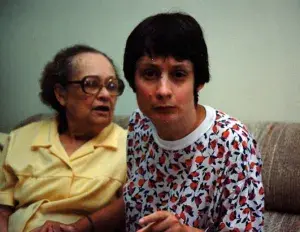
Where Is Genie Wiley Now?
From 1978 onward, Genie passed through at least four more foster homes and institutions, some of which subjected her to further physical abuse. Jay Shurley, one of the few people permitted to see her, attended her 27th birthday party in 1984 and visited again in 1986. He described her on both occasions as deeply depressed, stooped, and barely communicating.
Journalist Russ Rymer wrote about meeting Genie on her 27th birthday in his 1993 book 'Genie: A Scientific Tragedy', describing the encounter in terms that made plain how much had been lost. Susan Curtiss, who had spent years searching for her, told ABC News in 2008: 'I've spent the last 20 years looking for her. I can get as far as the social worker in charge of her case, but I can't get any further.'
In 2000, according to an ABC News report published in 2008, a private investigator located Genie in a small residential care facility for adults with intellectual disabilities. He reported that she appeared content, lived a simple life, and could still communicate fairly well in sign language, though she spoke only a few words.
Genie's mother, Irene Wiley, died of natural causes in 2003 at the age of 87. Her brother, who had moved to Ohio and stayed largely out of contact, gave his only public interview around 2008, saying he'd visited Genie and his mother just once, in 1982, and had refused to read or watch anything about her case until shortly before the interview. He died in 2011.

As of 2016, Genie was believed to be a ward of the state of California, living in an undisclosed location in Los Angeles. According to Britannica, as of 2023 there's no public record of whether she's still alive or where she's living. She'd be 68 years old in 2025. Susan Curtiss, who bonded with her more than anyone during those years of research, has reportedly been unable to renew contact despite repeated efforts.
The Ethical Question That Never Goes Away
Genie's case sits uncomfortably at the intersection of science and humanity. The researchers who worked with her weren't villains. By all accounts, many of them genuinely cared about her, and Curtiss's grief over losing contact with her has never been in doubt. But the ethical architecture of the study was flawed from the start. The same people responsible for her scientific testing were also her carers, her therapists, her foster parents, and her legal guardians. Those roles are incompatible, and modern psychology would never permit such overlaps. Today, APA ethical guidelines explicitly prohibit the kind of dual relationships that defined Genie's care.
Psychiatrist Jay Shurley, one of the few people who'd voiced discomfort during the research at the time, later reflected that all of the scientists involved, himself included, had been guilty to varying degrees of using Genie as an object and placing their scientific goals above her and her mother's best interests.
Child psychologist David Elkind went further. He withdrew from the study entirely after the initial grant meetings in May 1971, citing his belief that it prioritised research over Genie's welfare. He never changed his mind.
What's particularly devastating is the timing of the collapse. Genie had made genuine, remarkable progress by mid-1975. She was attending school. She was learning to manage her emotions, to share, to ask for things, to interact, imperfectly and unusually but meaningfully. When the funding ended and the research framework dissolved, so did the network of stable relationships and consistent care that had made that progress possible. The loss of that scaffolding appears to have been as damaging to her development as anything that came before it.
Genie's Legacy: What She Changed, and What We Still Don't Know
Genie's case transformed multiple fields simultaneously. In linguistics, it provided real-world evidence that vocabulary acquisition and grammatical acquisition are separable. You can learn words without learning the rules that govern them. It refined the Critical Period Hypothesis and helped establish that the brain processes language differently when acquisition begins after puberty. Her case is now standard curriculum in linguistics, developmental psychology, and neuroscience courses worldwide.
In neuroscience, her brain scans gave researchers their first detailed look at how sensory deprivation affects hemispheric specialisation. Her extraordinary right-hemisphere scores (the highest recorded on several spatial and pattern recognition tests) and her complete failure to lateralise language to the left hemisphere, as is typical in right-handed people, opened new avenues of research into brain plasticity and the relationship between early experience and neural development.
In psychology and ethics, her case became a landmark cautionary tale about what happens when scientific and therapeutic roles collide, and about the vulnerability of research subjects who have no one else advocating for them.
And then there's the deeper question her story raises, one Susan Curtiss captured with characteristic honesty: 'Does language make us human? It's possible to know very little language and still be fully human, to love, form relationships, and engage with the world. Genie definitely engaged with the world.'
Genie loved classical music. She had an extraordinary gift for spatial awareness. She could communicate volumes without a single word. She was intensely curious about the world, and the world, for a brief and complicated period, was curious about her.
Whatever happened after the doors closed on the scientists who knew her, wherever she is today, Genie Wiley spent 13 years in a room that the rest of the world didn't know existed. She deserves to be more than a case study. She deserves to be remembered as a person.
Sources
Curtiss, S. (1977). Genie: A Psycholinguistic Study of a Modern-Day 'Wild Child'. Academic Press.
Fromkin, V., Krashen, S., Curtiss, S., Rigler, D. & Rigler, M. (1974). The development of language in Genie: A case of language acquisition beyond the critical period. Brain and Language, 1(1), 81-107.
Rymer, R. (1993). Genie: A Scientific Tragedy. HarperCollins.
Lenneberg, E. H. (1967). Biological Foundations of Language. Wiley.
Wikipedia: Genie (feral child). https://en.wikipedia.org/wiki/Genie_(feral_child)
Wikipedia: Linguistic development of Genie. https://en.wikipedia.org/wiki/Linguistic_development_of_Genie
Britannica: Genie (feral child). https://www.britannica.com/biography/Genie-feral-child
ABC News (2008). Investigative report on the whereabouts of Genie Wiley.
Carroll, R. (July 2016). Genie: locked in bedroom for 13 years. The Guardian.
Rigler, D. (June 1993). Letter to the New York Times in response to review of Genie: A Scientific Tragedy.
University of Derby Online: Genie Wiley, America's Feral Child. https://www.derby.ac.uk


