

The Dolly Sisters: The Hungarian Twins Who Gambled With Kings and Broke a Millionaire
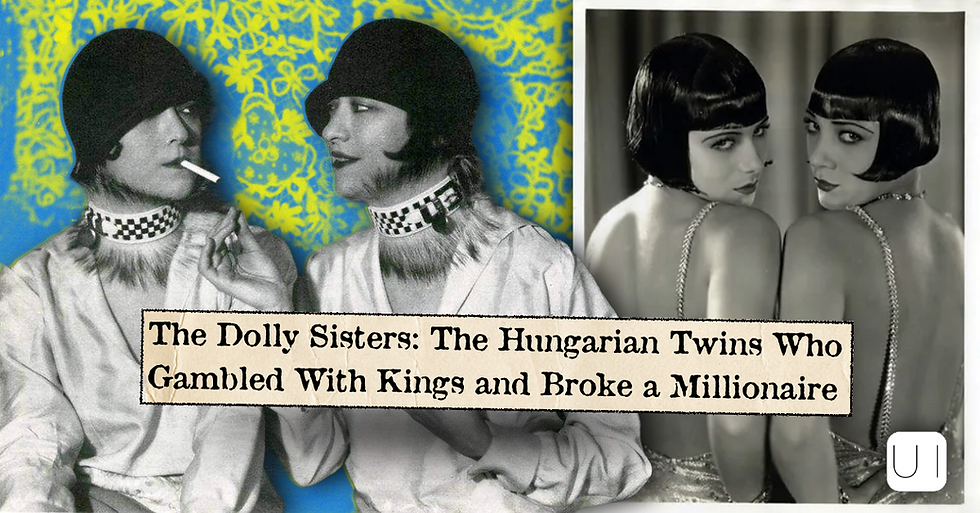
Jenny and Rosie Dolly were identical twins from Budapest who got so famous in the 1920s that a British department store magnate spent millions trying to keep them happy, a heavyweight boxing champion refused to pick a favorite between them, and a Spanish king reportedly carried on a three year flirtation with one of them. They danced their way from a cramped New York walk-up to chateaus in France, treated the casino at Deauville like a second stage, and packed in enough wealth, scandal and heartbreak for a dozen lifetimes. Then it all came apart, in a car crash outside Bordeaux and a length of rope in a Hollywood apartment. Most of what actually happened never made it into the sanitized 1945 movie version of their lives.
Two Girls Named Yansci and Roszika
Jenny and Rosie were born Janka and Roszika Deutsch in Budapest on October 25, 1892, to a photographer father and a mother who had once danced herself. Money was tight enough that the family eventually gave up on Hungary altogether, and in 1905 the girls and their mother sailed for New York while their father stayed behind. They had a younger brother, Ede, who later Americanized his name to Edward and built his own career as a stage and screen choreographer, a fact that tends to get lost next to his sisters' fame. The twins' only formal training was a few years of ballet lessons their mother scraped together the money for, and their mother sewed their earliest costumes herself.

They made their professional debut in Boston around age thirteen, and by 1909 they were dancing at Keith's Union Square in New York under a new stage name. The story goes that a friend watching them rehearse said they were as cute as little dolls, and Jenny and Rosie Deutsch became Jenny and Rosie Dolly for good.
Ziegfeld's "Cute" Discovery
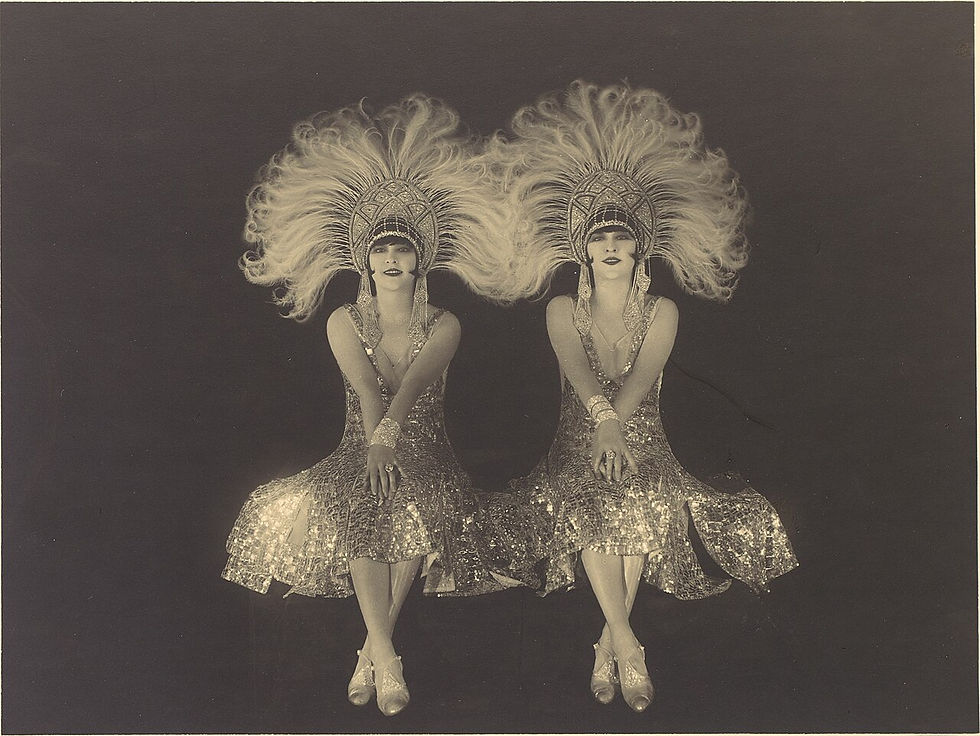
Florenz Ziegfeld booked the sisters for the 1911 Follies at $350 a week, reportedly telling them flatly, you can't do much but you're cute. It wasn't much of a compliment, but it worked. Ziegfeld built an entire visual identity around their looks rather than their voices, dressing them in elaborate costumes that leaned hard into an exotic, Asiatic-inspired fantasy, jeweled headdresses, finger cymbals and all, built around their dark hair, wide-set eyes and matching faces. Their signature number, a tightly synchronized routine built on the idea of two bodies moving as one, became the act every other twin duo on the circuit tried and failed to copy. Their singing was mediocre by most accounts. It didn't matter. Nobody bought a ticket to hear the Dolly Sisters sing.
Married, Separated, Reunited
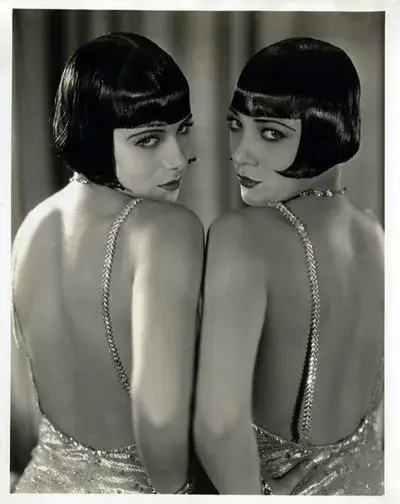
The sisters' personal lives ran on a strange, synchronized clock almost as tight as their dance routine. Rosie married the composer Jean Schwartz in 1913, best known for writing the hit song Chinatown, My Chinatown. Jenny followed in 1914, marrying the vaudeville dancer Harry Fox, who claimed credit for inventing the fox trot. Before the marriages, they'd actually shared stages with their future husbands professionally too, Jenny appearing in 1913's Honeymoon Express alongside Fox and Rosie taking the role of Chin Chin in 1914's Hello Broadway. Both sisters spent 1915 and 1916 trying solo careers alongside their husbands, and both found out fast that neither act worked without the other one standing next to her. They reunited for Ziegfeld's 1916 Midnight Frolic and rebuilt their audience from there, starring together in the 1918 Broadway show Oh, Look! alongside Fox, a modest hit that ran only 68 performances but produced the song I'm Always Chasing Rainbows, which far outlived the show itself. That same stretch of years also gave them their only joint screen credit, the 1918 silent film The Million Dollar Dollies, its title a fairly blunt acknowledgment of what they'd become and its production notable for 48 custom costumes designed by Lucile, the British couturier better known today as one of the most famous survivors of the Titanic. Jenny divorced Fox in 1920. Rosie and Schwartz separated the following year. Both marriages, like the solo careers, quietly gave way to the twin act that actually made money.
Twin Acts Were Big Business
The Dollys weren't the only set of twins vaudeville audiences were paying to see in this era, just by far the most famous and the best paid. A very different pair, Violet and Daisy Hilton, were building their own following around the same years, and their story shows how much luck and leverage actually separated the Dollys from real exploitation. Born conjoined in England in 1908, the Hilton twins were sold as infants and displayed for profit long before they were old enough to have any say in it, and it took a 1931 court case, with help from Harry Houdini, to finally free them from their guardian's control. The Dollys had their mother steering every costume choice and career decision from the wings, and they signed over plenty of autonomy to managers and lovers along the way, but they were never literally owned by anyone. That difference ended up mattering enormously for how each pair's story turned out.
Conquering London, Then Paris
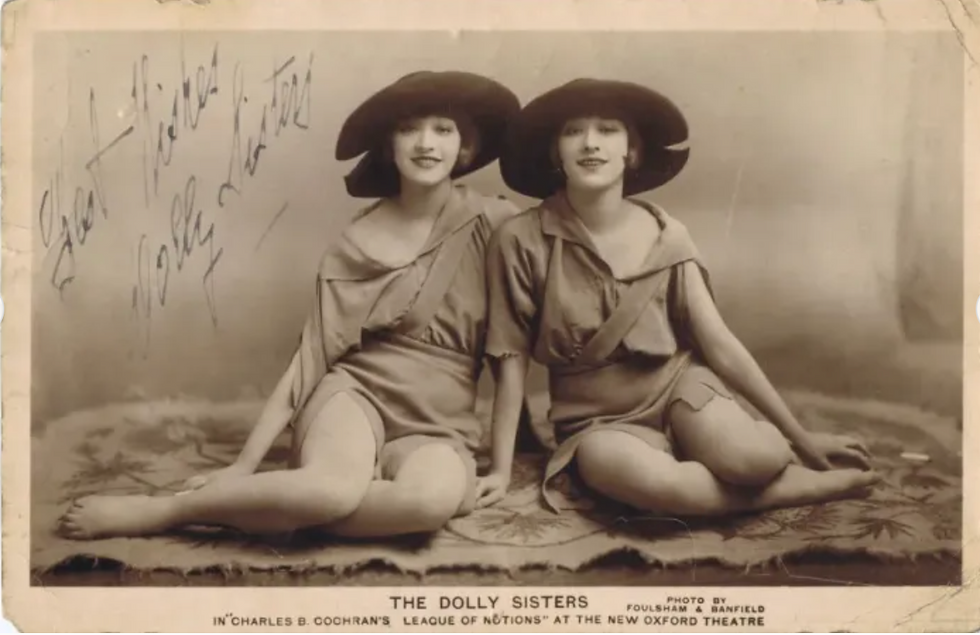
The sisters crossed the Atlantic in 1920 and quickly became fixtures of London society, starring in the West End shows Jigsaw that year and League of Notions the next, and adopting the fashionable close-cropped bob years before it became a general craze. It was during the Jigsaw run, in March 1921, that they were first introduced to Edward, Prince of Wales, at a private party, a connection that reportedly turned into something more serious with Jenny by 1924. From London they moved on to Paris, which is where the story really turns into a Jazz Age fable. In 1922 they signed a six week engagement at the Royal Hotel in Deauville, the seaside resort where wealthy Europe went every August to lose money elegantly, and the booking turned into years of return engagements there and in Cannes.
They'd been introduced to gambling years earlier by Diamond Jim Brady, the New York diamond merchant and world class spender who'd doted on them during their Broadway years, but Europe is where it became a genuine habit. After Saturday night shows at the Casino de Paris, they'd reportedly take a private, champagne stocked train out to Deauville to play chemin de fer and baccarat through the night, then ride back in time for Sunday's matinee. The newspaper Paris Soir reported on August 4, 1924, that the sisters had lost three hundred thousand francs at baccarat in a single stretch at Deauville, a loss they more or less shrugged off against the roughly one million francs they were pulling in performing at the Palace Theatre that same season.
The Millionaire Who Went Broke Loving Jenny
No man in the Dollys' orbit spent more, or lost more, than Harry Gordon Selfridge, the American-born founder of London's Selfridges department store and the man behind the phrase the customer is always right. Selfridge, nearly seventy by the mid-1920s, became fixated on Jenny after seeing the sisters perform, reportedly proposing marriage to her more than once and being turned down every time.
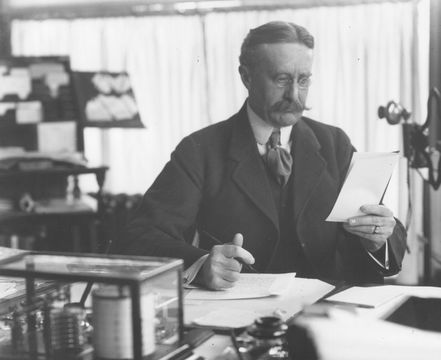
What he did instead was bankroll her life almost entirely. He bought and furnished a Paris home for her, covered her gambling losses at the casino while letting her keep any winnings, and showered her with gifts that ranged from the merely extravagant to the genuinely strange, including four-carat blue diamonds set by Cartier into tortoise shell cases and, on at least one documented occasion, ice cream flown over from London. After one particularly brutal losing streak at the tables, he reportedly sent Jenny a fresh set of diamonds and pearls with a note reading, I hope these will make up for your losses, darling girls. Estimates of how much Selfridge actually spent on the sisters over the years range wildly, anywhere from roughly four million to as much as twenty million dollars depending on the source, but the direction of the story isn't in dispute. He eventually lost control of the store that bore his name and died in relative poverty and debt, a business empire quietly dismantled in large part by his devotion to a woman who never did marry him.
Kings, Boxers and a Very Public Tug of War
Selfridge was far from the only man competing for the Dollys' attention. The Prince of Wales reportedly visited Deauville with the sisters in 1924 and won 80,000 francs at the tables during the trip. King Alfonso XIII of Spain kept up what one contemporary French magazine described as a three year flirtation with one of the twins, a romance discreet enough that it nearly had to be managed around a royal embassy event to avoid what the same report delicately called a family incident. William Randolph Hearst was said to be devoted to them, the Belgian financier Jacques Wittouck was another regular fixture in their circle, and Diamond Jim Brady, who never asked for anything more than their company, showered them with diamonds and once bought them a Rolls-Royce outright. Not every suitor got anywhere. One duke reportedly offered Rosie an emerald and diamond necklace and got turned down flat, for a reason that had nothing to do with money: she didn't care for men with red hair. When the heavyweight champion Jack Dempsey was asked which sister he preferred, he reportedly ducked the question by saying, "I ain't no Solomon", a nod to the biblical king famous for settling impossible disputes.. The twins were famously playful about their identical faces too. According to one story making the rounds among people who knew them, if Rosie found herself stuck at dinner with a suitor she didn't like, she'd order and eat a full meal, then slip away and let Jenny take her seat and order dinner all over again, running the unwitting date's patience and wallet down until he gave up and left.
Suing the Moulin Rouge, and Winning
For two women constantly portrayed as frivolous, the Dollys could be sharp-elbowed when it counted. In 1926 they sued the Moulin Rouge music hall over what they said was a breach of contract, after management billed the French star Mistinguett above them on the marquee. Rather than finish out the run, the sisters walked out of rehearsals and signed on with the rival Casino de Paris instead, prompting the Moulin Rouge to countersue for matching damages. The Dollys won outright, collecting roughly half a million francs in damages and costs, and rather than pocket it, they donated the entire settlement to the Actors' Benevolent Fund, a charity supporting performers who'd fallen on hard times. It's a detail that rarely makes it into the shorthand version of their story, which tends to flatten them into pure Jazz Age excess and nothing else.
One Car, Two Very Different Endings
The act itself quietly wound down before the tragedy did. Their last documented performance together was a charity gala at the Cannes Casino Ambassadeurs on February 7, 1928, which raised about $5,200 for local causes, a low key finish for two women who'd spent the better part of two decades as the most photographed act in Europe. The good years ran out for good once the 1930s arrived.
On March 2, 1933, Jenny was in a car that crashed near Bordeaux while she was traveling with the French aviator Max Constant. The injuries were severe, including a fractured skull, and by some accounts her stomach was forced up into her chest cavity, and she went through as many as fifteen reconstructive operations trying to repair her face and body. Selfridge covered much of the medical expense, but the romance between them didn't survive the accident, and Jenny sold off pieces of a jewelry collection once described as the largest in private hands in the world just to keep going. It didn't fix what the crash had taken from her. I may look the same but I am just a broken shell, she reportedly said afterward. In 1935 she married a lawyer, Bernard Vinissky, and the couple adopted two Hungarian orphan girls, Kalri and Manzi. The marriage didn't last, and by 1941 Jenny was living quietly and mostly alone.

On June 1, 1941, at 48 years old, she hanged herself from a curtain rod in her Hollywood apartment. She was buried at Forest Lawn Memorial Park in Glendale, where Rosie would eventually join her decades later.
Rosie's path after the twin act ended looked almost nothing like her sister's. She married the Canadian tobacco heir Mortimer Davis in 1927, a marriage that ended in divorce in February 1931 with a settlement reportedly worth around $2 million, then married the Chicago department store heir Irving Netcher in a civil ceremony on March 17, 1932, performed by New York mayor James J. Walker. She arrived for that wedding with twelve trunks in tow, reportedly packed with forty hats, fifty pairs of shoes and fifteen evening gowns, old habits dying hard even in a comparatively modest second act. She spent much of her later life doing charity work for Hungarian children and largely out of the public eye. In 1962, at 70 years old, she attempted suicide with an overdose of sleeping pills and survived, telling an interviewer around that time how sharply fame had evaporated: "I found out that America has changed. I'm in New York, old friends you call up when you arrive, they've forgotten you. They don't call back". She lived another eight years, dying on February 1, 1970, at 77, following a hip injury and a bout of flu, having outlasted her twin by nearly three decades and, by her own account, watched almost everyone who once fought over her forget she existed. They forget very easily, she said.
Hollywood's Sanitized Version
In 1945, Twentieth Century-Fox released The Dolly Sisters, a Technicolor musical starring Betty Grable as Jenny and June Haver as Rosie, directed by Irving Cummings and produced by George Jessel. It was a genuine hit and picked up an Academy Award nomination for the song I Can't Begin to Tell You.
It was also, by the studio's own later admission, heavily fictionalized. Grable and Haver weren't identical twins, an odd choice for a film literally titled after a pair of famous identical twins, and the contract for the film's rights reportedly barred the studio outright from depicting either Jenny's 1941 suicide or the couple's adoption of two orphaned children, both facts judged too dark for a wartime audience looking for glamour and spectacle. The real Harry Fox and Jean Schwartz both filed lawsuits over how the film portrayed them. Rosie, who was still alive to see it released, reportedly received around $52,500 for the rights to her and her sister's story, and was left privately unimpressed by just how much of the real story, including the hard parts her sister actually lived through, had been quietly written out.
A Legacy in Porcelain and Bronze
Long after vaudeville itself faded, the Dollys kept turning up in unexpected places. Art Deco sculptors of the 1920s and 30s, including Demetre Chiparus, Josef Lorenzl's contemporaries at Goldscheider, and the Royal Dux porcelain works, modeled bronze and ceramic figures directly on the sisters' matching silhouettes, meaning their image is still sitting in glass cabinets and auction house catalogs today, long after almost everyone who actually saw them dance is gone. The reckless, glittering, self-destructive version of the 1920s the Dollys represented on the French Riviera had a darker mirror playing out at the same time across the border in Weimar Berlin, where Anita Berber was dancing herself toward an early grave through nightly performances fueled by cocaine and morphine. Both scenes burned out around the same time, for strikingly similar reasons. Fame built entirely on being looked at rarely comes with an exit plan, and for one Dolly sister, it ran out in a Hollywood apartment on a summer afternoon in 1941. For the other, it just quietly stopped answering the phone.


