Coal Black and de Sebben Dwarfs: The Banned 1943 Cartoon Historians Still Argue Over
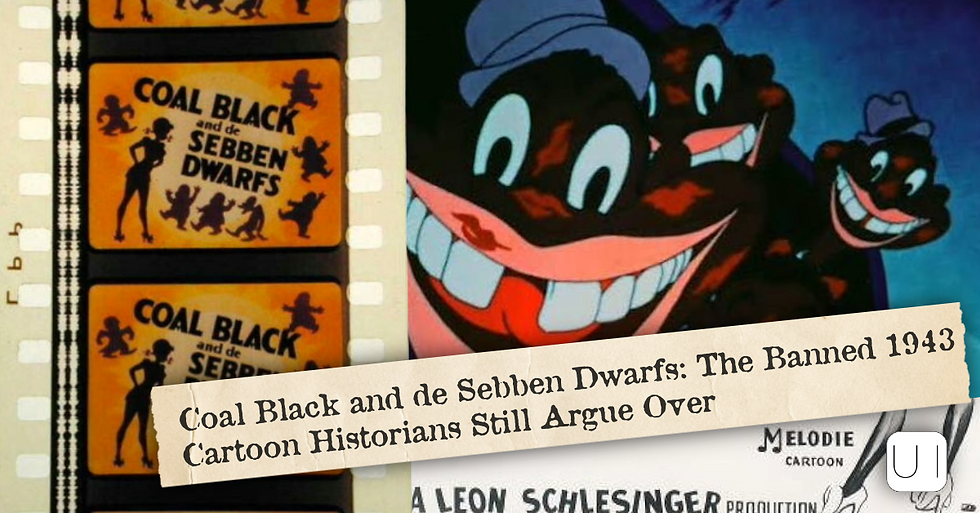
In January 1943, Warner Bros. released a seven-minute cartoon built around a swing band, a jitterbugging prince and an almost entirely Black voice cast, and it still divides the very people who study cartoons for a living. Coal Black and de Sebben Dwarfs gets ranked among the best animated shorts ever made by the animators who worked in that era. It's also been formally banned from American television since 1968. Both things are true, and neither cancels the other out.
Quick answers
What is Coal Black and de Sebben Dwarfs?
A 1943 Warner Bros. Merrie Melodies cartoon directed by Bob Clampett, a wartime, jazz-driven parody of Disney's Snow White performed almost entirely by Black voice actors and musicians.
Why was it banned?
In 1968, United Artists quietly pulled it along with ten other Warner Bros. cartoons from television syndication over their use of racial caricature. The group later became known as the Censored Eleven.
Who voiced the main characters?
Vivian Dandridge, sister of Dorothy Dandridge, voiced the heroine. Leo Watson voiced the prince, Lillian Randolph voiced the narrator and Danny Webb voiced the villain. Mel Blanc did the rest.
Can you watch it legally today?
Not through any official channel. It's never had an authorised home video or streaming release and hasn't aired on American television since 1968.
A Snow White parody that started with a night at the theatre
The idea came from a real night out. In July 1941, Bob Clampett attended Duke Ellington's musical revue Jump for Joy at the Mayan Theater in Los Angeles, a show that ran for nine weeks and pulled in the likes of Orson Welles and Charlie Chaplin. Ellington himself later described it as his first attempt at what he called social significance on stage, aiming to move past the old theatrical stereotypes of the era. Clampett had musician friends in the cast, and when they found out he directed cartoons, they reportedly asked him a simple question: why didn't he ever use performers like them?
Not long after, the show's leading man, Herb Jeffries, and others from the cast started visiting Clampett's studio, and somewhere in those conversations a story began to take shape. Clampett also drew visual inspiration from Harlem As Seen by Hirschfeld, a book of stage caricatures by the artist Al Hirschfeld. Around the same time, the stage and film hit Carmen Jones, an all-Black reworking of the opera Carmen, was getting talked about in Los Angeles too, and likely fed into the idea of doing something similar with Snow White.
Field trips to a jazz club, and the band the studio wouldn't pay for
To get the tone right, Clampett sent his animation unit on field trips to Club Alabam, a Los Angeles nightclub built around Black musicians and dancers. Animator Virgil Ross later recalled the trips directly inspiring specific gags, describing tall men dancing with much shorter women and swinging their legs clean over their partners' heads, a move that made it straight into the finished cartoon.

Clampett wanted the whole score performed by an all-Black band for authenticity, but producer Leon Schlesinger refused on cost grounds, since he was already paying an in-house band at the studio. The score ended up handled by regular Warner composer Carl Stalling, who brought in Black musicians as consultants to get the blues and jazz feel right. Clampett didn't fully give up on his original idea either: he hired Eddie Beal and His Orchestra, an all-Black band, to record the trumpet solos for the cartoon's climactic kiss sequence. Band member Herb Jeffries spoke proudly of that work for the rest of his life.
One of the uncredited animators on Coal Black had an especially strange connection to the film it was spoofing. Art Babbitt had spent the 1930s as one of Disney's top animators, bringing the Wicked Queen and Geppetto to life on Snow White and the Seven Dwarfs and Pinocchio, before Walt Disney fired him in May 1941 for organising the studio's animators into a union, a move that triggered the Disney animators' strike. While the two men were estranged, Babbitt spent roughly a month freelancing in Clampett's unit at Schlesinger's studio, where he worked uncredited on Coal Black, a parody of the very film whose villain he'd helped design six years earlier.
Setting the cast record straight
For decades, most retellings of Coal Black repeated the same voice-cast lineup, and got a key detail wrong. Vivian Dandridge, the older sister of actress and singer Dorothy Dandridge, did voice the heroine, credited in the film only as So White. Leo Watson, a jazz singer nicknamed Zoot and formerly of the vocal group the Spirits of Rhythm, voiced Prince Chawmin'. Louis Armstrong was actually Clampett's first choice for that role, but he was booked on tour and had to pass. Lillian Randolph, later known for playing Mammy Two Shoes in MGM's Tom and Jerry shorts, voiced the film's opening narrator.
The long-repeated error concerned the villain. Sources for decades claimed Dorothy and Vivian's mother, Ruby Dandridge, voiced the Wicked Queen. Animation historian Keith Scott dug into the original recording logs held at USC's Warner Bros. archive and found no evidence for that at all. Ruby Dandridge had auditioned early on for the narrator role that eventually went to Randolph, and Clampett himself told a fellow historian in a 1974 letter that the Queen was actually voiced by Danny Webb, a Warner voice regular since 1937. Mel Blanc, credited elsewhere across the Warner cartoon library, provided the remaining voices.

What happened to the two leads
Vivian Dandridge never came close to matching her younger sister's fame. The Dandridge Sisters singing act she'd performed in since childhood broke up in 1940 once Dorothy decided to pursue acting solo, leaving Vivian to scrape together a career of minor film and TV roles alongside club dates for the next three decades. By the time she died in Seattle in 1991, friends there remembered a warm, unpretentious woman who performed at local open-mic nights and never mentioned that she'd once voiced the lead in one of the most famous, and most argued-over, cartoons ever made. She was in the middle of writing a memoir about herself and her sister when she suffered a fatal stroke, and it was never finished.
Leo Watson's own life story is oddly hard to pin down, which feels fitting for a performer best known for scat singing that dissolved words into pure sound. Most sources give his birth year as 1898, but music historian Marv Goldberg's research into contemporary newspaper clippings found Watson telling an interviewer in 1934 that he was 21 at the time, which would put his real birth year closer to 1912 or 1913, a full generation later than the commonly repeated date. What's certain is that he died in Los Angeles in 1950, only seven years after voicing Prince Chawmin', largely forgotten outside of jazz specialist circles despite having fronted one of the era's more inventive vocal groups, the Spirits of Rhythm.
What actually happens in seven minutes
The plot keeps Snow White's basic shape while dragging it firmly into wartime America. A wicked Queen, hoarding scarce rations, sends a gang modelled on Murder Inc. to deal with her rival, So White, but the gang falls for the young woman instead and drops her off safely in the woods. There she meets the Sebben Dwarfs, reimagined as a newly enlisted army unit, off fighting the war rather than mining diamonds. The Queen tricks So White into eating a poisoned apple, and when Prince Chawmin's kiss fails to revive her, it's the youngest dwarf whose kiss finally does the job, at which point her pigtails unfurl into small American flags, a patriotic sight gag that replaces Disney's original happy ending outright.
Why a film about “So White” is called “Coal Black”
Producer Leon Schlesinger worried the working title, So White and de Sebben Dwarfs, sat too close to Disney's own Snow White and could invite legal trouble, so the released title was changed to Coal Black and de Sebben Dwarfs before it reached theatres. Nobody went back and changed the film itself, though, so the heroine is still called So White in every line of dialogue and every piece of on-screen text throughout the actual short.
The protest that started in 1943, not the 1960s
It's often assumed that the backlash against Coal Black only caught up with it decades later, but the NAACP objected the moment it hit theatres. According to animation historian Christopher P. Lehman, author of a book on the history of Black stereotyping in American cartoons, the organisation called theatres in New York directly to ask them to stop screening the film and wrote to Warner Bros. president Harry Warner personally. Its 1943 public statement called the short a decided caricature of Negro life and an insult to the race, and separately criticised the depiction of Black soldiers as diamond-mining dwarfs as damaging to wartime morale.

The Censored Eleven
In 1968, United Artists Television, which then controlled the pre-1948 Warner cartoon library, quietly withdrew Coal Black along with ten other shorts from its syndication package because of their use of Black stereotyping. According to animation historian Jerry Beck, who worked at UA from 1978 to 1984 and handled bookings of the withdrawn films for colleges and repertory cinemas, the decision was never publicly announced. It was simply an internal instruction to stop supplying those eleven titles.
The nickname Censored Eleven was coined later by fans and historians, not by the studio itself.
The other ten titles span 1931 to 1944 and include Hittin' the Trail for Hallelujah Land, the oldest of the group and the only one in black and white, and Angel Puss, the sole entry directed by Chuck Jones and the only one from the separate Looney Tunes series. Clampett has one other cartoon on the list alongside Coal Black, a Fats Waller-inspired short called Tin Pan Alley Cats.
Banned twice over, a decade apart
Coal Black ran into trouble again in 1979, when it was scheduled for a Los Angeles film festival screening. The Black Panthers objected so strongly that organisers pulled it from the programme. That same day, the protesting group met with Los Angeles Mayor Tom Bradley, who was Black. When they mentioned they'd spent the day watching a screening of Bob Clampett cartoons, Bradley told them Coal Black was in fact his own favourite cartoon of all time, one he'd first seen just once, while serving in France during the Second World War.
Where it stands today
In February 2010, Warner Bros. and Turner Classic Movies announced a special screening of restored 35mm prints of eight of the eleven films at the Egyptian Theatre in Hollywood, as part of the first TCM Classic Film Festival. The event was organised by Warner Bros. classic film catalogue vice president George Feltenstein and hosted by film historian Donald Bogle, and according to Beck it was widely understood as a way of testing audience appetite for a possible official home video release. Three of the eleven, Jungle Jitters, All This and Rabbit Stew and Angel Puss, were left out of the programme for containing even heavier stereotyping than the rest.
Nothing came of it. Coal Black has never had an authorised home video or streaming release, its copyright was renewed in February 1970 so it never lapsed into the public domain, and it hasn't been broadcast on American television since 1968, more than fifty-five years and counting. Despite all that, it still shows up on best-of lists made by the people who actually work in animation. When animation historian Jerry Beck polled a thousand animation professionals for his 1994 book The 50 Greatest Cartoons, with a foreword written by Chuck Jones, Coal Black placed twenty-first.
A cartoon its own admirers can't fully agree on
Even people who love Coal Black tend to qualify that love. Fans point to the animation itself, routinely described as some of the most inventive and technically ambitious work to come out of the Warner Bros. studio, to the genuine collaboration with Black jazz musicians at a time when few studios bothered, and to the unusual choice of showing an all-Black army unit serving in uniform at all. Critics, including some of the same animation historians who admire the craft, point out that none of that required leaning on racial caricature to land, and that the same energy could have honoured jazz and the Black war effort without it. It's a case where a Louisiana-born trumpeter almost got the lead role instead of playing along from the sidelines: Louis Armstrong turned Coal Black down simply because he was busy touring, a reminder that the era's biggest Black musical stars were working figures with their own schedules, not just source material for someone else's cartoon.
Unlike some studio cartoons of the same period that were later quietly re-edited to cut a single offensive gag, historians generally agree the racial material in Coal Black is too woven into the plot to trim without gutting the film outright, which is part of why Warner Bros. has simply left it alone rather than release an edited version. The argument over what to do with it sits inside a much bigger one about how mainstream American culture was handling race at exactly that moment, from Albert Einstein's own public stance against segregation that same decade to the wider jazz scene the cartoon borrowed so heavily from, the same world captured a few years later in one of the most famous photographs jazz ever produced.
FAQ
Was the cartoon popular with audiences when it came out?
By most accounts, yes, including with Black audiences at the time, even as the NAACP was simultaneously campaigning against it.
Did Walt Disney ever comment on a parody of his own film?
If he ever saw it, there's no record he said anything about it publicly.
Is Coal Black the only Censored Eleven cartoon still talked about today?
No, but it's the most written-about of the eleven, largely because of its unusual pedigree working with real jazz musicians and its high technical reputation among animators.
Has Warner Bros. come close to releasing it since 1968?
The closest was the single 2010 theatrical screening at a film festival, reportedly used to gauge interest in a possible DVD release. Nothing came of it, and the television ban remains in place.
You might also like
Music, Baseball and New Orleans Pride: Louis Armstrong's Forgotten Team, the Secret Nine, Einstein and His Stance on Segregation in America and A Great Day in Harlem: Capturing the Heartbeat of Jazz
Sources
1. Cartoon Research (Jim Korkis): Jim Korkis on Bob Clampett's “Coal Black and de Sebben Dwarfs” (1943)