How Bo Derek Never Waited Around for Hollywood to Define Her

Bo Derek is mostly remembered for a slow-motion beach run and a head full of cornrows that took over the country in 1979. What gets missed is how much of that image was her own doing. Nobody handed her a persona and told her to live up to it. She built it herself and made her peace with it before anyone else got a say. "What I did as soon as I became famous is, I objectified myself," she said years later. "I thought, well, if this is what it is, I'm going to do it." That's not someone describing what happened to her. That's someone describing a decision.

A Teenager, a Married Director, and a Trip to Greece
Bo Derek was born Mary Cathleen Collins on November 20, 1956, in Long Beach, California. In 1973, at 16, she was cast in a small film shooting in Greece, directed by John Derek, an actor turned director in his mid-40s who was married at the time to actress Linda Evans. The two began a relationship on set. When Evans found out, she left him. What happened next isn't really in dispute, even in the most flattering retellings: Bo and John stayed in Europe, eventually settling for a stretch in Germany, reportedly because returning to the U.S. before she turned 18 carried real legal risk under American age-of-consent law. They didn't marry until June 10, 1976, once she was old enough that the marriage itself couldn't be used against him.
It's worth saying plainly what most breezier write-ups skip over: by any modern standard, a relationship that starts when one person is 16 and the other is pushing 47 is not a charming Hollywood origin story, it's a serious red flag, and several retrospectives written decades later make exactly that point. Bo herself has mostly described it as something she chose and never regretted, saying they stayed together because "I loved him, he loved me," and that she took it "day-to-day" rather than assuming it would last. It lasted 22 years, until his death.
The Company They Actually Named Svengali, Inc.
Three years after they married, Bo Derek got her breakthrough. Director Blake Edwards cast her as Jenny Hanley in 1979's 10, after his original lead, George Segal, walked off the production in a pay dispute and successfully sued for it. The film cost roughly $5 to $6 million to make and pulled in $74.8 million, making it the seventh biggest movie of the year. Its most famous image, Derek jogging along a beach in a hairstyle that took two stylists roughly ten hours to braid, made her an overnight global fixture and set off a cornrow trend so widespread that one retrospective called it the first time an actress had triggered a copycat hairstyle craze since Debbie Reynolds' pigtails in the 1950s. Bo Derek was 22. Rather than sign with a studio or an agent the normal way, she and John formed their own production company the following year to control everything about her career and image themselves. They named it Svengali, Inc. Nobody made them call it that. They chose the name themselves, apparently without irony, for a company built entirely around one man managing every frame the public saw of his much younger wife.
The company's first real project was a 12-page Playboy pictorial in March 1980, shot by John himself. It wouldn't be the last time he photographed her for the magazine, they did it again when she was approaching 40, but it set the pattern for everything that followed: John behind the camera, Bo in front of it, and the two of them selling the arrangement as art rather than anything more complicated.
Tarzan, Nine Razzies, and a Very Public Defense
John Derek went on to direct Bo in three films built almost entirely around her body: Tarzan, the Ape Man (1981), Bolero (1984), and Ghosts Can't Do It (1990). Critics were not kind. Tarzan picked up six Golden Raspberry nominations, and Bo won the Razzie for Worst Actress. Bolero did worse, nine nominations, and was released completely unrated in the U.S. because of how far its content went. Both movies made real money anyway, largely because of the very thing critics hated about them.
Bo didn't shy away from any of it. When Bolero came under fire in 1984, she gave a defense that reads less like damage control and more like an actual philosophy: "Nudity in paintings or statuary is acceptable but in movies there are double standards and hypocrisy," she said, pointing out that a bikini reduced to "three little dots or patches" was fine on a beach but full nudity on screen wasn't. She called the film's love scenes "erotic and beautiful" and insisted the goal was to show "a woman's body as something beautiful, not cheap exploitation." Whether or not you buy the argument, it wasn't a woman being talked into something. It was a woman making the case herself, in her own words, to a skeptical press.
She Wasn't the First Wife He Photographed Like This
John Derek had a type, and a pattern. He left his first wife, Pati Behrs, after meeting a 19-year-old Swiss actress named Ursula Andress in 1957. He and Andress divorced in 1966, and he moved on to Linda Evans. Then came Bo. Retrospectives on his marriages have noted how physically similar all his wives looked, dark-haired, similarly built, cast again and again in the same visual role in front of his camera. Andress, notably, went on to become the first Bond girl in Dr. No, filmed in Jamaica, years before she ever met Derek's third wife. By the time Bo came along, the dynamic wasn't new, it was just more explicit, more deliberate, and, with Svengali, Inc., literally branded.
Life After John Derek
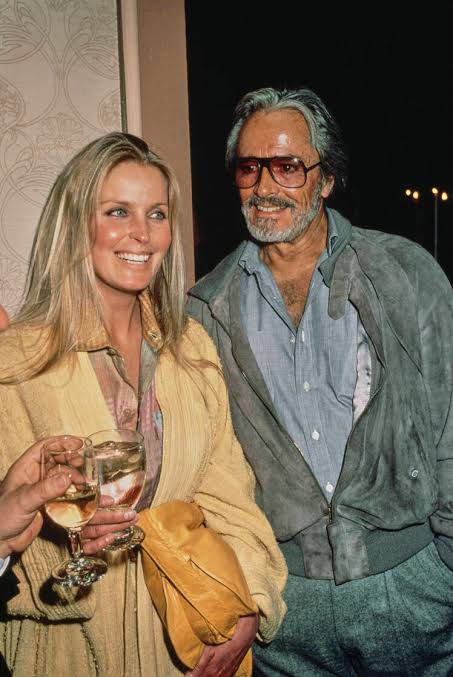
John Derek died of heart failure in 1998, ending a marriage that had lasted 22 years. Bo has said she didn't date at all for five years afterward, not out of some vow of loyalty, she was open to it, but nothing clicked. In 2002 she was set up on a blind date with actor John Corbett at an Academy Awards after-party. They were together for 18 years before finally marrying in 2020, and now split their time on a California ranch with horses and German Shepherds, living, by her own description, a much quieter life than the one Svengali, Inc. was built to sell.
Horses, Congress, and a Very Different Kind of Public Life
The second half of Bo Derek's public life has almost nothing to do with nudity at all. She's a serious horsewoman, breeding Portuguese Lusitano horses on her 130-acre Santa Ynez Valley ranch, and wrote a memoir, Riding Lessons: Everything That Matters in Life I Learned From Horses, built entirely around that side of her. She's also lobbied Congress directly on the American Horse Slaughter Prevention Act and was later appointed to the California Horse Racing Board, a nomination that ran into enough resistance to require Senate confirmation. One colleague who watched her work the issue put it simply: "Bo Derek can get to anybody's congressman."
What She Says About It Now
Looking back on the image that made her famous, Derek has been unusually clear-eyed about how manufactured it all was. "I realize how artificial it is, beauty," she said at 58. "I realize that it doesn't last forever, that's for damn sure." She's also pointed out the impossible bind that comes with aging as a former sex symbol, getting praised for skipping cosmetic surgery in one breath and criticized for not doing more in the next. It's a strange kind of consistency: the same woman who once said she objectified herself on purpose is now just as blunt about what that decision cost her, and just as unbothered about saying so out loud. A very different kind of Hollywood sex symbol, one who spent her career trying to avoid exactly the role Bo Derek ran toward, ended up in roughly the same place: neither woman ever got to just be an actress.