Archduke Ludwig Viktor: A Habsburg Rebel in a Conservative Era
Updated: Sep 2

Emperor Franz Joseph I ran the Austro-Hungarian Empire for 68 years with a rigid sense of duty that left almost no room for personal weakness, in himself or in his family. His youngest brother spent decades testing exactly how far that tolerance stretched. Archduke Ludwig Viktor was openly gay in a court built entirely around appearances, and for most of his life his family simply let it be. Then a brawl in a public bathhouse forced the emperor's hand, and he banished his own brother from Vienna for good.
Within the family they called him Luziwuzi. Outside it, almost nobody was allowed to say what everyone already knew.
Quick Answers
Who was Archduke Ludwig Viktor? The youngest brother of Emperor Franz Joseph I of Austria, born in 1842, known for his art patronage, his refusal to marry, and his open homosexuality within a court that publicly pretended not to notice.
Why was he exiled from Vienna? After years of quietly tolerated scandal, an incident at a Vienna men's bathhouse in the early 1900s became public enough that Franz Joseph ordered him to leave the capital permanently and live out his life near Salzburg.
Did his family know he was gay? Yes. It was an open secret inside the family, tolerated with some affection, but kept hidden from the public through the strict press censorship of the era.
How did he die? He died at Schloss Klessheim near Salzburg on 18 January 1919, aged 76, a few weeks after the Habsburg monarchy itself had collapsed.

Born Into the Habsburg Machine
Ludwig Viktor Joseph Anton was born on 15 May 1842, the youngest child of Archduke Franz Karl and Princess Sophie of Bavaria. His much older brothers included Franz Joseph, who became emperor in 1848, and Maximilian, who would go on to a short and disastrous reign as Emperor of Mexico. As the baby of the family, Ludwig Viktor grew up indulged and cosseted, and within the household he picked up two affectionate nicknames, Luziwuzi and Bubi.
Like every Habsburg male, he was expected to build a military career and support the family's political interests. He went through the motions, eventually reaching the rank of General of the Infantry, but he had no real appetite for either soldiering or governance. Contemporary accounts describe him as entertaining and quick-witted, with a sharp tongue that made him both good company and, at times, genuinely feared.
The Marriages He Refused
Ludwig Viktor's mother Sophie had arranged advantageous matches for her other children, and she tried repeatedly to do the same for him. The first serious prospect was his cousin, Duchess Sophie Charlotte in Bavaria. He turned her down flatly. Sophie Charlotte later became engaged to King Ludwig II of Bavaria, another monarch widely believed to be gay, and that engagement also collapsed.
A second attempt came in 1863, when his brother Maximilian, about to leave for Mexico, urged him to consider marrying Princess Isabel of Brazil, daughter of Emperor Pedro II, reasoning that the match might extend Habsburg influence into Latin America. Maximilian wrote to Franz Joseph that Ludwig Viktor was "anything but pleased with the idea" and asked the emperor to order him into the marriage. Franz Joseph declined to force the issue, and the match never happened.
In a family whose marriages were treated as instruments of dynastic strategy, refusing not one but two arranged matches was itself an act of defiance.

An Open Secret
Ludwig Viktor's homosexuality was never really hidden from the people who knew him. What kept it out of public view was the Habsburg court's strict press censorship, which made it politically impossible for Austrian newspapers to report anything unflattering about the imperial family. Most surviving descriptions from the period rely on careful, veiled language rather than saying anything outright.
One of the more candid accounts comes from Princess Nora Fugger, a contemporary memoirist who moved in the same aristocratic circles. She was no admirer of the archduke, describing him as "completely different from his brothers, adept at neither military nor artistic matters, puny, unmanly, affected and of repellent appearance," a description that, however unkind, was clearly gesturing at something beyond simple criticism of his character.
Franz Joseph, otherwise famous for his rigid sense of duty, treated his youngest brother with something closer to protective tolerance for most of his life. His sister-in-law, Empress Elisabeth, was less forgiving, and accused Ludwig Viktor of stirring up family intrigue.
A Life Built Around Art Instead of Power
the architect Heinrich von Ferstel to design a grand city palace on Vienna's Schwarzenbergplatz, completed in the mid-1860s, which became the setting for his salons and gatherings. That building still stands today, now used as a rehearsal and performance space for the Vienna Burgtheater.
His main residence, though, was Schloss Klessheim, a baroque palace four kilometres outside Salzburg that Franz Joseph handed him in 1866. He had it extended with a winter residence in 1881, and filled both properties with art, silver, porcelain and furniture. According to Dorotheum, the Vienna auction house that eventually sold off his estate, he had a particular fondness for watercolours, especially by Franz von Alt, who painted Klessheim itself more than once. The grounds ran to a swimming pool, a bathhouse and a tennis court, hardly the trappings of a prince with no interest in comfort.

His philanthropy followed the same pattern as his art collecting, generous and public-facing. He funded a primary school near Salzburg, supported the Society of St Vincent de Paul, and organised relief efforts after a serious regional flood in 1899. In Salzburg especially, he became a genuinely popular local figure and patron of the city's arts society, well before his exile made the city his permanent home.
That popularity had limits. Officers stationed in Salzburg were quietly instructed not to accept his invitations, on the unofficial grounds of what contemporary records describe only as his "unnatural inclinations," a telling sign that his reputation followed him even to the city that otherwise welcomed him.

The Scandal at the Bathhouse
For decades, Franz Joseph tolerated his brother's private life without public consequence. That changed in the early 1900s, after an incident at Vienna's Central-Bad, a well-known men's bathhouse where Ludwig Viktor was a regular. According to Nora Fugger's own account, the archduke made an unwanted advance that ended in a physical altercation: "One fine day a real scandal came to pass, a brawl in a public baths. It was said that the archduke had had his ears boxed and been forced to take to his heels."
Fugger noted that the story reached the emperor "in the most lurid colours." Whatever the exact details, the fact of an ordinary subject striking a member of the imperial family made this impossible to bury quietly the way earlier incidents had been. Outraged, Franz Joseph ordered his brother to leave Vienna immediately and take up permanent residence at Schloss Klessheim. He reportedly joked, with some bitterness, that his wayward brother should be assigned a ballerina as an aide-de-camp to keep him out of trouble.
Why the Emperor Finally Drew the Line
Historians studying Habsburg family records have never fully settled why Franz Joseph, after tolerating his brother's conduct for so long, suddenly cut him off. One theory points to Franz Ferdinand, the heir to the throne, as a driving force behind the banishment. Franz Ferdinand had fought his own bitter, years-long battle with the emperor over his wish to marry Sophie Chotek, a countess without the noble rank required of an imperial consort, a fight that only ended in 1900 when Franz Joseph allowed the marriage on the condition it be morganatic, stripping Sophie and their children of succession rights and court privileges.
Ludwig Viktor had been one of the more vocal opponents of that marriage within the family. Franz Ferdinand, according to Habsburg historians, never forgave him for it, and may well have used the bathhouse scandal as the opening he needed to finally push his uncle out of Vienna for good.

Exile in Salzburg
Banished from the capital in his early sixties, Ludwig Viktor rebuilt something like his old life at Klessheim. He hosted informal musical evenings, kept collecting art, and continued his local charitable work. Salzburg society, largely removed from the stiff formality of the Viennese court, welcomed him warmly, and he remained a popular fixture of local social life for the rest of his years, even as he never set foot in Vienna again.
His final years were quieter and harder. In 1915, in the middle of the First World War, his family had him placed under a form of legal guardianship after he was declared of unsound mind, likely the effects of age-related dementia. He died at Klessheim on 18 January 1919, at 76, just weeks after the Habsburg monarchy he'd been born into had formally ceased to exist. He chose burial not in Vienna's Imperial Crypt alongside most of his relatives, but in the local cemetery at Siezenheim, near the Salzburg home that had become his by force rather than choice.

His art collection outlived him by a few years. Between April 1921 and February 1922, Dorotheum auctioned off the entire contents of Klessheim in a sale that ran 54 days and moved more than 7,000 lots, still the largest single auction in the house's history. What had been assembled as one man's private world of taste and refuge was scattered across hundreds of new owners within a few years of his death, along with most memory of who he'd actually been.
Why This Story Stayed Obscure
Ludwig Viktor has never had an English-language biography. The only book-length study of his life, Helmut Neuhold's Das andere Habsburg ("The Other Habsburg"), was published in German in 2008 and has never been translated. It's part of the reason his story circulates mostly in fragments and family anecdotes rather than as settled history, and part of why so much online writing about him leans on vague, unnamed "historians" rather than citing anything specific. The clearest primary material that does exist, like Nora Fugger's memoir, was written by people who knew him personally but had every reason to describe his life in careful, coded language rather than plainly.

He Wasn't the Only One
Ludwig Viktor's life overlapped almost exactly with that of Henry Cyril Paget, 5th Marquess of Anglesey, a British aristocrat nicknamed "the Dancing Marquess." Paget converted his family's chapel at Plas Newydd into a 150-seat private theatre, performed in elaborate silk costumes, and spent his fortune on jewellery, furs and extravagant productions until he died bankrupt in 1905 at just 29. His marriage to his cousin Lilian Chetwynd lasted only a few weeks, later annulled for non-consummation. His own family worked for decades to erase him from its history, a story covered in full in Henry Cyril Paget: The Dancing Marquess of Anglesey. Unlike Ludwig Viktor, Paget's sexuality has never been definitively established by historians, but his flamboyant persona was enough that the National Trust featured him on the cover of its members' magazine in 2017 as part of an LGBTQ+ history campaign.
The two men's societies handled scandal differently. In the Habsburg court, the approach was silence: private tolerance so long as public appearances held, and quiet internal exile once they didn't. In Britain, the same period saw the far more public 1895 trial and imprisonment of Oscar Wilde, a reminder that even without Ludwig Viktor's rank, defying convention in Victorian Britain could carry a much harsher, more public price.

Frequently Asked Questions
Did Ludwig Viktor ever marry?
No. He turned down at least two arranged matches proposed by his family, including a cousin, Duchess Sophie Charlotte in Bavaria, and a proposed union with Princess Isabel of Brazil.
Was Ludwig Viktor removed from the line of succession?
No formal change to his succession rights is recorded. His banishment from Vienna in the early 1900s was a personal and social punishment imposed by Franz Joseph, not a legal stripping of his Habsburg status.
Where is Ludwig Viktor buried?
At Siezenheim Cemetery near Salzburg, not in Vienna's Imperial Crypt where most Habsburg family members were laid to rest.
You Might Also Like
For another well-known figure whose sexuality was persecuted rather than quietly tolerated, see Alan Turing: Code Breaker, Computer Visionary, WW2 Hero, and Persecuted Gay Man That Died a Criminal.
Ludwig Viktor's costume balls were far from unique for the era. See Drag in the Lecture Halls: Estonian Frat Boys and the Cross-Dressing Stage Tradition, 1870-1910 for a very different corner of the same period.
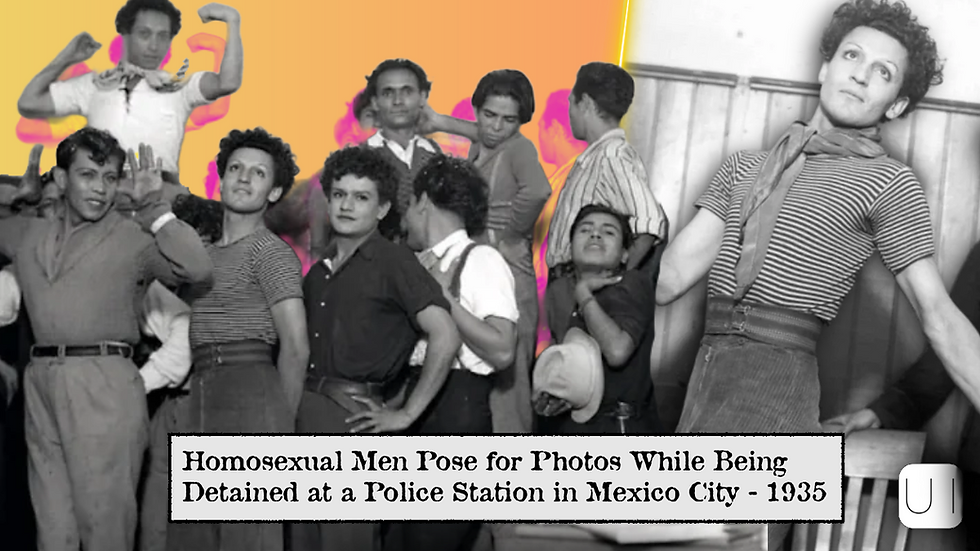
For a stark reminder of how much more dangerous it was to be gay outside the protection of an imperial title, see Homosexual Men Pose for Photos While Being Detained at a Police Station in Mexico City - 1935.