

The Vintage Erotic Photography ofJacques Biederer and Studio Biederer
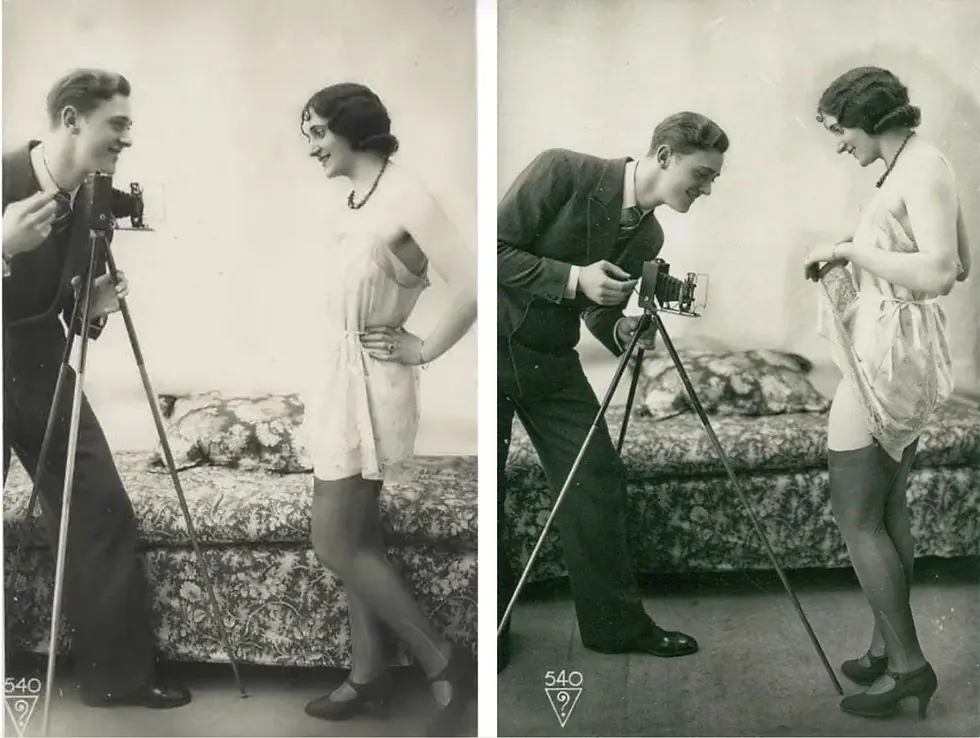
On a quiet Parisian boulevard in the years before the First World War, a modest photography studio began producing images that would quietly shape the future of erotic art. At first glance the photographs were playful, theatrical and often humorous. Yet behind the velvet curtains, corsets and elaborate poses lay something quietly radical. The images created by Jacques and Charles Biederer would become some of the earliest examples of what we now recognise as fetish photography.
Today the name Biederer appears regularly in collections of vintage erotic imagery, yet the story behind the brothers is far more complex than the photographs alone might suggest. Their work sits at the intersection of art, censorship, sexuality and tragedy.
Operating from Paris during the early twentieth century, the Czech born photographers produced thousands of staged erotic photographs that circulated discreetly across Europe. Their studio became known for its unusual themes of domination, corsetry and playful role reversal.
The story ends in one of the darkest chapters of European history. Both brothers were deported during the Nazi occupation of France and murdered in Auschwitz in 1942. The survival of their photographs therefore carries an additional historical weight. They are not simply provocative curiosities but fragments of a creative world that was violently interrupted.
From Prague to Paris
Jacques Biederer was born in Prague in the late nineteenth century, at a time when the city formed part of the Austro Hungarian Empire. Prague already had a lively photographic culture, but for ambitious photographers there was one place that held particular promise. Paris was widely regarded as the artistic capital of Europe.
By the early twentieth century Paris was a centre for painters, writers, performers and photographers. The city also possessed a thriving commercial market for portrait photography. Studio photographers documented actors, dancers, aristocrats and tourists. Erotic photography existed as well, though it occupied a complicated position between art and illegality.
Jacques Biederer moved to Paris in 1913, bringing his younger brother Charles into the business soon afterwards. The brothers opened a photographic studio at 33 Boulevard du Temple, an address that would become associated with their work for decades.
Initially the studio produced fairly conventional portrait photography. Like many studios of the era, they photographed women in fashionable clothing and occasionally in lingerie. Such images were not particularly unusual in the Paris of the 1910s and 1920s. Photography magazines and theatrical publicity materials often featured glamorous portraits of actresses and dancers.
Yet Jacques Biederer soon began pushing the boundaries of what the studio produced.
The Gradual Move Toward Erotic Photography
The shift toward erotic imagery happened gradually. Early photographs featured models wearing lingerie or posed in suggestive positions. These pictures were still relatively restrained by modern standards. The emphasis remained on composition, lighting and theatrical posing.
The Biederer studio soon began producing classical nude studies. Such photographs often borrowed visual cues from painting and sculpture, presenting the body as an artistic subject rather than something purely erotic.
However, by the 1920s and early 1930s the brothers began exploring themes that were far more unusual for the time. Their images increasingly incorporated elements of fetishism, particularly corsetry and dominance. In some scenes women disciplined male partners using whips or riding crops. In others models played elaborate roles involving tight lacing, theatrical punishment or playful humiliation.
These images were striking not only because of their subject matter but also because of the way they were staged. Many Biederer photographs resemble miniature theatrical productions. The sets included furniture, costumes and props that helped create a narrative across several images.
The Studio at Boulevard du Temple
The studio at Boulevard du Temple became the centre of the Biederer operation. Over time the business used several names, including Studio Biederer and Ostra Studio. Photographs were usually signed simply “Biederer”, which has made it difficult for historians to distinguish precisely which brother was responsible for each image.
Most evidence suggests that Jacques was the principal photographer and creative force behind the studio. Charles assisted with lighting, staging and the running of the business. Together they developed a distinctive style that combined humour, theatricality and erotic suggestion.
Their photographs were typically produced in small series. A set of images might depict a story unfolding over several photographs. One sequence might show a man being punished by a woman dressed as a dominatrix. Another might show two women teasing or disciplining a male partner.
Despite the provocative themes, the photographs rarely appear hostile or cruel. The expressions of the models often suggest amusement or playfulness. In many images the male subject seems to be participating willingly in the scene.
This tone distinguishes the Biederer photographs from later fetish photography, which sometimes emphasised harsher forms of domination. In contrast, the Biederer scenes often feel closer to theatrical comedy.
Corsetry and the Fascination with Tight Lacing
One recurring element in the Biederer archive is the presence of corsets. Corsetry had long been part of European fashion, but by the early twentieth century it had also become an object of fascination within certain erotic subcultures.
Some individuals were intrigued by the physical transformation created by tight lacing, which could dramatically alter the shape of the waist and torso. Biederer photographed several elaborate corset designs, sometimes focusing closely on the garments themselves.
These images often emphasised the process of lacing, with attendants tightening the corset while the model posed theatrically. The corset thus became both a fashion object and a symbol of control.
Distribution and the Shadow Economy of Erotica
One question often asked by historians is how such photographs circulated during a period when many countries had strict laws governing obscene material.
France occupied an ambiguous position in this regard. While certain publications were banned, enforcement was inconsistent and often depended on how material was presented. Photographers sometimes framed erotic images as artistic studies, theatrical scenes or costume photography.
Biederer photographs were typically distributed as small prints, postcards or cabinet cards. Many were sold through specialist bookshops or through mail order catalogues. Collectors could purchase series of images that told a loose narrative.
Because the prints were small and easily concealed, they circulated discreetly among private collectors across Europe. Over time the photographs developed a reputation among enthusiasts of fetish imagery.
Early Fetish Films
In addition to still photography, the Biederer studio reportedly produced short erotic films during the 1920s and early 1930s. These films belonged to a genre often described as “stag films”.
Such films were usually very short silent reels intended for private viewing. Surviving examples suggest that the Biederer productions followed the same tone as their photographs. They were playful, theatrical and rarely explicit by modern standards.
Many of these films have been lost, but historians believe they played an important role in the development of early underground erotic cinema.
Influence on Later Fetish Photography
Although the Biederer brothers worked decades before the rise of modern fetish publications, their influence can be traced in later artists.
American fetish photographer Charles Guyette began producing bondage themed imagery in the 1930s and 1940s. His work helped inspire later photographers such as Irving Klaw and John Willie, the publisher of the magazine Bizarre.
These later figures expanded the visual vocabulary of fetish imagery in the mid twentieth century. However, many of the themes they explored had already appeared in the staged tableaux of the Biederer studio.
The emphasis on narrative sequences, elaborate costumes and playful domination scenes can all be seen in Biederer photographs produced decades earlier.

A Culture of Experimentation in Interwar Paris
The environment of Paris between the First and Second World Wars also played an important role in shaping the Biederer aesthetic.
During the 1920s and 1930s the city attracted artists and writers from across Europe and the United States. Surrealist painters experimented with dream imagery and unconventional symbolism. Writers explored sexuality in ways that challenged traditional morality.
Within this broader cultural landscape, the Biederer photographs can be seen as part of a wider exploration of identity, performance and erotic imagination.
Their images were not produced in isolation. They belonged to a city that encouraged experimentation, artistic risk and a certain tolerance for unconventional ideas.
The German Occupation and the End of the Studio
The creative world that had allowed the Biederer studio to flourish came to an abrupt end during the Second World War.
In June 1940 German forces occupied Paris. Anti Jewish legislation introduced by the Nazi regime and enforced by the Vichy government quickly transformed everyday life for Jewish residents of France.
The Biederer brothers were Jewish, which made them immediate targets under the new racial laws.
Records held by the Archives of the Contemporary Jewish Documentation Centre show that Jacques Biederer was deported on 17th July, 1942 as part of Convoy No. 6, which departed from the Drancy internment camp for Auschwitz.
Charles Biederer was deported earlier, on 25th June, 1942.
According to the archives of the Auschwitz Birkenau Museum, Charles died there on 15th August, 1942. Jacques did not return either.
The studio at Boulevard du Temple disappeared, and with it a large portion of the brothers’ archive.
Rediscovery of Their Work
For decades the Biederer photographs circulated quietly among collectors of vintage erotica. Because the studio had vanished and documentation was limited, the identity of the photographers remained partially obscure.
During the late twentieth century historians and collectors began identifying the images more clearly. Prints appeared in auctions and private collections, allowing researchers to piece together the story of the Biederer studio.
Today their photographs are recognised as important examples of early fetish imagery and experimental erotic photography.
What once circulated as underground curiosities are now studied as historical artefacts that reveal how sexuality, humour and performance intersected in early twentieth century visual culture.
A Complicated Legacy
Looking at the Biederer photographs today, it is easy to focus solely on their provocative elements. Yet they also reveal something deeper about the social world in which they were created.
The images show a playful exploration of power, costume and role playing long before such themes entered mainstream discussions of sexuality. They also reflect the theatrical culture of Paris during the interwar years.
At the same time, the fate of the brothers reminds us how fragile artistic communities can be during periods of political upheaval. The Nazi deportations destroyed not only individual lives but also entire creative networks.
The survival of the Biederer photographs therefore serves as both a record of artistic experimentation and a reminder of the cultural losses caused by the Holocaust.
Nearly a century after they were produced, the images continue to provoke curiosity, debate and historical interest. They remain unusual, sometimes humorous and occasionally bewildering.
But above all they capture a moment when photography became a stage on which fantasy, performance and imagination could briefly flourish.
Sources
The Photographic Journal – “The Biederer Brothers: Erotic Art in Interwar Paris.”
Kinsey Institute Archives, Indiana University – Collection of 1920s French erotic photography.
The Guardian: “Eroticism and Modernism in Early 20th Century Paris Photography.”
Biederer, Jacques & Charles: Atelier Biederer Photographs, Musée d’Orsay Archives, Paris.
Photoseed.com – “Jacques and Charles Biederer: Pioneers of Art Deco Eroticism.”
Le Monde de la Photo – “La Maison Biederer et l’Âge d’Or de la Photographie Érotique à Paris.”


