

The Gorgeous Letters Jim Henson Wrote to his Children and Friends Before he Died
- May 17
- 12 min read
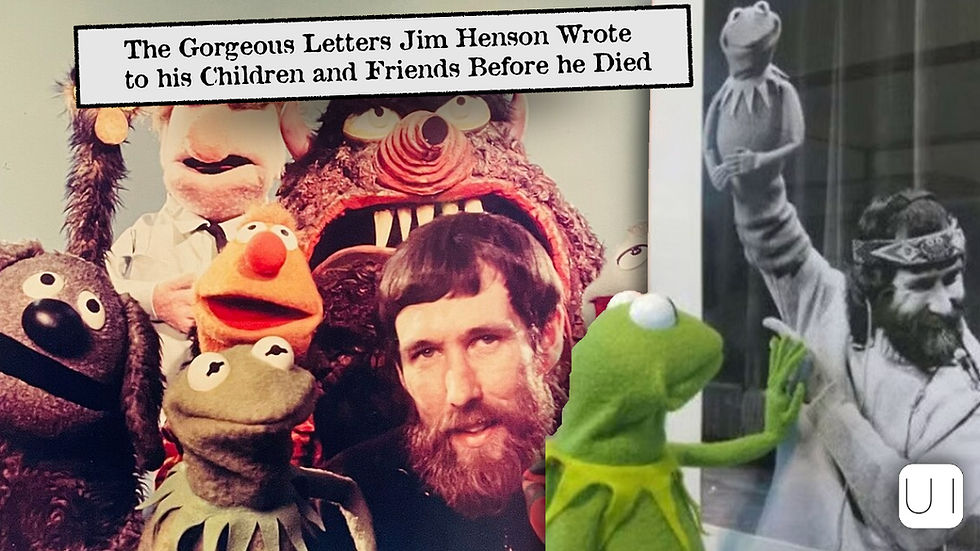
On the morning of May 16, 1990, Jim Henson died in a New York hospital at 1:21 a.m., just hours after being admitted. He was 53. The world learned what had happened and didn't quite know how to process it. This was the man who had made Kermit the Frog cry and made Miss Piggy indignant and made Fozzie Bear the kind of optimist who told bad jokes without apology. He was, in the words of one colleague, as close as a human being could get to a saint. And he'd gone from a sore throat to dead in less than two weeks.
What made it worse was how unnecessary it all felt. Doctors said later that had Henson arrived at the hospital even half a day earlier, he almost certainly would have survived. Instead, he spent his final days downplaying his symptoms, telling his daughter Cheryl he was just tired, flying back from visiting family in North Carolina, and quietly clearing his throat in an airport to test his voice for a recording session the next morning. He never made it.
But four years before any of that happened, in 1986, Jim Henson sat down and wrote two letters to be opened after his death. They are, in many ways, the most revealing things he ever produced. Not because they're dramatic, but because they're so completely, recognisably him. History has no shortage of famous people who left behind letters meant for posterity, but few carry the tone of these ones: funny, warm, and completely unburdened by self-importance. If you've ever read about Kurt Cobain's final days or the last words of other cultural icons, you'll know how rare that quality is.
The Man Mississippi Made
James Maury Henson was born on September 24, 1936, in Greenville, Mississippi, the younger of two sons. His father, Paul Ransom Henson Sr., was an agronomist working for the U.S. Department of Agriculture, a background that meant the family moved when work required it. Henson grew up in nearby Leland before the family eventually relocated to University Park, Maryland, near Washington D.C., when he was around ten years old.
He was raised as a Christian Scientist, a faith that tends to treat prayer as the primary response to illness. He later drifted away from organised religion altogether, formally writing to a Christian Science church in 1975 to notify them he was no longer a member. By then his spiritual outlook had become something harder to categorise: a warm, broadly humanist belief in the goodness of people and the value of joy. The letters he'd write eleven years later would carry that exact flavour. It's a disposition not unlike the one behind how Alcoholics Anonymous started, another American story rooted in the idea that human beings are fundamentally worth saving.
The event he'd cite most often as the biggest moment of his adolescence wasn't graduation, or a relationship, or a sporting triumph. It was the arrival of the family's first television set. He was transfixed by it immediately, drawn in particular to the early TV puppetry of Burr Tillstrom on Kukla, Fran and Ollie and the work of Bil and Cora Baird. Radio ventriloquist Edgar Bergen was another influence. The medium and the art form collided in his imagination and never separated.
He enrolled at the University of Maryland as a studio arts major, considering a future as a commercial artist. What changed his direction was a puppetry class in the applied arts department. It connected to craft and textiles work in the college of home economics, and he graduated in 1960 with a Bachelor of Science degree in home economics. Not the most conventional route to becoming the most famous puppeteer in history, but Henson wasn't a conventional person.
A Coat, a Ping Pong Ball, and an Empire
The thing that became Kermit the Frog started life in the most unglamorous way imaginable. Henson made it from a halved table tennis ball and fabric cut from one of his mother's old spring coats, with a denim sleeve from a pair of jeans for the puppeteer's arm to slide into. The character didn't start out as a frog. He evolved into one gradually, his personality growing more layered as Henson grew more confident. Henson would later describe Kermit as "literally my right hand."
That primitive version of Kermit first appeared on Sam and Friends, a five-minute puppet show Henson created for WRC-TV in Washington D.C. during his freshman year at college. He enlisted a fellow student named Jane Nebel to help him. They'd get married in 1959. The show ran for eight years, winning a local Emmy in 1958, and it gave Henson the space to experiment with techniques that would permanently reshape how puppetry worked on television.
The key insight was simple but transformative. Instead of pointing the camera at a static puppet theatre, Henson used the camera frame itself as the stage. He moved off-camera and worked the puppet within the lens's field of view. He built his characters from soft foam rubber instead of carved wood so they could convey a wider range of emotion through their movements. He used rods rather than strings to control his Muppets' arms, giving him precision no marionette could match. In 1958, he and Jane co-founded Muppets Inc., the company that would eventually become The Jim Henson Company.
The word "Muppet" itself was essentially invented. Henson told interviewers for years that it was a portmanteau of "marionette" and "puppet," but he eventually came clean. "It was really just a term we made up," he said. "Basically, it was just a word that we coined."
The 1960s brought an unexpected revenue stream: advertising. Henson's Muppets appeared in commercials for Wilson Meats, Royal Crown Cola, Claussen's Bread, La Choy, and Frito-Lay, where an early prototype of Cookie Monster promoted Munchos potato snacks. The Wilkins Coffee ads were particularly notable for their peculiar formula: Kermit would promote the coffee and something violent would befall anyone who didn't drink it. One Claussen's Bread ad had Kermit dangling from a window while a character named Mack slammed the window on his fingers for failing to bring bread. Henson, working inside a commercial system he'd eventually transcend, was already finding creative ways to make it memorable. The decade was full of unlikely creative collisions in popular culture. Over in California, Charles Manson was moving in with a Beach Boy while Henson was making his puppets throw each other out of windows to sell bread.
Rowlf the Dog, a piano-playing anthropomorphic character, became the first Muppet to make regular appearances on a network programme, landing a recurring spot on The Jimmy Dean Show in the early 1960s. During this same period Henson was also making experimental films. His nine-minute short Time Piece earned an Academy Award nomination for Best Live Action Short Film in 1966. He wasn't just the puppet man. He never was.
Sesame Street and the Show That Changed Everything
In 1969, Joan Ganz Cooney and the team at the Children's Television Workshop approached Henson about a new educational programme they were developing. Henson hesitated. He'd spent years trying to position the Muppets as entertainment for everyone, not just children, and he worried about being boxed in. He signed on anyway, and what he and his team created for Sesame Street would define the childhoods of multiple generations across dozens of countries.
The characters he developed for the show are among the most recognised in the history of television: Grover, Big Bird, Oscar the Grouch, the Count, Bert and Ernie, Cookie Monster. Sesame Street eventually broadcast in over 100 countries and was translated into 14 different languages. Henson's puppeteer Frank Oz, who'd joined the team in 1963, was his closest creative collaborator throughout. Their pairing was described by Life magazine as a comedy duo as enduring as Laurel and Hardy or Burns and Allen.
The Muppet Show arrived in 1976, but only after American network television passed on it. A British producer named Lew Grade agreed to fund the first season, and the show aired in syndication in the U.S. It used Hollywood guest stars as straight-men to the chaos of the Muppet backstage world, and it ran for five seasons. At its peak it had 235 million viewers each week across more than 100 countries, making it one of the most-watched programmes in television history. Henson voluntarily ended it in 1981, worried that quality would start to slip if it ran longer. The Muppet Movie followed in 1979, The Great Muppet Caper in 1981, and The Muppets Take Manhattan in 1984. Like the making of the Blues Brothers, which aired the same year as the first Muppet Movie, these productions combined comedy, live performance and genuine craft in ways that didn't fit neatly into any existing category.
The Dark Crystal in 1982 and Labyrinth in 1986 were attempts to push into darker, stranger territory. Both were commercial disappointments on release, though both became cult films over time. Labyrinth in particular stung. Jane Henson described the film's failure as "a real blow." Henson reportedly told his son Brian, "What did we do wrong?" That same year, 1986, he and Jane formally separated, though they never divorced and she remained close to him for the rest of his life.
The Disney Deal and the Final Days
By the late 1980s, Henson was deep in talks with Disney about a potential sale of his company and characters. The figure being discussed was around $150 million. Henson's only non-negotiable: Sesame Street stayed out of the deal. Disney's chairman Michael Eisner wanted it included. Henson refused. He'd told people he wanted Disney or no one, and the prospect of handing the business side to someone else appealed to him. He wanted to spend more time on the creative work.
His colleague Frank Oz, in a 2021 interview, said something that's hard to shake: "The Disney deal is probably what killed Jim. It made him sick." The negotiations were grinding and stressful. Henson was simultaneously completing production on The Muppets at Walt Disney World, a TV special, developing Muppet Vision 3D, an attraction for the Disney parks, and working on early ideas for a television series tentatively titled Muppet High.
On May 4, 1990, he made what would be his last public appearance, on The Arsenio Hall Show, performing as Kermit. He told his publicist he was tired and had a sore throat. He flew home to New York, then flew back out again to North Carolina with his daughter Cheryl to visit his father Paul and stepmother Bobby. He wasn't well, but he'd brush it off. "I'm just tired," he told Cheryl. At the airport heading back to New York, he kept clearing his throat, testing his voice, saying "Hi ho, Kermit the Frog here" in quiet repetition, preparing for a recording session the next morning. Cheryl later said the repetition was unlike him.
By Monday, May 14, he'd cancelled the recording session, which was unheard of. Early on May 15, at around 2 a.m., he told Jane he felt like he was dying. He was coughing up blood. He still didn't want to bother anyone. Jane drove him to New York Hospital. Doctors found his lungs had developed multiple abscesses from a Group A streptococcal infection that had been spreading quietly for days. He was placed on a ventilator. Multiple antibiotics were given. The medicine killed most of the infection, but the damage to his organs was already catastrophic: kidney failure, heart failure, his blood unable to clot. At 1:21 a.m. on May 16, 1990, he died.
The cause was ultimately classified as organ dysfunction caused by streptococcal toxic shock syndrome from Streptococcus pyogenes. Doctors said the same infection in a different patient, caught earlier, would very likely have been straightforward to treat. In the days following his death, false rumours spread suggesting AIDS was involved, partly because several prominent men had recently died from AIDS-related illness. The hospital's intensive care director refuted those rumours directly and quickly. It was a reminder of how quickly a narrative can form around a sudden, unexpected death, and how hard it can be to dislodge. The same thing happened with Sid Vicious, whose death the previous year had generated its own mythology that took years to unpick.
He was cremated. In 1992, his ashes were scattered near Taos, New Mexico. He died on the same day as Sammy Davis Jr., and the two deaths shared the news cycle. Henson received a posthumous star on the Hollywood Walk of Fame in 1991. He was named a Disney Legend in 2011, twenty-one years after the deal he'd been trying to complete when he fell ill.
The Letters
Jim Henson wrote both letters in 1986, the same year he and Jane separated, the same year Labyrinth came out. He was 49. He had no particular reason to think he was going to die any time soon.
The first letter is addressed directly to Henson’s five children, all of whom were aged between 19 and 30 at the time of his death. The site Letters of Note has published the complete text:
“First of all, don’t feel bad that I’m gone. While I will miss spending time with each of you, I’m sure it will be an interesting time for me and I look forward to seeing all of you when you come over. To each of you I send my love. If on this side of life I’m able to watch over and help you out, know that I will. If I can’t, I’m sure I can at least be waiting for you when you come over. This all may sound silly to you guys, but what the hell, I’m gone—and who can argue with me?
Life is meant to be fun, and joyous, and fulfilling. May each of yours be that—having each of you as a child of mine has certainly been one of the good things in my life. Know that I’ve always loved each of you with an eternal, bottomless love. A love that has nothing to do with each other, for I feel my love for each of you is total and all encompassing. Please watch out for each other and love and forgive everybody. It’s a good life, enjoy it.”
The second letter is addressed ‘to friends and family’, and contains Henson’s reflections on death and his wishes for his funeral.
“I’m not at all afraid of the thought of death and in many ways look forward to it with much curiosity and interest. I’m looking forward to meeting up with some of my friends who have gone on ahead of me and I will be waiting there to say hi to those of you who are still back there. I suggest you first have a nice, friendly little service of some kind. It would be lovely if some of the people who sing would do a song or two, some of which should be quite happy and joyful. It would be nice if some of my close friends would say a few nice, happy words about how much we enjoyed doing this stuff together. Incidentally, I’d love to have a Dixieland band play at this function and end with a rousing version of ‘When the Saints Go Marching In’.
Have a wonderful time in life, everybody; it feels strange writing this kind of thing while I’m still alive, but it wouldn’t be easy to do after I go.”
Both memorial services honoured his wishes closely. The one at the Cathedral of St. John the Divine in New York and the one at St. Paul's Cathedral in London both featured hymns, Bible readings, a solo from Big Bird, and a collective performance of "Just One Person" by the puppeteers alongside the Muppet characters. Brian Henson read from his father's letters. The phrase that kept returning, printed on the programmes and spoken from the pulpit, was the one his father had typed in 1986: "Please watch out for each other and love and forgive everybody. It's a good life, enjoy it."
What the Letters Tell You
People who've read a lot about Henson come away with the same impression: the letters sound exactly like him. Frank Oz described his creative partner as someone who operated with what he called "ridiculous optimism." The late Muppeteer Richard Hunt, who worked with Henson for years, said: "Jim wasn't a saint, but he was as close as human beings could get to it."
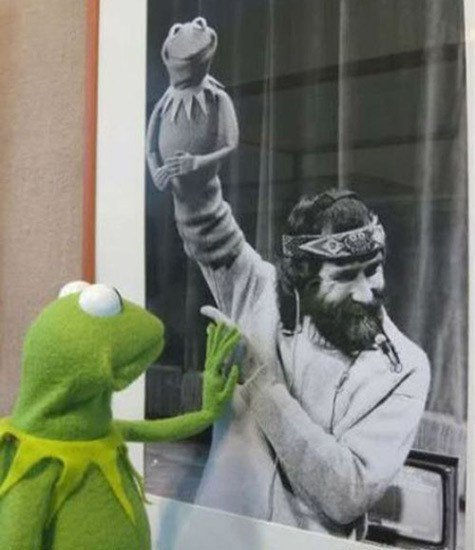
What's unusual about the letters isn't any single thing they contain. It's the consistency between who Henson was in public, who he was in the room with people who loved him, and who he was when he sat down alone to write something he knew would only be read after he was gone. There's no shift in register, no sudden gravity, no sense of a man performing a version of himself for posterity.
He was raised to believe in something bigger than himself, spent decades creating characters who modelled kindness, forgiveness, and the willingness to try things that might go badly, and then when he had the chance to address his children and his friends one final time, he told them life was good and to love each other. It would almost be too easy to dismiss as saccharine if it weren't so clearly, simply, what he meant. Not everyone who shaped pop culture left behind something that clear. John Lennon's final days were markedly different, and the words he left behind carried a different kind of weight entirely.
The original Kermit was made from a coat that belonged to his mother and half a table tennis ball. The first time he performed it, he was a university student who'd stumbled into a puppetry class. By the time the letters were written, those characters had become part of the texture of childhood for hundreds of millions of people across the world. He didn't treat that as an achievement to protect. He treated it as something that happened because he was curious and kept going.
Jim Henson died on May 16, 1990. The Disney deal fell through after his death. The Muppets eventually made it to Disney anyway, acquired in 2004. Sesame Street is still running. The letters are still out there. And the line at the end of the one he wrote to his children, the one that kept getting repeated at both memorial services, hasn't aged at all.
Please watch out for each other and love and forgive everybody. It's a good life, enjoy it.
Sources


