

Lewis Hine: The Photographer Who Helped America See Itself
- Sep 21, 2024
- 8 min read
Updated: 6 days ago

“If I could tell the story in words, I wouldn’t need to lug a camera.” – Lewis Hine
Lewis Hine spent sixteen years lying his way into factories, mines and mills across America, posing as a Bible salesman or an insurance man just to get a camera past the foreman. He measured children's heights against the buttons on his own jacket because pulling out a tape measure would have blown his cover. By the time he was done, he'd taken more than 5,000 photographs that helped end child labour in the United States, then went on to risk his life photographing ironworkers a quarter of a mile above Fifth Avenue.
Quick Answers
Who was Lewis Hine? An American sociologist turned photographer who documented child labour, immigration at Ellis Island and the construction of the Empire State Building in the early 20th century.
Did Lewis Hine take the famous “Lunch Atop a Skyscraper” photo? No. That's a common mix-up. The photo was taken at Rockefeller Center, not the Empire State Building, and the actual photographer has never been confirmed.
From Oshkosh to the Classroom
Hine was born in Oshkosh, Wisconsin, on 26 September 1874. His father died in an accident when Hine was young, and the family's modest circumstances meant he had to work to help support his mother, an early taste of the kind of labour he'd spend his career documenting. He saved up for college through a string of small jobs and eventually studied sociology at the University of Chicago, Columbia and New York University.
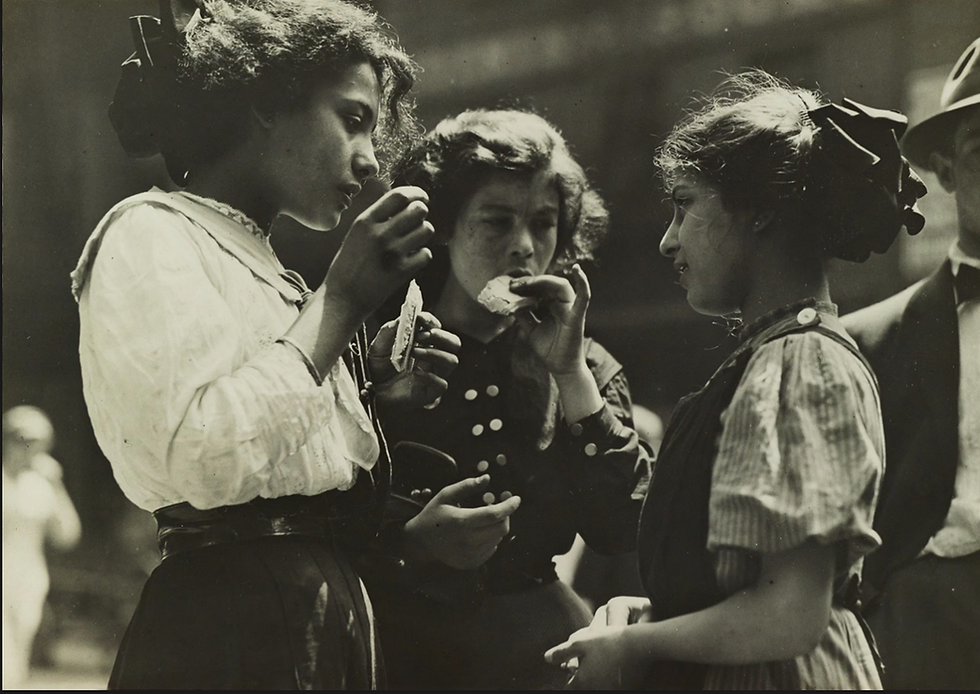
That academic grounding shaped everything that came after. Hine started teaching at New York's Ethical Culture School, a progressive institution, and began bringing his students to Ellis Island with cameras, treating photography as a tool for studying society rather than a craft for its own sake. Between 1904 and 1909 he shot more than 200 images there, of families waiting in inspection lines, mothers holding infants, fathers weighed down with bundles, turning anonymous arrivals into people with names and stories.
His personal life took shape around the same time. Hine had met a fellow student, Sara Ann Rich, back in Wisconsin in 1899, and the two married in 1904. Census records suggest they lost a first child in infancy before their son, Corydon, was born in 1912. The family later spent summers and holidays in Franklin, New York, in the Catskills, a quiet counterpoint to the grim working conditions Hine spent most of his career documenting.

The Pittsburgh Survey
Before Hine became known for exposing child labour, he spent 1907 and 1908 photographing adult labour, hired by the Russell Sage Foundation for what became known as the Pittsburgh Survey, one of the first large scale sociological studies of an American industrial city. He photographed the cramped tenement housing, open drains and overworked steelworkers of Pittsburgh's poorest neighbourhoods, building the same visual argument he'd later bring to child labour: that a photograph of a specific, named person could do more than pages of statistics. It's a project that rarely gets mentioned alongside his more famous work, but it's really where his method as a documentary photographer first came together.
Going Undercover for the National Child Labor Committee
In 1908 Hine left teaching to work as an investigative photographer for the National Child Labor Committee, a reform group pushing to end the exploitation of child workers. At the time there were essentially no federal laws stopping a five year old from working a twelve hour shift in a cotton mill or coal breaker, and employers had every incentive to keep it that way. Children were cheap and obedient, and for many poor families their wages were the difference between eating and not.
Hine's job was to get the evidence, and factory owners quickly caught on to what he was doing. Some accused him of faking his photographs and barred him outright. So he adapted. He'd talk his way in claiming to be a Bible salesman, an insurance agent or a postcard photographer there to shoot the machinery, then ask to have a child stand next to it just to show the scale. When that failed, he waited outside the gates at shift change. His gear alone weighed close to fifty pounds, a large format camera, tripod, glass plates and a magnesium flash lamp, none of it easy to hide.
The Girl Who Never Saw Her Own Photograph
One of Hine's most reproduced images is a 1910 portrait of a young spinner in a Vermont cotton mill, a barefoot girl standing before towering machinery. She told him she was 12. Other workers at the mill told him the truth, that she was actually 10, and that she'd started working there at just 8 years old.

Her real name was Addie Card, though Hine recorded it incorrectly as Addie Laird, a mistake that stood uncorrected for decades. Card lived to 94, dying in 1993, and never saw the photograph that made her one of the most recognisable faces of America's child labour era. In 1998 that same image appeared on a US postage stamp marking the centennial of child labour reform, a small, strange piece of recognition that arrived more than eighty years too late for her to see it.

What the Photographs Actually Changed
Hine's images were shown at exhibitions, printed in magazines and used in NCLC lecture materials, gradually turning an abstract debate into something people couldn't argue their way around. The pressure helped push through the Keating-Owen Act of 1916, which restricted child labour in certain industries. The US Supreme Court later struck it down as unconstitutional, but it set the template that eventually led to the Fair Labor Standards Act of 1938, the law that finally put lasting federal protections in place, two years before Hine's death.

Photographing Refugees for the Red Cross
With the worst of the child labour campaign behind him, Hine spent 1918 and 1919 in Europe photographing for the American Red Cross, documenting refugees displaced by the First World War across France and the Balkans for the organisation's own Red Cross Magazine. It was a different kind of documentary work, less about building a legal case and more about putting a human face on a humanitarian crisis for an American public largely removed from it. He carried the same instinct from his NCLC years into it, seeking out individuals rather than crowds, and the experience fed directly into the ‘work portraits’ he began producing through the 1920s, a series that shifted his focus from documenting hardship to documenting skill and craft.

A Quarter Mile Above Fifth Avenue
By the late 1920s Hine's focus had shifted from exploitation to craftsmanship. He began photographing mechanics, engineers and construction crews, drawn to the relationship between people and the machines they built. It was his neighbour, the architect Richard Shreve of Shreve, Lamb and Harmon, who suggested he document the firm's newest project: the Empire State Building.

Hine was 56 when he started, and getting the shots he wanted meant being swung out from the unfinished tower in a specially built open steel basket, hanging a quarter of a mile above Fifth Avenue with no safety harness. Workers joked that it was safer up there than on the ground. Hine later wrote that he'd always avoided reckless stunts and didn't consider this one either, though he admitted the experience gave him “a new zest.” Over about six months in 1930 he shot close to a thousand negatives, later published in his 1932 book Men at Work. One of the best known, showing a lone steelworker silhouetted against the sky, he titled Icarus, after the boy in Greek myth who flew too close to the sun.
The Famous Photo That Isn't His
Here's a correction worth making clearly: Hine is very often credited with Lunch Atop a Skyscraper, the 1932 image of eleven ironworkers eating on a beam hundreds of feet above Manhattan. He didn't take it. That photograph was shot during the construction of Rockefeller Center's RCA Building, not the Empire State Building, as part of a staged publicity campaign, and the actual photographer has never been conclusively identified. Three photographers, Charles Ebbets, Thomas Kelley and William Leftwich, were all on site that day, and the negative surfaced decades later in a commercial archive with barely any documentation attached. Hine wasn't even part of that shoot. It's one of the most reproduced images of the twentieth century, and the mix-up with Hine's genuine Empire State Building work has stuck around for close to a century.
Child labourers Soldier thrown in the air
A Difficult Ending
Hine's later career didn't match his earlier impact. Documentary photography moved on through the 1930s, and the Farm Security Administration hired photographers such as Dorothea Lange and Walker Evans to document the Great Depression in a newer visual style. Hine applied to join them more than once and was turned down each time. He picked up occasional work with the American Red Cross photographing drought relief and with the Tennessee Valley Authority, but demand for his particular approach had faded, and by the late 1930s he'd exhausted most of his savings.
Sara died just before Christmas 1939. Hine couldn't afford her funeral or cremation and had to turn to her family in Franklin, New York, for help covering the cost. He died less than a year later, on 3 November 1940, in Hastings-on-Hudson, at 66. His death barely made the news outside his hometown paper in Oshkosh. Their son Corydon later arranged for both his parents' remains to be moved to the same cemetery in Franklin, reuniting them in the town where the family had spent their happiest summers.

Corydon donated his father's remaining prints and negatives to the Photo League, a New York collective of documentary photographers. The League itself didn't last much longer, blacklisted as a supposed communist front during the anti-Communist crackdowns of the early 1950s and forced to shut down within about a decade. It wasn't until the 1960s that curators and historians began seriously reassessing Hine's work, and his archive is now split between institutions including the Library of Congress, the George Eastman Museum and the International Center of Photography.

There's a strange postscript to all this. In the 1980s, a wave of prints signed “Hine” suddenly flooded the collectors' market, well beyond what his known output could explain. One dealer grew suspicious enough to call in the FBI, and forensic testing found that much of the paper dated from the 1950s and some of the chemicals used hadn't even existed in Hine's lifetime, meaning they'd been faked decades after his death. Genuine, properly authenticated Hine prints now sell for $10,000 or more, a level of value he never saw a fraction of while he was alive and, by the end, applying for welfare.
If you're interested in photographers who used a camera to look closely at ordinary lives during roughly the same stretch of the twentieth century, our piece on Diane Arbus covers a very different photographer working with a similar instinct decades later, to see people other photography looked past.

You Might Also Like
Diane Arbus: A Brief Yet Brilliant Career
17 Year Old Stanley Kubrick's Photos of 1940s New York Prove He Was Born to Be Behind the Lens


