

George Burchett: The Life and Work of the King of Tattooists

If you have ever looked up the early history of British tattooing, the name George Burchett pops up so often it almost feels like he was everywhere. Sailors talked about him, soldiers lined up outside his shop, royalty sought him out, and circus performers trusted him to create designs that would literally define their careers. Yet his story is not flashy or outrageous. It is simply the story of someone who fell in love with tattooing long before it was fashionable and kept at it until the very end.
George Burchett’s life reads like quite the adventure. A Brighton childhood, a run-in with school authority, a stint in the Royal Navy, years spent wandering overseas, and eventually a tattoo studio in central London where the world seemed to come to him. For around fifty years he was the tattooist people talked about. Not because he tried to be famous, but because he genuinely cared about the craft at a time when almost nobody took it seriously.
Brighton Beginnings
George Burchett was born on 23 August 1872 in Brighton, the eldest of eleven children. He used to draw constantly, but the spark that really stayed with him came during a childhood trip to the Royal Aquarium in London. The Aquarium, despite its name, was more like a Victorian entertainment hall where you could find everything from performing animals to curiosities and sideshow stars.

One thing that caught young George completely by surprise was the tattooed performers. These men and women stood on stage proudly showing their skin as living canvases. For a boy from Brighton, this was something entirely new. He went home still thinking about them.
Once he had the idea in his head, George tried to recreate it using the only volunteers he had access to: his younger brother and a few schoolmates. His brother allowed him to scratch small marks into his skin in exchange for sweets. School, however, was less forgiving. His early experiments eventually got him expelled at the age of twelve.
With formal education cut short, George went straight into work, first at Muttons Hotel in Brighton and later in London repairing shoes. But he was still restless, and by seventeen he had set his mind on joining the Royal Navy. His parents refused to sign the papers, so he asked his grandmother, who happily agreed.
That decision changed the direction of his life.

Travels with the Royal Navy
Serving aboard HMS Vincent, George saw more of the world in a few years than most people would in a lifetime. The ship travelled to Africa, India, the West Indies, the Mediterranean and the Far East. Everywhere he went, he watched local tattooists with fascination. Tattooing outside Europe was far more developed and often deeply tied to tradition. He later said that these travels taught him more than anything he had learned back home.
During one voyage an able seaman named Weatherby sold him his first tattooing kit. With the enthusiasm of youth and very little hesitation, George began tattooing fellow crew members. The work was probably rough around the edges, but the practice was invaluable.
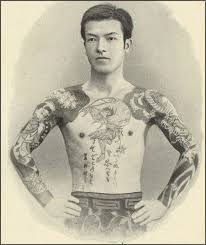
One of the defining moments of his naval years came in Japan. In Yokohama he met the tattoo artist Hori Choyo and received one of his own tattoos. Japanese tattooing had a grace and structure unlike anything in Europe. For George, it was unforgettable.
Despite the excitement of travel, naval discipline was not for him. During shore leave in Jaffa he deserted, a decision that could have ended badly if he had been caught. To survive, he briefly set up shop in Jerusalem and tattooed passing travellers. Eventually he boarded a Spanish merchant ship to escape notice and spent the next twelve years away from England.
In 1896 he returned, dropped the surname Davis and restarted life as George Burchett.
Back in London and Back to Tattooing
Returning to London, George opened a cobbler’s shop on Mile End Road. The front room sold repaired boots. The back room slowly became a tattooing space. It was modest, but word travelled quickly. If someone in the East End wanted a tattoo done properly, they were told to go to George.
He married Edith Smith Walters in 1898 and the couple settled in Bow. Around this time George met two figures who would become key to his development: Tom Riley and Sutherland Macdonald. Macdonald was the first professional tattooist in the country and had recently developed an electric tattoo machine. He saw talent in George and taught him how to use it.
The effect was immediate. George’s technique improved, his designs became sharper, and within a few years he was able to give up shoe repair entirely.

The Famous Studio on Waterloo Road
In 1904 George moved his family and business to Waterloo Road, just a short walk from Waterloo Station. It was the perfect spot. The area was always busy and soldiers passing through London for training or deployment often stopped in for a tattoo.
By the time the First World War began, his studio had become well known. Reporters occasionally visited to write features about the growing tattoo trend among servicemen. In one interview from 1917 George said, “It is a busy life now, one long rush.” He explained that most customers were soldiers or sailors, though plenty of women also came in to have regimental badges tattooed in honour of loved ones.
Descriptions of his studio give a charming sense of the place. Flash sheets covered the walls. A shelf of pigments sat beside a table scattered with china palettes. His electric machine, which journalists always described with fascination, allowed him to work quickly and cleanly. Tattooing was still seen by some as an odd trade, but when people visited George’s studio they found a surprisingly calm, tidy space.
Edith often modelled his designs. She had birds, flowers and delicate patterns tattooed by her husband, and photographs of her became well known. Her tattoos helped to show sceptical members of the public that tattooing did not have to be crude or intimidating.

A Style Shaped by Travel
George Burchett’s tattoo style blended many influences. African patterns, Asian motifs, Japanese waves and classic British imagery all found their way into his flash sheets. But what set him apart was the gentle flow of his designs. Compared with the heavy bold lines used by many American artists at the time, his tattoos had a softer, more painterly feel.
He tattooed everything from tigers, snakes, bulldogs and traditional hearts to finely shaded portraits. He could handle military badges, romantic motifs, exotic symbols and delicate floral work with equal confidence. This versatility made him popular with almost every type of client.
By the 1920s and 1930s he was attracting far more than local or working class visitors. Wealthy clients, and eventually royalty, began coming to his studio.

Among them was King Frederick IX of Denmark, who proudly displayed his tattoos throughout his life. George Burchett also tattooed King George V and King Alfonso XIII of Spain. It was unusual for royalty to seek out a London tattooist, but George’s reputation had quietly exceeded expectations.
Despite this elevated clientele, he never changed the welcoming, open nature of his shop. He tattooed soldiers, dock workers, labourers, and artists with the same respect he showed to kings.

Horace Ridler and The Great Omi
One of the most memorable figures in George’s career was Horace Ridler. Ridler had served as an army officer, struggled to find work after the war, and eventually turned to sideshow performance. He had tattoos already but felt he needed a more dramatic look to compete with other performers.

In the late 1920s he contacted George with a bold request. He wanted to be tattooed from head to toe in thick stripes, transforming himself into a human zebra.
George took the request seriously and made sure Ridler and his wife understood the commitment. Once he had written consent, he started work. The project took 150 hours and cost a substantial sum. When it was finished, Ridler became The Great Omi, one of the most recognisable tattooed performers of his era.
George later said, “To become a freak in order to earn a livelihood was a gamble which might not have come off. Fortunately it did.” The partnership between the two men became a well known chapter in tattoo history.
Cosmetic Tattooing and New Ideas
In the 1930s George began exploring cosmetic tattooing. This was a completely new idea at the time. Women travelled from across Europe to have their eyebrows shaped, their lips tinted or fine colour added to their cheeks. Some came for beauty spots or complexion enhancements. George invented these techniques himself after noticing the growing interest in permanent beauty treatments.

The success of this new service helped push him further into the public eye. He appeared in magazines, newspapers, and even cigarette card collections. People began to see tattooing not just as decoration but also as a form of enhancement or artistry.
War Work, Retirement Attempts and Final Years
George tried to retire in 1942 at the age of seventy, hoping to hand the business to his sons. But the Second World War created a sudden rush of demand and he returned to help.

In a 1940 interview he said, “I have never been busier than today.” Patriotic symbols, lovers’ names, early versions of pin ups and traditional motifs remained popular. His studio once again became a steady stop for servicemen.
George continued working until 1953. He was still tattooing at eighty years old and passed away suddenly on Good Friday that year at his home in Surrey. His death marked the end of a long, steady career that shaped modern tattooing in Britain.

Legacy of the King of Tattooists
George Burchett tattooed for more than fifty years. He took a fringe trade and helped push it into the mainstream. He taught a generation of artists what professionalism looked like. He made tattoo shops a place where anyone could feel welcome. He worked with courage, patience and a steady hand right until the end of his life.
Today, his influence sits quietly behind many familiar styles. His flash sheets and photographic portraits appear in books, archives and exhibitions. Tattooing has changed enormously since his time, but his impact still runs through it.
The title King of Tattooists was originally given to him in the press, but it has stayed with him because it fits. Not for showmanship, but for dedication. Not for spectacle, but for craft. George Burchett earned his place in history simply by doing what he loved and doing it well.
Sources
Tattoo Archive. George Burchett Collection - http://www.tattooarchive.com
British Newspaper Archive. The Graphic Newspaper, July 1917 - https://www.britishnewspaperarchive.co.uk
The National Archives. Royal Navy Records, HMS Vincent - https://www.nationalarchives.gov.uk
Circus Museum. Horace Ridler Photographs - http://www.circusmuseum.nl
Vanishing Tattoo. Sutherland Macdonald Material - http://www.vanishingtattoo.com


