Amy Winehouse: The Camden Days
Updated: May 12
Walk down Camden High Street in 2007 and you might have caught a glimpse of her. Black beehive, ballet flats, tattoos peeking through a Fred Perry top, cigarette in hand.
Amy Winehouse strolled past kebab shops and market stalls soaking up Camden as much as she could, waving at people she recognised, ducking into the Hawley Arms or the Good Mixer as if she owned the place. Which, in a way, she did.
That was Camden Ames. Just the girl who'd end up behind the bar serving strangers their pints, scribbling lyrics on napkins, and singing along to the jukebox until closing time.

She Moved There at Twenty and Never Really Left
Amy arrived in Camden in 2003, the same year her debut album Frank came out. She was twenty years old. The area suited her immediately. It was where punk met soul, where goths and jazz musicians shared the same pubs, where nobody asked you to explain yourself.
Her first flat was at 28 Jeffrey's Place, in the upper floors of a property her father Mitch owned. During the Frank period she was photographed looking out of the window from that address, young and largely unknown. As the tabloids found her she moved around the corner to Prowse Place, where the press camped outside in shifts. Amy, apparently unbothered, brought them cups of tea and ice lollies.
She eventually bought the house at 30 Camden Square. That became her final home.
After her death, fans began stealing the Camden Square street signs as souvenirs. Camden Council replaced them fourteen separate times. Each sign cost over £290.
The Hawley Arms Was Her Second Living Room
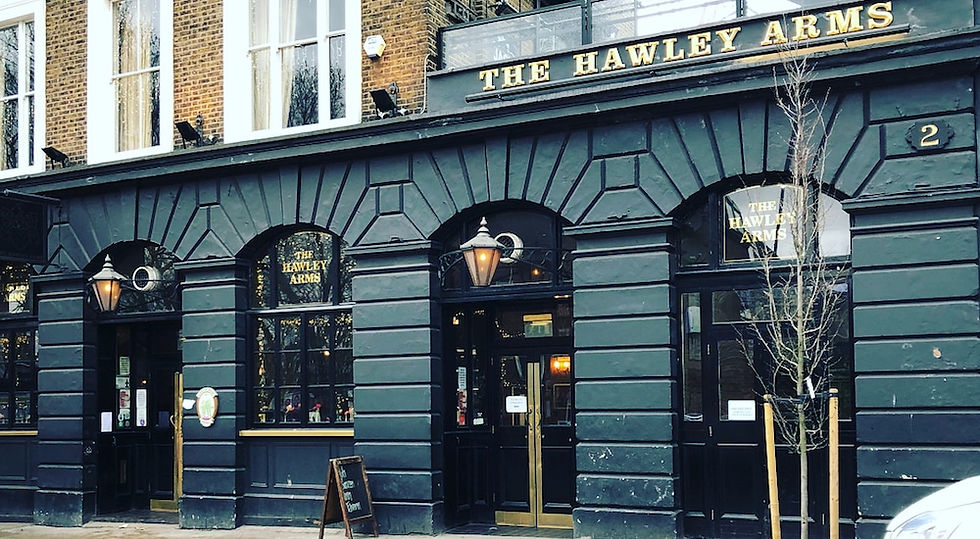
The Hawley Arms on Castlehaven Road was the beating heart of Amy's Camden years. Liam Gallagher, Kate Moss, and Pete Doherty all drank there. But the pub owed its real fame and notoriety to Ames more than anyone else.
She was known for jumping behind the bar and pulling pints, properly, working the till and getting drinks orders done pretty quickly. Tim Burgess of The Charlatans, who spent a lot of time at the Hawley during those years, remembered the first time he went in: "Amy Winehouse was pulling pints when I first went in, pretty sure she didn't work there, but it was that kind of place." One regular was blunter still, telling a journalist: "I've seen grown men break down in tears after being served by Amy."
On 9 February 2008, a fire tore through Camden Market and severely damaged the Hawley Arms. The blaze started in an alleyway behind the pub at around 7pm, took over 100 firefighters to bring under control, it destroyed the garden, the upstairs living quarters, and much of the downstairs bar. The building survived, but it would be eight months before the pub reopened.
Amy was performing at the Grammy Awards, via satellite link from an London because the US authorities wouldn't grant her a visa due to her drug convictions. She won Record of the Year for Rehab. In her acceptance speech, after thanking her label and her producers, she ended with a line she'd written into her notes in advance: "This is for London, 'cause Camden Town ain't burning down."
Those handwritten notes were auctioned in 2015 alongside her Grammy backstage passes. The "Camden Town ain't burning down" line was there in black and white, planned before she'd even gone on. She was thousands of miles away, at the biggest night of her career, and she'd already made sure the pub got a mention.
The Songs Written on Napkins
Many of Amy's songs came out of the Camden years in a very literal sense. Staff at the Hawley remembered her arriving with a notebook and settling into a corner, then stopping mid-conversation to grab a pen and say she'd had a lyric.
The connection between Amy and producer Mark Ronson had begun in New York, where the two talked for hours during their first meeting. "That day changed my life forever," Ronson later said. But the world of Back to Black was distinctly Camden in its emotional texture. Songs like Love Is a Losing Game and You Know I'm No Good were lived rather than written. You can almost hear the background in them, glasses, laughter, rain on the pavement outside.
There's a longstanding story at the Hawley that Amy wrote parts of Frank at the end of the bar. Nobody's ever convincingly disputed it.
The Pets
Amy's home life in Camden was chaotic, warm, and distinctly her own. Her choice of pets tells you quite a lot about her.
She wrote October Song, one of the most unusual tracks on Frank, in memory of a pet canary she'd named Ava — after Ava Gardner, the actress. The bird had woken her each morning by "twittering away and rocking on her little swing," as Amy put it. When it died, she was hit hard. "It was a sad time," she said. "But I got a good song out of it."
She also kept a mynah bird named Cat Stevens, after the British singer Yusuf Islam. Friends who visited the Camden house mentioned the bird regularly. It had apparently picked up phrases from Amy's daily life and studio sessions. Whether it could do a passable impression of Rehab is not recorded.

Then there were the cats. At her peak she had eleven of them living in the house. By 2010, when she flew to Jamaica to work on her third album, they had become, as a source told The Sun, somewhat unmanageable: "They were climbing all over the place, breeding and generally getting out of control." Amy gave two cats to her goddaughter Dionne Bromfield and called a shelter to collect the rest. She was reportedly upset about it. She made the responsible call anyway.
One of those cats once escaped and ended up in the neighbouring office. A staff member walked it around to Amy's address the morning after the 2008 Prince's Trust Charity Ball.
Dionne and the Kitchen
Amy's relationship with her goddaughter Dionne Bromfield was one of the constants of her Camden life. She signed Dionne to her own label, Lioness Records, in 2009. The two spent a lot of time together in Amy's kitchen, which was apparently where Amy was most herself.
Dionne later recalled a specific afternoon that captured something essential about who Amy was when she wasn't performing. Amy had decided to make a seafood dish. She pulled ingredients out, threw them into the pan, and kept asking Dionne to try it throughout. The cooking was not going well.
"Fast-forward to the finished dish," Dionne said, "and I remember her looking at me dead in the eyes, pretending to enjoy it, only for her to say: 'It's alright, you don't have to lie — it tastes like shit.'"
Dionne said that what she missed most wasn't the Amy on the stage or the Amy in the newspapers. It was the Amy who just wanted someone in the kitchen with her. "She was such a nurturing person," she said, "and that's what I love and miss about her most."

She Loved a Singalong
Amy was a regular at gigs as well as pubs. She'd turn up at the Dublin Castle or the Barfly to watch unsigned acts, standing at the back with a drink and a hood up, then heading over afterwards to tell the band they were brilliant.
Long before 'Valerie' became her hit with Mark Ronson, reaching number two on the UK Singles Chart, selling 329,490 copies and becoming the ninth biggest-selling UK single of 2007, she was singing it in Camden karaoke bars because she simply liked the song, you'd see her singing with buskers on the High Street. She couldn't walk past music without getting involved.
She'd grown up on 1960s doo-wop, soul, and Motown girl groups. "I like the attitude and drama of it," she said once. "I didn't so much like the polished groups. I'm not a big Supremes fan. I like garage girl groups." Camden, with its record stalls and basement venues, fed that appetite.

The Fame Changed Everything Except Where She Drank
By 2007, *Back to Black* had made Amy a genuine global star. Five Grammy Awards. The most talked-about British artist in a generation. She still came back to Camden.
Janis Winehouse, Amy's mother, wrote in her memoir *Loving Amy* that the pressure of fame had left her daughter fragmented in ways that were painful to watch. "There was rarely a time at Camden Square when Amy was a whole person," she wrote. "Rather, she continued to be this fragmented girl, a series of creations."
Amy's own view of success was simpler and more stubborn. "I think the more people see of me," she said, "the more they'll realise that all I'm good for is making tunes. So leave me alone and I'll do it."
Camden Said Goodbye in Its Own Way
Amy died on 23 July 2011, three days after making her last public appearance at the Roundhouse to support Dionne Bromfield during a gig.
At the Hawley Arms that night, there was no music. Some of her closest friends gathered in the room upstairs. Downstairs, regulars wrote tributes on beer mats. One person told a journalist who was there: "She made this pub her home and everyone remembers what a good laugh she was. She even used to serve behind the bar sometimes. She was part of the community in Camden."

The memorials are still there. A bronze statue by sculptor Scott Eaton stands in Camden Stables Market, unveiled in 2014 on what would have been her 31st birthday. It was opened by actress Barbara Windsor, who had been a friend of Amy's. Visitors leave bracelets on its wrists. There's a mural on Pratt Street alongside her friend and hairdresser Michael Dixon, known as Irish Michael. A granite stone on London's Music Walk of Fame, unveiled in March 2020, sits outside Barclays Bank near Camden Town underground station.
Amy once said: "I fall in love every day. Not with people, but with situations."
Camden was one long situation she never stopped being in love with. The streets gave her the material. The pubs gave her a community. The people gave her the freedom to be messy, brilliant, and entirely herself.
She poured all of it into the songs. That's why they still sound like they're coming from somewhere real.
Sources
1. Kapadia, A. (Director). (2015). *Amy* [Documentary]. Universal Pictures.
2. Winehouse, J. (2014). *Loving Amy: A Mother's Story*. Hodder & Stoughton.
3. NME: "Inside Amy Winehouse's Camden — a guide to the beehived singer's beloved borough" — https://www.nme.com/features/music-features/camden-amy-winehouse-jennifer-brown-tour-guide-3612801
4. Rolling Stone UK: "Amy Winehouse's friends and fans toast late singer's 40th at The Hawley Arms" — https://www.rollingstone.co.uk/music/news/amy-winehouses-friends-and-fans-toast-late-singers-40th-at-the-hawley-arms-32754/
5. Vice: "Remembering The Hawley Arms, the Pub That Became Indie's 2000s Hub" — https://www.vice.com/en/article/hawley-arms-camden-pub-amy-winehouse-indie-2000s/
6. Far Out Magazine: "How New York birthed the song that defined London in one night" — https://faroutmagazine.co.uk/new-york-birthed-song-defined-camden/
7. Like Love London: "Amy Winehouse Famous London Quote" — https://likelovelondon.com/amy-winehouse-famous-london-quote/
8. Wikipedia: "Valerie (Zutons song)" — https://en.wikipedia.org/wiki/Valerie_(Zutons_song)
9. Camden Guides: "Amy Winehouse: Queen of Camden" — https://camdenguides.com/amy-winehouse-queen-of-camden/
10. Pakistan Today: "At the Scene" (Hawley Arms, night of Amy's death) — https://archive.pakistantoday.com.pk/2011/07/24/at-the-scene
11. Amy Winehouse Forum: "A memory from Dionne Bromfield" — https://www.amywinehouseforum.co.uk/forum/topic/24010-a-memory-from-dionne-bromfield/
12. uDiscover Music: "Amy Winehouse Quotes: Ten Poignant Insights Into Her Life" — https://www.udiscovermusic.com/stories/amy-winehouse-in-ten-poignant-quotes/
13. Patrick Mahaney: "Did Amy Winehouse Leave Behind Any Pets Along With Her Musical Legacy" — https://www.patrickmahaney.com/services/blog/did-amy-winehouse-leave-behind-any-pets-along-her-musical-legacy
14. Richard Luck, Substack: "I Rescued Amy Winehouse's Cat" — https://richardluck.substack.com/p/i-rescued-amy-winehouses-cat
15. Irish Examiner: "Winehouse gives away cats" — https://www.irishexaminer.com/lifestyle/arid-30445884.html
16. First Class Memorabilia: "Former Houses where Amy Winehouse Lived Camden London" — https://firstclassmemorabilia.com/houses-where-amy-winehouse-lived-camden-london/
17. Timeout London: "Amy Winehouse's London: nine places connected to the star" — https://www.timeout.com/london/blog/amy-winehouses-london-nine-places-connected-to-the-star-102716
18. IMDB Quotes: *Amy* (2015) — https://www.imdb.com/title/tt2870648/quotes/
19. Goodreads: Janis Winehouse, *Loving Amy* quotes — https://www.goodreads.com/work/quotes/42905698-loving-amy-a-mother-s-story
A Camden Farewell
When Amy died in 2011, Camden mourned like it had lost one of its own. The Hawley Arms became an impromptu memorial. People brought flowers, guitars, and handwritten notes. Her songs played from open windows.
Even now, her presence lingers everywhere. There’s a bronze statue of her in Camden Market, slightly leaning, one hand on her hip, eyes full of mischief. Locals pass it and say, “Alright, Aims,” as if she might answer.
There’s a mural of her near the Roundhouse, another by the canal, and endless street art that keeps her alive in the neighbourhood she loved most.
“She’ll always be Camden’s girl,” said one local musician. “She didn’t just live here. She was here. She soaked it up and turned it into songs.”
The Spirit of Camden Lives On
Amy Winehouse’s Camden years were a collision of joy, chaos, friendship, and creativity. They were full of late-night laughter, soulful songs, and moments of surprising tenderness.
Yes, there was pain, but there was also warmth. She brought people together, made them sing, made them laugh. She had this rare ability to make ordinary moments feel electric.
Her story isn’t just about fame or addiction. It’s about a woman who loved deeply, who found inspiration in everyday life, and who poured her soul into music that will outlast every scandal.
Amy once said, “I just want to live a life worth writing songs about.”
She did.
Sources
Winehouse, M. (2012). Amy, My Daughter. HarperCollins.
Amy (2015), directed by Asif Kapadia.
The Guardian: “Amy Winehouse: The Camden Queen Who Never Stopped Believing.”
Rolling Stone: “Amy Winehouse’s Final Days.”
The Telegraph: “Inside the pubs and streets Amy Winehouse called home.”
The Independent: “Camden and the Ghost of Amy Winehouse.”
Interviews with Hawley Arms staff, 2007–2011 (BBC News archives).
NME archives, Mark Ronson interviews (2008).
Camden Market official website: “The Amy Winehouse Statue Story.”