The Husband and Wife Who Went to War Together — With Her in Charge
- Apr 25
- 9 min read

Aleksandra and Ivan Boyko saved up their wages, bought a tank, wrote to Stalin, and drove into combat together. He was the driver. She was the one giving the orders. Aleksandra Leontievna Boyko remains the only woman known to have commanded a heavy tank in combat during the Second World War — and she did it with her husband sitting just a few feet in front of her, following her directions.
That's not the usual shape of a wartime love story. In most versions, a woman waits. In this one, she led.

From Bashkiria to Magadan: A Life Before the War
Aleksandra Leontievna Morisheva was born on 20 May 1918 in Belebey, a small city in what is now the Republic of Bashkortostan in Russia. She was bright and practically minded, going on to graduate from the Kiev Chemical-Technological Technical College in 1938 before taking work as a chemist at a distillery back in Bashkortostan.
In 1940, she signed a contract to work in Magadan, a remote city in the Soviet Far East — the gateway to the notorious Kolyma region. Wages were higher there than almost anywhere else in the country, partly because life in Magadan was genuinely hard. It was, as one account puts it, "the back of beyond," with little to spend money on and long, brutal winters. Aleksandra took a post as an inspector at the Kolymsnab trust, a supply organisation connected to Dalstroy, the vast state enterprise that effectively ran the region.
It was in Magadan that she met Ivan Fedorovich Boyko, who had been born in 1912 in Nizhyn, in the Chernihiv region of Ukraine. Ivan had worked as a fitter in Ukraine before serving in the Soviet Navy in the Far East. After being demobilised, he'd ended up in Magadan driving heavy trucks along the punishing Kolyma Highway, transporting machinery, equipment, and supplies to the mines and power stations scattered across one of the most inhospitable places on earth. He was good at it. He earned commendations, awards, and the badge of "Excellent Worker of Dalstroy."
The two married, and Aleksandra became Aleksandra Boyko. Neither of them could have known then that within a few years they'd be fighting the Wehrmacht together in a 46-tonne tank — or that when they did, it would be her name on the command order and his hands on the controls.

The Decision to Fight
When Germany invaded the Soviet Union in June 1941, the Boyko family weren't on the front. They were thousands of kilometres away in Magadan, separated from the fighting by the width of the country. But the war came to them anyway — through letters from family describing atrocities, through news that Ivan's hometown of Nizhyn had been captured, and through the reports Ivan brought back from a 1942 trip to the front as part of a Dalstroy delegation delivering gifts to Red Army soldiers.
What he saw there clearly shook him. When he returned and told his wife about conditions at the front, both of them made a decision.
During the war, the Soviet government actively encouraged — and sometimes pressured — citizens to donate money directly to the war effort. Funds went towards tanks, aircraft, artillery, and ships. Over the course of the war, Soviet civilians collectively funded thousands of tanks, around 2,500 aircraft, eight submarines, and vast quantities of shells and other equipment. The practice had a personal dimension too: occasionally, individuals who donated enough money to pay for a specific piece of equipment were allowed to serve with it or name it.
The Boykos pooled their savings. Living in remote Magadan with few opportunities to spend money, they'd managed to accumulate 50,000 roubles — enough to pay for the construction of an IS-2 heavy tank. They handed the money over to the Defence Fund, and then did something audacious: they wrote a letter directly to Stalin asking to be allowed to crew the tank themselves.
Stalin replied in February 1943 with characteristic brevity: "Thank you, Alexandra Leontyevna and Ivan Fyodorovich, for your care for the Red Army. Your wish will be fulfilled. Accept my greetings."
Tank School and the Long Road to the Front
With Stalin's permission secured, the couple enrolled at the Chelyabinsk Tank School, a major training facility in the Urals that had been relocated there as part of the wartime evacuation of Soviet industry. The school ran accelerated programmes to get crews trained and deployed as quickly as possible.

In November 1943, both Aleksandra and Ivan graduated with the rank of Junior Technician-Lieutenant. But they couldn't simply head straight to the front. More letters, more requests, more waiting followed before they finally received their IS-2 in the Tula area in May 1944.
The tank that rolled off the production line and into their hands was something genuinely formidable. The IS-2 (IS stood for Iosif Stalin) weighed around 46 tonnes, was armed with a 122mm D-25T main gun capable of penetrating the turret of a Tiger I at up to 1,500 metres, and carried a crew of four in a space that was, by all accounts, cramped and uncomfortable. It was loud, slow by the standards of lighter tanks (top speed around 37 km/h), and its main gun fired two-part ammunition that slowed reloading considerably. But it was devastating. German generals reportedly warned their crews not to engage IS-2s without overwhelming numerical advantage, and the tank earned the nickname the "Victory Tank" in Soviet propaganda for good reason.
The Boykos' tank was officially named "Kolyma" — a nod to the region where they'd saved the money to buy it. Some accounts also mention a plate fixed inside the hull identifying the machine and its origins. The crew were assigned to the 48th Separate Guards Heavy Tank Regiment, part of the 5th Tank Corps.
And here's the thing that makes this story genuinely unusual, even by the standards of an era full of unusual stories: when the roles were assigned, Aleksandra got command. Ivan, the experienced truck driver with years of handling heavy vehicles on brutal roads, was the driver-mechanic. His wife, the chemist-turned-tanker, was the one who called the shots. She chose the targets. She gave the directions. He put the tank where she told him to put it.
That wasn't an accident or a formality. It was how they trained, how they served, and how the Soviet Army formally recorded it. Every official document, every award order, every Sovinformburo communiqué listed her as the commander and him as the driver. In the cramped, deafening interior of a 46-tonne IS-2, rolling towards enemy lines, she was in charge.
Into Battle: The Riga Offensive
From May 1944 to May 1945, the Boykos fought across the Baltic states, Poland, and Czechoslovakia. Their first taste of combat came during operations connected to the Riga Offensive of 1944.
On 25 July 1944, near the village of Malinovka, the Kolyma and its crew distinguished themselves in a firefight that would earn both of them their first decorations. Aleksandra directed the tank into position, identified targets, and her gunner destroyed a German Tiger tank and two enemy guns. She was wounded in the process, and stayed anyway. Her official award order later noted that she "skilfully commanded her crew, found targets, gave directions" and, despite being wounded, refused to leave her position.
Ivan, for his part, kept the tank moving and responding under fire. That was its own kind of courage. But the citation was clear about who was running the battle from inside that hull.

A day later, as German forces launched a counterattack, Aleksandra directed the Kolyma into an ambush position and knocked out a German self-propelled gun. Her award order specifically highlighted this — a talent for ambush tactics, for reading ground, for putting a 46-tonne vehicle exactly where it would do the most damage.
Marshal Andrei Eremenko later wrote about the wider operations around Daugavpils and Riga during this period, describing how Soviet armoured units bypassed the city, cut the road and railway leading to Riga, and on the night of 27 July rushed the near approaches to the city's outskirts. When German troops counterattacked at dawn, they ran into prepared ambushes. One of those ambushes included the Boykos' IS-2.
By 6 August 1944, the Soviet Information Bureau (Sovinformburo) was reporting publicly on their crew's record. The communiqué was precise about the chain of command: the tank was commanded by Junior Technician-Lieutenant Aleksandra Boyko, with her husband Ivan as driver-mechanic. In two weeks of continuous fighting, they'd destroyed five enemy tanks and two guns. For her role in those engagements, Aleksandra received the Order of the Patriotic War, First Class. Ivan was awarded the Order of the Red Banner, a different decoration, a different citation, a clear distinction in roles.
A Face on the Cover of Ogoniok
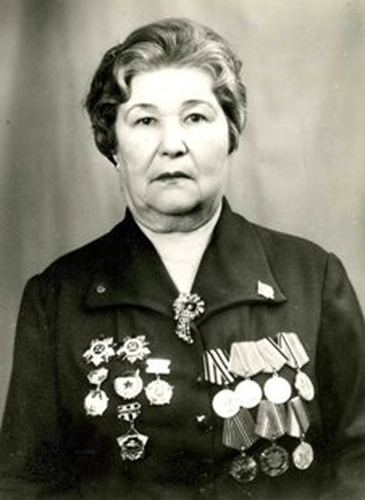
In September 1944, Aleksandra was temporarily pulled from the front and sent to Moscow, where she spoke at the Fourth Anti-Fascist Rally, a significant public propaganda event aimed at demonstrating Soviet resolve and the breadth of the war effort. Her portrait appeared on the cover of Ogoniok, one of the most widely read Soviet illustrated magazines of the era. For a brief moment, she became a public face of Soviet women's contribution to the war.
Then she went back.
More Fighting, Wounds, and Victory in Prague
The Boykos' war wasn't over, and it wasn't without further cost. Later in the fighting, accounts vary slightly on the timing, their tank was hit and the entire crew was wounded. Both Aleksandra and Ivan spent time recovering in hospital, but they returned to action and were still fighting when the war ended.
They celebrated Victory Day not in Berlin, not in Moscow, but in Czechoslovakia — in Prague, where the 48th Guards Heavy Tank Regiment was positioned when the guns finally fell silent on 9 May 1945. By any measure, they'd earned it.

Back to Magadan: Life After the War
After demobilisation, both Boykos returned to Magadan. Ivan spent seven years as deputy head of the 4th Motor Depot. Aleksandra ran a bakery. In 1947 and again in 1953, both were elected as deputies to the Magadan City Council of Workers' Deputies.
In the mid-1950s, their paths diverged and the couple separated. They continued to meet at veterans' gatherings over the years. In 1989, both were invited back to Magadan for the city's 50th anniversary.
On 4 December 1991, just weeks before the Soviet Union itself dissolved, Aleksandra and Ivan Boyko were jointly awarded the title of Honorary Citizen of the City of Magadan.
After 1954, Aleksandra had moved to Apsheronsk in the Krasnodar Territory, where she lived out the rest of her life. She'd been awarded the Order of the Patriotic War First Class in 1944, and received a second Order of the Patriotic War (Second Class) in 1985, along with numerous medals. She died on 25 May 1996, five days after her 78th birthday.
Why Aleksandra Boyko's Story Still Matters
She wasn't the only Soviet woman to fight in armoured vehicles during the war. Mariya Oktyabrskaya famously bought a T-34 with her savings after her husband was killed and drove it into battle herself, becoming the first female tanker to receive the Hero of the Soviet Union award, posthumously. Others, including Aleksandra Samusenko and Irina Levchenko, also served in armoured roles.
But none of them commanded a heavy tank. That distinction belongs to Aleksandra Boyko alone.
What makes her story different from almost every other wartime account — male or female — is the specific shape of it. She and Ivan were a team, genuinely and demonstrably. They saved the money together. They trained together. They fought together. They were wounded together. They celebrated victory together. By any measure, this was a partnership.
But inside the Kolyma, the partnership had a clear structure. She outranked the situation. In a war where women were overwhelmingly cast in supporting roles, she was directing a weapon that weighed more than 40 tonnes, choosing when to fire and where to move, commanding a husband who was by any conventional measure the more experienced heavy vehicle operator of the two. The Soviet Army looked at both of them, assessed what each could do, and put her in charge.
That's worth sitting with for a moment. Not just that she fought. That she led. And that the person following her orders was her husband.
Key Facts at a Glance
Born: 20 May 1918, Belebey, Bashkortostan
Died: 25 May 1996, Apsheronsk, Krasnodar Territory
Rank: Guard Junior Technician-Lieutenant
Unit: 48th Separate Guards Heavy Tank Regiment, 5th Tank Corps
Tank: IS-2, named "Kolyma"
Awards: Order of the Patriotic War (First Class, 1944; Second Class, 1985), Order of the Red Star, numerous campaign medals
Notable: The only woman known to have commanded a heavy tank in combat in World War II
Sources
Top War (Russian military history site), translated: https://en.topwar.ru/67406-zhenschiny-tankisty-velikoy-otechestvennoy-voyny-aleksandra-boyko.html
Tank Archives / Wargaming History Group (Yuri Bakhurin et al.): https://www.tankarchives.com/2014/12/world-of-tanks-history-section-women-of.html
Chernaya Kobra (Ivan and Alexandra Boyko and the tank Kolyma): https://chernayakobra.ru/ivan-fedorovich-alexandra-leontievna-boyko-and-the-tank-kolyma/
History Collection (Women of Peace and Those Sided the Wrong Way in WWII): https://historycollection.com/women-of-peace-and-those-sided-the-wrong-of-world-war-ii/33/
Tank Archives – Tank Inscriptions (Soviet civilian donations for tanks): https://www.tankarchives.com/2014/01/tank-inscriptions.html
IS-2 Wikipedia: https://en.wikipedia.org/wiki/IS-2
HistoryNet – IS-2 Heavy Tank: https://historynet.com/is-2-heavy-tank/
Boot Camp & Military Fitness Institute – Who Was Aleksandra Boiko: https://bootcampmilitaryfitnessinstitute.com/2021/06/07/who-was-aleksandra-boiko/