

The Gibsons of Scilly: The Family Who Captured Cornwall’s Past in Glass and Silver

In the age before smartphones, before even the casual Brownie camera, photography was an art form that demanded patience, heavy equipment, and a keen eye. On the remote Isles of Scilly, twenty-eight miles off the coast of Cornwall, one family mastered that art and turned it into a legacy. For more than a century, the Gibson family captured shipwrecks, storms, and everyday life in beautiful photographs.
Today, their archive is considered one of the most important visual records of 19th- and early 20th-century maritime Britain. But behind the pictures lies a story of a family whose business became a dynasty, whose artistry documented not just landscapes but the precarious relationship between the Cornish people and the sea.

John Gibson: A Pioneer with a Lens
The story begins with John Gibson (1827–1920), born in Penzance and later moving to St Mary’s, the largest of the Isles of Scilly. Gibson trained first as a sculptor and mason, but by the mid-19th century he had turned his attention to photography, then still a relatively new invention.
By 1860, Gibson had set up a photographic studio in St Mary’s. This was no small feat. The wet collodion process used at the time required glass plates, chemical baths, and darkroom facilities. For Gibson to carry this out on an island community, with supplies ferried across rough seas, spoke to his determination.
His work at first included portraits of locals and visiting dignitaries, but it quickly expanded. The sea, with its beauty and its dangers, became his most powerful subject.

A Family Business
Photography soon became a Gibson family trade. John’s sons, Alexander (1857–1944) and Herbert (1861–1937), joined the business, learning the craft under their father’s eye. Together, the Gibsons documented not just their island home but also the tragedies that occurred along Cornwall’s treacherous coastline.
It was Alexander and Herbert who developed the family’s reputation for shipwreck photography. Whenever a vessel struck rocks near Scilly or Cornwall, the Gibsons would rush to the scene, lugging their heavy cameras, tripods, and glass plates. They captured scenes of destruction with stark clarity: shattered hulls against jagged rocks, waves battering stranded masts, and rescuers working frantically to save lives.
These photographs were more than local curiosities. They were sold as postcards, prints, and news images, distributed far beyond Cornwall. In many cases, they became the only surviving visual records of ships lost at sea.

The Shipwreck Chronicles
The waters around Cornwall and Scilly were notoriously dangerous. Storms, shifting sands, and hidden rocks claimed countless vessels, from local fishing boats to grand transatlantic liners. The Gibsons were there to witness it.
One of their most famous photographs depicts the wreck of the Schiller, a German ocean liner that struck rocks near Scilly in 1875. More than 300 people died, and the Gibsons’ haunting images of the wrecked vessel, surrounded by survivors and debris, were published worldwide.

Another shows the Minnehaha, an American cargo ship, stranded on rocks in 1910. The ship had been carrying a cargo of wheat, cattle, and cars — and the image of her stuck fast, her fate uncertain, is both surreal and tragic.
Over four generations, the Gibsons recorded more than 200 shipwrecks. Their photographs combined documentary urgency with an artist’s eye for composition, making them both historical evidence and works of art.

Everyday Life in Cornwall
Yet the Gibsons’ lens didn’t stop at wreckage. They also turned their cameras toward the rhythms of daily life.
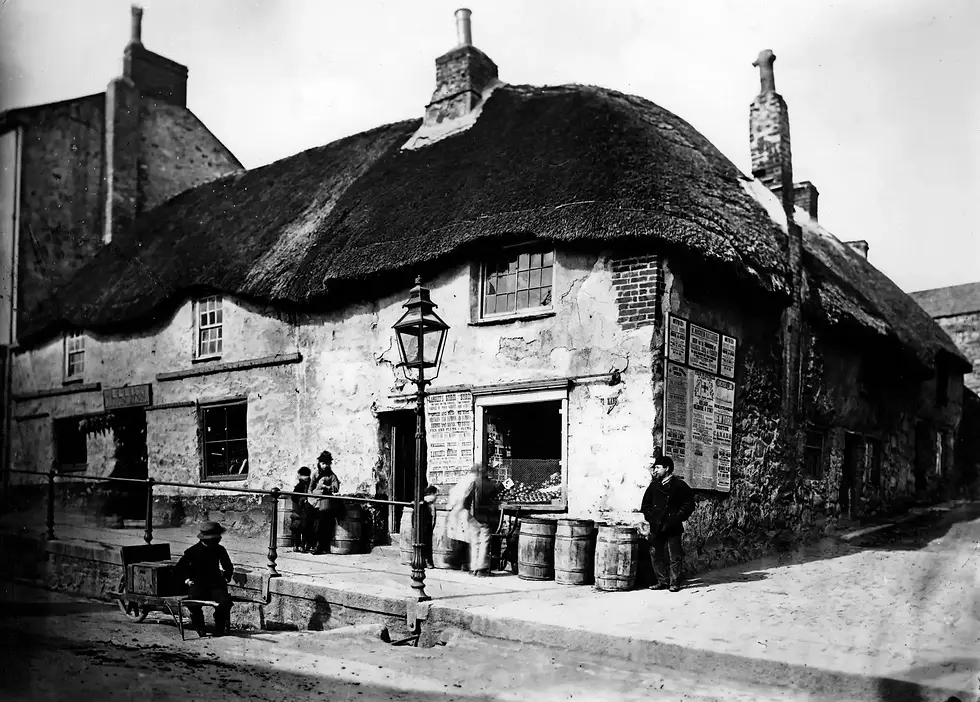
Children appear in their photographs with toy wheelbarrows, their solemn expressions belying childhoods that would soon turn to work. Fishermen are shown hauling nets heavy with mackerel, their faces weathered by salt and sun. Shopkeepers stand proudly outside their storefronts, such as Langley Stores in Penzance, shelves lined with goods that connected Cornwall to the wider world.

At Mousehole, one of Cornwall’s most picturesque fishing villages, the Gibsons captured scenes of locals looking out over the harbour, their livelihoods tied to the uncertain generosity of the sea. In another image, Lord St Levan’s boatmen at St Michael’s Mount pose as a reminder of a society built around service, tides, and tradition.
Not all their images are idyllic. One photograph shows residents gathered around a pod of beached whales, at once a marvel and a grim spectacle. Another records flooding in Newlyn, streets submerged and daily life disrupted.
Through these images, the Gibsons created a portrait of Cornwall and Scilly not as a romantic holiday postcard but as a working land, shaped by labour, community, and resilience.
The Technology of Their Time
The Gibsons worked with what we now consider cumbersome technology. In the 19th century, photographs were captured on glass plate negatives coated with light-sensitive chemicals. Each exposure required precise preparation and immediate development in portable darkrooms.
This made their shipwreck photography all the more impressive. Imagine scrambling over jagged rocks in a storm, carrying heavy wooden cameras and fragile glass plates, all while trying to capture a scene before the sea destroyed it. Their perseverance resulted in images of astonishing clarity and depth, still powerful more than a century later.
By the late 19th and early 20th centuries, as photography equipment improved, the Gibsons expanded their output. They produced postcards for tourists, portraits for families, and documentary records for newspapers. The family studio on St Mary’s became a hub of both art and commerce.

Four Generations Behind the Lens
What makes the Gibson story extraordinary is its continuity. The business did not end with John, Alexander, or Herbert. It continued through successive generations, with each adding their own perspective.
By the early 20th century, Herbert’s son, James Gibson, was carrying the torch. Later, Frank Gibson, Herbert’s grandson, joined in. Between them, they amassed tens of thousands of images, creating one of the richest visual archives in Britain.
The family’s commitment meant that Cornwall and Scilly were documented in a way few other regions were. From Victorian fishing fleets to Edwardian shopfronts, from First World War shipwrecks to interwar seaside visitors, the Gibsons’ photographs span an era of immense change.

Recognition and Legacy
For years, the Gibson photographs were valued locally but not widely known beyond Cornwall. That changed as historians, collectors, and institutions began to recognise their significance.
In 2013, Royal Museums Greenwich acquired a large part of the Gibson shipwreck archive, paying more than £120,000 at Sotheby’s. This ensured that thousands of glass plate negatives would be preserved for future generations.

In 2016, another set of more than 1,500 images depicting everyday Cornish life went up for auction at Penzance Auction House. Valued at £25,000, the sale highlighted the growing recognition of the Gibsons’ work as both cultural treasure and historical evidence. Some of these photographs are now in the care of institutions such as Penlee House Gallery and Museum in Penzance, keeping them rooted in the communities they portray.
Today, exhibitions of Gibson photographs draw crowds who marvel not only at the artistry but at the window they provide into a lost world.

Why Their Work Matters
The Gibsons captured more than just images. They preserved memory. Without their work, many shipwrecks would be forgotten, many communities unrecorded. Their photographs show not just what Cornwall looked like, but how it felt to live there — the hard labour, the close ties to the sea, the blend of beauty and danger.
They also remind us of photography’s power as social history. Where written records might detail dates and events, photographs reveal faces, gestures, and details that words cannot capture. The Gibsons gave Cornwall a voice in silver and glass.

Conclusion
The Gibsons of Scilly were more than photographers; they were chroniclers of a world on the edge of land and sea. From John Gibson’s first studio in the 1860s to the last glass plates developed by his descendants in the 20th century, the family produced an archive that is both art and history.
Their images of shipwrecks remain haunting, but their photographs of daily life are just as powerful. They show us children, shopkeepers, fishermen, and mothers in moments both ordinary and profound.
Today, their legacy survives not only in museums and archives but in the way we understand Cornwall’s past. The Gibsons’ work is a reminder that history is not only about kings and battles, but about the lives of ordinary people, captured forever in a flash of light on glass.
Sources
The Guardian, Everyday life in Cornwall captured in the 19th century – in pictures: https://www.theguardian.com/uk-news/gallery/2016/may/19/everyday-life-in-cornwall-captured-in-the-19th-century-in-pictures
Royal Museums Greenwich – Gibson Shipwreck Archive: https://www.rmg.co.uk
Cornish Bird Blog – The Gibson Dynasty: Pioneers of Photography: https://cornishbirdblog.com
Sotheby’s Auction Archive – Gibson photographs sale (2013)


