

Christine Jorgensen: The Shy Bronx Kid Who Gave the Sexual Revolution "a Good Swift Kick in the Pants"
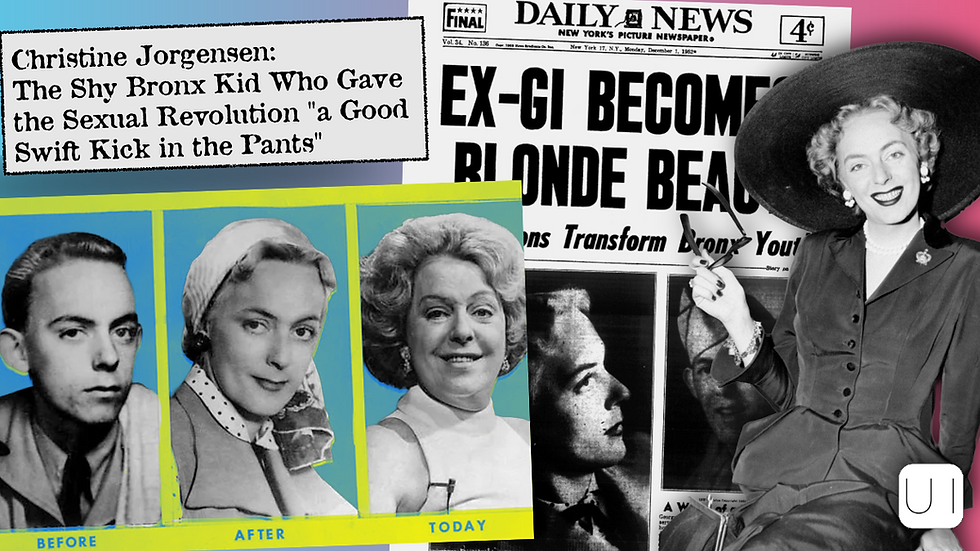
When the New York Daily News ran its front page on December 1, 1952, the headline read: "Ex-GI Becomes Blonde Beauty." Within 48 hours, Christine Jorgensen was the most talked-about person in America. What followed was a life that became part celebrity circus, part quiet courage, and entirely unlike anything the 20th century had seen before.
A Frail, Introverted Boy from the Bronx
Christine Jorgensen was born George William Jorgensen Jr. on May 30, 1926, and grew up in the Belmont neighbourhood of the Bronx, New York City, the second child of carpenter and contractor George William Jorgensen Sr. and his wife Florence Davis Hansen. From the very beginning, she knew something set her apart. She later described herself as a "frail, blond, introverted little boy who ran from fistfights and rough-and-tumble games."

As a child, Jorgensen felt very different from other boys and remained secluded and shy. The other boys poked fun at her for displaying feminine tendencies, and even her own sister would join in from time to time. Her grandmother, however, became one of her fiercest supporters and encouraged her to express her identity freely. It was a rare comfort in a household where the family's religious beliefs left little room for anything outside of strict gender norms.
During her time at Christopher Columbus High School, Jorgensen experienced feelings of confusion when she developed a romantic interest in one of her male friends and began to reflect on questions of sexuality and identity. She graduated in 1945 and was almost immediately drafted into the US Army.
A Book That Changed Everything
After military service, where she worked as a clerical worker, Christine attended several educational institutions including the Progressive School of Photography in New Haven, Connecticut, and worked briefly for Pathé News. It was during this period that a book quite literally redirected the course of her life.
In 1948, Jorgensen read "The Male Hormone: A New Gleam of Hope for Prolonging Man's Prime of Life" by Paul De Kruif, a book discussing the discovery of testosterone and its role in sexual development. According to a biography by psychology professor Richard Docter, the book helped Jorgensen connect her identity struggles to hormones and influenced her decision to pursue medical procedures to align her body with her gender identity.
American doctors weren't interested in helping. When she contacted a noted endocrinologist, Dr. Harold Grayson, he immediately rejected her request and referred her instead to a psychiatrist who could help her eliminate her "female inclinations." Jorgensen refused, still believing there had to be a biological answer to how she felt.
Copenhagen and the Doctor Who Changed Her Life
Jorgensen began taking estrogen in the form of ethinylestradiol and started researching sex reassignment surgery with the help of Joseph Angelo, the husband of a classmate at the Manhattan Medical and Dental Assistant School. She originally intended to travel to Sweden, where the only doctors performing such surgery in the world were located.

Fate intervened. During a stopover in Copenhagen to visit relatives, she met Dr. Christian Hamburger, a Danish endocrinologist and specialist in rehabilitative hormonal therapy associated with the Serum Institute. Hamburger agreed to perform the experimental procedure for free, and became the first person to formally diagnose Jorgensen as transsexual rather than homosexual. For Christine, it was the first time a medical professional had confirmed what she'd always known about herself.
She obtained special permission from the Danish Minister of Justice Helga Pedersen to undergo a series of operations. On September 24, 1951, surgeons at Gentofte Hospital in Copenhagen performed the first procedure. In November 1952, doctors at Copenhagen University Hospital completed a second operation. She'd later return to the US for further reconstructive surgery.
She chose the name Christine in honour of the doctor who'd finally listened. In a letter to friends after the first surgery, she wrote that the shy, miserable person who'd left America was gone and that she was now "in marvellous spirits."
Outed by a Leaked Letter
Christine's plan had always been to transition quietly. She intended for her change to remain private. An unidentified person who knew about the procedures contacted the press, and on December 1, 1952, the New York Daily News published photographs of Christine before and after her transition. The headline, "Ex-GI Becomes Blonde Beauty: Operations Transform Bronx Youth," was on newsstands before she'd even set foot back on American soil.

Notably, the Daily News story referred to Jorgensen with female pronouns when discussing events after her transition and with male pronouns when discussing events before it. By the standards of 1952, that was a surprisingly considered distinction to make.
She returned to the US in February 1953. A large crowd of journalists met her as she came off the plane, and despite the Danish royal family being on the same flight, the press entirely ignored them in favour of Jorgensen. It was the kind of celebrity that arrived overnight and never fully went away.
The $20,000 Story and the Relentless Press
She soon launched a successful nightclub act and appeared on television, radio, and theatrical productions. The first five-part authorised account of her story was written by herself in a February 1953 issue of The American Weekly, titled "The Story of My Life." She was paid $20,000 for those rights, a significant sum at the time.

The press, though, was rarely kind for long. Over time, media coverage shifted from enthusiasm to scrutiny, with print publications regularly asking Jorgensen whether she'd pose nude for their pages. She consistently declined. She was learning, as many celebrities do, that fame and dignity aren't always offered at the same time.
Wonder Woman, Vice Presidents, and Louis Farrakhan
Christine's nightclub career produced some genuinely strange and wonderful moments. Around 1958, while performing at the Latin Quarter in New York, she saw Pat Suzuki perform "I Enjoy Being a Girl" from the musical Flower Drum Song on Broadway. The song became her theme, and she closed her act each night with a quick change into a Wonder Woman costume.
It couldn't last. Warner Communications, owners of the Wonder Woman copyright, demanded she stop using the character in 1981. She created a new character she called Superwoman, identifiable by a large letter S on her cape. DC Comics, which had trademarked Superwoman since 1947, either didn't notice or didn't mind.
Then there's the Spiro Agnew episode. When the Vice President called Republican senator Charles Goodell "the Christine Jorgensen of the Republican Party," Christine demanded a public apology. Agnew refused and later resigned from the vice presidency on charges of bribery and conspiracy. Christine's response to the insult was considerably classier than anything he'd manage.

Perhaps the strangest cultural footnote of all: in 1954, a calypso singer performing under the name "The Charmer" released a song about Jorgensen called "Is She Is or Is She Ain't," a play on the Louis Jordan song "Is You Is or Is You Ain't My Baby." That singer was Louis Farrakhan, two years before he joined the Nation of Islam. Christine's fame had become so enormous it was attracting commentary from directions no one could have predicted.
Ed Wood, the Film She Turned Down
Posters for Ed Wood's 1953 film Glen or Glenda, also released under the title I Changed My Sex, publicised it as being based on Jorgensen's life. Producer George Weiss had made her offers to appear in the film, but she turned them down. It was a characteristically sharp instinct. The film became a cult oddity; Christine's reputation survived it entirely.
Two Engagements, No Marriage Licence
Christine's romantic life carried its own particular sadness. After her vaginoplasty she planned to marry labour union statistician John Traub, but the engagement was called off. In 1959 she announced her engagement to typist Howard J. Knox in Massapequa Park, New York, where her father had built her a home. She and Knox joined a Lutheran church together.

The couple couldn't obtain a marriage licence because Jorgensen's birth certificate still listed her as male. The New York Times reported that Knox had lost his job in Washington DC when their engagement became public knowledge. The legal system simply hadn't caught up with the reality of who she was.
The Autobiography and a Life on the Lecture Circuit
In 1967, Jorgensen published her autobiography, Christine Jorgensen: A Personal Autobiography, which sold almost 450,000 copies. In it she wrote with characteristic honesty about her struggles with depression and the moments when she'd contemplated suicide, concluding memorably that "the answer to the problem must not lie in sleeping pills and suicides that look like accidents, or in jail sentences, but rather in life and the freedom to live it."
Throughout the 1970s and 1980s she toured university campuses speaking about her experiences, and in 1984 returned to Copenhagen to perform her show, appearing in a Danish documentary film about transgender lives. She kept a small Christmas tree on her bedside table as a reminder to treat every day as a celebration, and by all accounts she did so until the last day of her life.
A Word She Chose for Herself
One aspect of Christine's legacy that's often overlooked is her role in shaping the very language used to describe transgender identity. According to a 1985 publication, Jorgensen opposed the word "transsexual" because in her view "sex" only referred to sexual intercourse. She stated: "I am a transgender because gender refers to who you are as a human." She was using the word in its modern sense decades before it entered mainstream usage.
Death and Legacy
Christine died of bladder and lung cancer on May 3, 1989, aged 62. Her ashes were scattered off Dana Point, California.
In one of her final interviews she reflected on the whole extraordinary arc of her life: "I am very proud now, looking back, that I was on that street corner 36 years ago when a movement started. It was the sexual revolution that was going to start with or without me. We may not have started it, but we gave it a good swift kick in the pants."
In 2012 she was inducted into Chicago's Legacy Walk, celebrating LGBTQ history. In 2014 she was among the inaugural honourees of the Rainbow Honor Walk in San Francisco's Castro neighbourhood. In June 2019, she was one of the first 50 Americans included on the National LGBTQ Wall of Honor within the Stonewall National Monument in New York City.
She'd gone from a frightened kid in the Bronx to a permanent fixture in the history of civil rights. Not bad for someone who once described herself as too shy to get into a fistfight.
SOURCES
Britannica: Christine Jorgensen — https://www.britannica.com/biography/Christine-Jorgensen
The National WWII Museum: From GI Joe to GI Jane — https://www.nationalww2museum.org/war/articles/christine-jorgensen
OutHistory: Christine Jorgensen biography project — https://outhistory.org/exhibits/show/tgi-bios/christine-jorgensen
Embryo Project Encyclopedia: Christine Jorgensen (1926–1989) — https://embryo.asu.edu/pages/christine-jorgensen-1926-1989
Women and the American Story, NY Historical Society — https://wams.nyhistory.org/growth-and-turmoil/cold-war-beginnings/christine-jorgensen/
Library of Congress Families Blog: LGBTQ+ History: Christine Jorgensen — https://blogs.loc.gov/families/2022/06/lgbtq-history-christine-jorgensens-life-of-fame-and-femininity/
US National Archives: Christine Jorgensen, America's First Transgender Celebrity — https://unwritten-record.blogs.archives.gov/2024/03/26/christine-jorgensen-americas-first-transgender-celebrity/
People's World: This Week in LGBTQ History: Christine Jorgensen — https://www.peoplesworld.org/article/this-week-in-lgbtq-history-celebrating-and-honoring-christine-jorgensen/
LGBTQ Nation: Remembering transgender pioneer Christine Jorgensen — https://www.lgbtqnation.com/2019/10/remembering-transgender-pioneer-christine-jorgensen/
Jorgensen, Christine. Christine Jorgensen: A Personal Autobiography. Paul S. Eriksson, 1967.
Docter, Richard F. Becoming a Woman: A Biography of Christine Jorgensen. Haworth Press, 2008.


