


What the Doctors Gave Ian Curtis: The Pills, the Pressure, and the Night Joy Division Fell Apart
Updated: Oct 6
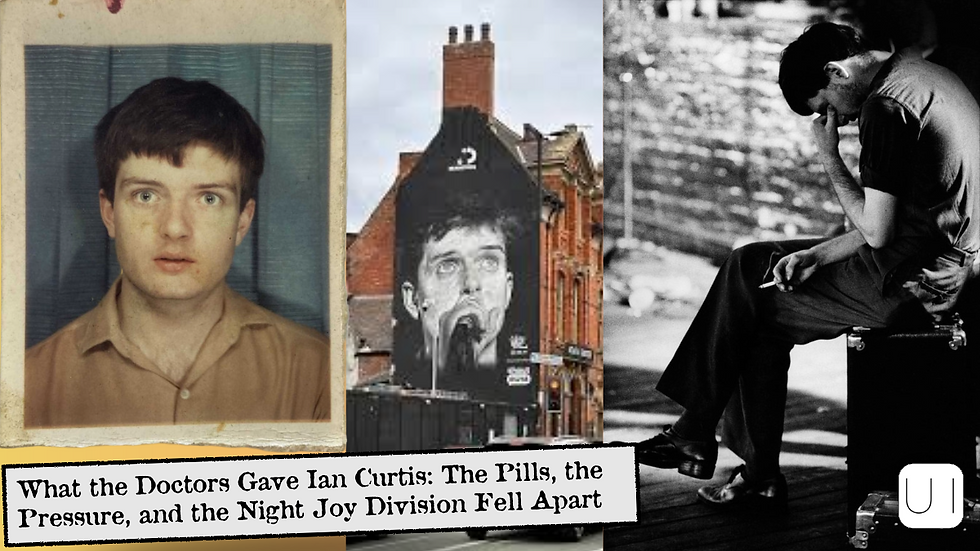
Everyone knows the surface of the Ian Curtis story. The seizures. The failing marriage. The affair with Annik Honoré. The Werner Herzog film playing in an empty house in Macclesfield on the night of 17 May 1980. Most accounts stop there, arranging the same details into the same elegiac shape. What gets overlooked is something considerably darker: the serious possibility that the drugs prescribed to keep Curtis alive were actively making him want to die, that the people around him kept booking shows despite abundant evidence he was in crisis, and that the final six weeks of his life constitute one of the more troubling episodes in rock history, not because of the mythology, but because of what was plainly visible to anyone paying attention.
Curtis died on 18 May 1980, aged 23, on the eve of Joy Division's first North American tour. He'd been a recognised epileptic for just sixteen months. In that time, his doctors had worked through a succession of anticonvulsant drugs, each one carrying its own cargo of side effects, and the combination of those drugs with a punishing touring schedule, a crumbling marriage, and a passionate but complicated long-distance relationship had left him in a state that his own bandmates later admitted they'd catastrophically underestimated.
The parallels with other musicians whose mental health deteriorated in plain sight are uncomfortable. Kurt Cobain's final weeks are often discussed in similar terms: the warning signs that were present, the people around him who either missed them or weren't equipped to act. Curtis's story predates Cobain's by fourteen years, and the psychiatric understanding of epilepsy-related depression was far more limited in 1980. That context matters.

The Pills That Made Things Worse
Curtis was officially diagnosed with epilepsy on 23 January 1979, though his wife Deborah later wrote that she and others had noticed signs of the condition before that date. His first major recognised seizure happened on 27 December 1978, during the drive home from a gig at the Hope and Anchor in London. He was hospitalised, and the process of trying to manage his condition with anticonvulsant medication began almost immediately.
His initial prescription was phenobarbitone, a barbiturate-class anticonvulsant that had been in use since the early twentieth century. When that failed to adequately control his seizures, his doctors added phenytoin. Over the months that followed, carbamazepine and sodium valproate were also tried, and at various points Curtis reportedly lost track of which medications he was supposed to be on and which had been discontinued. He was, by the end, taking around twenty pills a day.
The side effects of these drugs, particularly phenobarbitone and phenytoin, are now well documented. A significant body of clinical literature has found that both drugs are associated with depressive episodes in a meaningful proportion of patients. Phenobarbitone in particular has long been understood to carry a risk of worsening mood disorders. A paper published in the journal Seizure in 2015, which examined the intersection of epilepsy treatment and mental health using Curtis as a case study, concluded that he almost certainly suffered from a combination of recurrent major depression and pharmacoresistant focal epilepsy, and that both conditions fed destructively into the other.

One leading epilepsy specialist, quoted in MOJO's detailed account of Curtis's final months, described the effect of his medication regime as like being drunk without the high: unpredictable mood swings, emotional flatness, cognitive fog. Annik Honoré, in the only substantial interview she gave before her death in 2014, noted that the medication Curtis was taking had rendered any physical relationship impossible. She'd said Curtis was taking so many pills and had mixed that with alcohol that the side effects were overwhelming his life.
The significance of this is hard to overstate. Curtis's depression is generally discussed as something that existed alongside his epilepsy and his medication, rather than something that may have been substantially caused or worsened by his treatment. His doctors, working with the tools available to them in 1979 and 1980, were doing what they could. But the clinical picture that emerges is of a young man whose attempts to manage one serious condition were actively destabilising his mental health, while everyone around him, including his management, largely processed this as a personality change rather than a medical emergency.
The Epilepsy Foundation now recommends that epilepsy patients be screened for depression at diagnosis, before and after starting any anticonvulsant medication, and at every annual follow-up. None of that practice existed in any formal sense when Curtis was being treated. The band's name itself had darker roots than most fans realise: Joy Division was taken from the 1955 novel House of Dolls, which depicted sexual slavery in Nazi concentration camps. The world that produced Rudolf Höss and the industrialised cruelty of Auschwitz was the same world the name reached back into. Curtis's lyrics often circled themes of control, imprisonment, and loss of agency. His medical situation gave those themes an uncomfortably literal dimension.
Terry Mason and the Illusion of a Safety Net
By April 1980, enough people around Curtis had become alarmed that a practical response was arranged. The band's road manager and friend Terry Mason was appointed as a kind of personal minder, tasked with making sure Curtis took his medication, stayed away from alcohol, and got adequate sleep. It was a well-intentioned arrangement that also illustrated, with some clarity, how little genuine support was actually in place. Mason was a friend and colleague, not a mental health professional, and the idea that a touring schedule could be rendered safe for someone in Curtis's condition by adding a responsible adult to the entourage was optimistic at best.
The April schedule went ahead. On 4 April 1980, Joy Division supported The Stranglers at the Rainbow Theatre in Finsbury Park. Contrary to instructions Rob Gretton had given to the venue's lighting team, the strobes were switched on mid-set. Curtis staggered backwards almost immediately and collapsed against Stephen Morris's drum kit in the middle of a full tonic-clonic seizure in front of nearly three thousand people. When he recovered, he insisted on travelling across London to honour a second booking that same night at the Moonlight Club in West Hampstead. Around twenty-five minutes into that second show, his dancing lost its rhythm and he went down again. His bandmates carried him offstage.
Three days later, on 7 April, Curtis swallowed a quantity of his phenobarbitone in what was clearly a deliberate overdose. He told Deborah what he'd done. She got him to hospital, where his stomach was pumped. He was discharged, incredibly, the following day so he could perform at a Joy Division gig at the Derby Hall in Bury. He managed two songs before a riot broke out among the audience. Tony Wilson found Curtis upstairs, crying. The gig was called off.

The Manager Who Made All the Decisions
Rob Gretton is one of the more complicated figures in the Joy Division story, and one of the least examined. Peter Hook described him in later years as domineering and almost intimidating, someone who made all the decisions about record labels, recording schedules, and touring. The dynamic has echoes elsewhere in rock history. Brian Wilson's relationship with his therapist and de facto manager Dr Eugene Landy is perhaps the most notorious example of a creative figure whose personal autonomy was effectively surrendered to someone who controlled every aspect of his professional life. Gretton wasn't Landy, and the situations were very different. But the question of how much say Curtis genuinely had over his own schedule in those final months is one that doesn't get asked often enough.
Gretton was, by most accounts, a smart and dedicated manager who genuinely cared about the band's success. He was also the person most responsible for the decision to press ahead with the American tour despite the state Curtis was in. The tour had been a long time coming. Joy Division's reputation in the United States, built largely on the strength of Unknown Pleasures and an enthusiastic critical reception, was considerable, and there was a real sense that the trip could transform the band's commercial fortunes. The band were due to fly out on 19 May 1980.
What's striking, looking at the timeline, is how much had happened in the seven weeks before that flight. Two major on-stage seizures in one night. A deliberate overdose. A hospitalisation. A riot. And yet the American tour remained on. Tony Wilson, in a 2005 interview, said of those final weeks: I think all of us made the mistake of not thinking his suicide was going to happen. We all completely underestimated the danger. We didn't take it seriously. That's how stupid we were. Bernard Sumner later said the same thing, more simply: we had no idea he was going to do it. If we had, we wouldn't have let him out of our sight.
Curtis, for his part, seems to have had genuinely mixed feelings about America. Hook, in a choice of words he may later have regretted, said that as far as the band were concerned, Curtis was dead excited about going, really looking forward to it. Whether that reflected Curtis's actual state of mind or the version of himself he was projecting to his bandmates is harder to say. He'd spent much of the preceding months telling people what they wanted to hear.
The Last Show: Birmingham, 2 May 1980
Joy Division's final concert took place at the High Hall of Birmingham University on 2 May 1980, sixteen days before Curtis died. The gig was billed as a stopgap date before the American tour, and the tickets cost £1.50 in advance, £1.75 on the door. A Certain Ratio opened. The audience was a mix of students, punks, and rockers. Joy Division took the stage late.
The setlist was eleven songs in forty-five minutes, and it included something historically significant: the first and only live performance of Ceremony, a track that the band had written and intended to record, which would eventually become New Order's debut single after Curtis's death. It was the first time Curtis sang it on a stage. It was the last time he sang anything on a stage.
By the time they reached the second-to-last song of the night, a track called Decades, Curtis was struggling badly. Terry Mason helped him off the stage after he completed the vocal. The rest of the band finished the number without him. Then Curtis came back for the final song, Digital, the very first track Joy Division had recorded for Factory Records back in October 1978. He got through it. They played the outro. That was the end.
The fan David Pryke, who was there, recalled decades later: they were very late. He remembered waiting around for a long time listening to A Certain Ratio sound check. Of what happened when Joy Division finally took the stage, the official soundboard recording tells its own story. It's a tight, focused set, but you can hear something wrong with Curtis's energy if you know what you're listening for. The full recording was released in November 1981 on the double album Still, by which point it had become something else entirely: a document of what the end sounded like.
The High Hall at Birmingham University was later renamed Chamberlain Hall. It was demolished in January 2014.
Annik Honoré and the Letters Nobody Was Supposed to Read
Annik Honoré met Ian Curtis at the opening night of Plan K, a Brussels arts venue she was helping to promote, on 16 October 1979. Joy Division were on the bill. She was 21, working at the Belgian Embassy in London. He was 23, newly a father, already deep in his epilepsy diagnosis and his deteriorating marriage to Deborah.
What followed over the next seven months is one of the most contested relationships in rock music. Deborah Curtis, in her 1995 memoir Touching From a Distance, described it as an affair. Honoré, in a rare 2010 interview, insisted until her death in 2014 that it was entirely platonic, that the medication Curtis was taking had made any physical relationship impossible, and that Deborah had fundamentally mischaracterised what was between them. One of Curtis's letters to Honoré, she said, explicitly stated that his relationship with Deborah had already ended before he and Annik became close.
The letters themselves have had their own strange afterlife. Honoré preserved them, passing copies to Joy Division documentary filmmaker Grant Gee in 2007. In 2019, Peter Hook included copies in a memorabilia auction alongside instruments and vinyl. Bernard Sumner and Stephen Morris issued a joint statement expressing serious unhappiness at the proposed sale, describing the letters as very private and personal correspondence. The letters were withdrawn before the auction took place. Sumner and Morris made a donation of £1,500 to the Christie Hospital in Manchester in lieu of the charity donation Hook had said the proceeds would go towards.
What the letters actually contain, beyond a T.S. Eliot poem that Honoré mentioned in her interview, remains largely private. Honoré showed them to the journalist who interviewed her but declined to have them reproduced in full. She said: I am the only person to have his letters. Whatever he felt, he wrote it to me.
On the night before he died, Honoré was at a James White gig at Plan K in Brussels. Curtis phoned her. He said he wanted to see her at Heathrow before the flight to America. She travelled to London on Sunday morning. She didn't find him at their arranged meeting point. She called his parents' house. His father told her Ian was dead, and hung up. She wasn't allowed to attend the funeral. Deborah Curtis, according to Honoré, was afraid she'd make a scene. Tony Wilson and his partner Lindsay put Honoré up for a week before Wilson bought her a plane ticket back to Brussels. Wilson had it issued in the name of Annik Curtis.
The Last Night: 17 May 1980
In the two weeks between the Birmingham gig and his death, Curtis appeared to those around him to be in relatively stable shape. Stephen Morris remembered dropping him off at a Mexican restaurant called Amigos in Macclesfield on the night of the Birmingham show: he was cheerful, saying see you in America. On the surface, the American tour seemed to represent something hopeful.
On Saturday 17 May, he was supposed to go water-skiing in Blackpool with Bernard Sumner. He didn't show up. That evening, he went to Barton Street, the house where he and Deborah had lived, and spent the night alone. He asked Deborah, who had begun divorce proceedings, to drop them. She said he'd probably have changed his mind by the morning, and offered to stay with him. He told her he wanted to be alone. He made her promise not to come back to the house before his 10am train to Manchester the following day.
He watched Werner Herzog's 1977 film Stroszek, a story about three low-life Berliners relocating to America for a better life that ends in failure, despair, and a bizarre, despairing final scene. He listened to Iggy Pop's The Idiot, the album he'd loved for years. He wrote a letter to Deborah expressing the love he felt for her and their daughter Natalie, and stating that he wished he was dead. At some point in the early hours of 18 May 1980, he hanged himself in the kitchen.
Deborah found him when she returned to collect him for the train. Peter Hook received the news by telephone while he was sitting down to dinner. A police sergeant rang and told him. Hook went back in, sat down, and didn't say a word for about an hour. Bernard Sumner heard from Rob Gretton later that afternoon, while returning from a day's water-skiing in Blackpool. He sat down and didn't speak.
The grief that followed, and the way three survivors turned it into something extraordinary, is its own story. The way the Goebbels children were used and consumed by the adults around them offers a different kind of parallel: people in impossible situations, surrounded by adults who kept the machinery running regardless. The comparison isn't neat. But the question of who protects the vulnerable person inside a system built around their output doesn't have many comfortable answers in either case.
What the Story Actually Is
Ian Curtis has been mythologised in ways that often obscure what his life was actually like. The image of the doomed visionary, the dark poet who somehow knew his fate, sits more comfortably than the more specific story: a young man from Macclesfield with a mortgage and a dog and a baby daughter, prescribed a cocktail of drugs that likely worsened his depression, kept on a punishing touring schedule when he was clearly in crisis, who ran out of road at 23.
Joy Division's influence on subsequent music is enormous. Their effect on post-punk, gothic rock, and alternative music of the 1980s and beyond reached well beyond Manchester. The culture they helped create was one that Sid Vicious and the punk generation had torn open a few years earlier: raw, confrontational, refusing comfort. Curtis took that energy and turned it inward, which is part of why the music still hits the way it does.
The three surviving members regrouped almost immediately as New Order, eventually co-founding the Hacienda and becoming one of the most significant bands of the decade. Gretton managed them until his own death from a heart attack in May 1999, aged 46.

Closer, the album Joy Division completed in the weeks before Curtis's death, was released posthumously in July 1980 and reached number six in the UK. Love Will Tear Us Apart, the single, reached number thirteen. Curtis's memorial stone in Macclesfield Cemetery, inscribed with Ian Curtis 18-5-80 and Love Will Tear Us Apart, was stolen in 2008. A replacement was installed. That one's still there.
Annik Honoré left the music business in 1985 and spent decades working as a civil servant at the European Commission in Brussels. She had two children. She died on 3 July 2014, aged 56, after a serious illness. She'd spent thirty-four years waiting for Natalie Curtis to knock on her door. As far as is publicly known, it never happened.
There's no neat resolution to any of this, which is perhaps why so many accounts settle for the myth instead. The drugs prescribed to help Curtis may have helped kill him. The tour he was heading for might have broken him on another continent rather than his own. The people who cared about him either didn't know how bad things were, or knew and kept going anyway. And the music he left behind, written from inside a state of genuine desperation, has outlasted every easy story told about it.
Sources
ScienceDirect: Ian Curtis: Punk rock, epilepsy, and suicide (Seizure journal, 2015) https://www.sciencedirect.com/science/article/abs/pii/S1525505015004783
PubMed: Ian Curtis: Punk rock, epilepsy, and suicide https://pubmed.ncbi.nlm.nih.gov/26496010/
Psychology Today: Epilepsy and Depression: Learning From the Ian Curtis Story https://www.psychologytoday.com/us/blog/brain-bulletin/202101/epilepsy-and-depression-learning-the-ian-curtis-story
UK Disability History Month: Ian Curtis 1956-1980, Depression and Epilepsy https://ukdhm.org/ian-curtis/
MOJO: Ian Curtis Remembered https://www.mojo4music.com/articles/stories/ian-curtis-remembered/
Louder Sound: The day Joy Division learned Ian Curtis had died https://www.loudersound.com/features/the-day-joy-division-learned-ian-curtis-had-died
Radio X: What did Joy Division play at their final concert? https://www.radiox.co.uk/artists/joy-division/final-gig-setlist-2-may-1980-birmingham-university-high-hall/
Far Out Magazine: Joy Division's final show https://faroutmagazine.co.uk/joy-division-final-show-gig-brimingham-1980/
Diffuser.fm: 35 Years Ago: Joy Division Play Their Final Concert https://diffuser.fm/joy-division-final-concert/
The Manc Review: Interview with Annik Honoré (2010, translated) https://www.mancreview.com/2014/07/r-i-p-annik-honore-an-interview-with-annik-honore-by-philippe-cornet-from-next-music-2010/
Don't Get Out Much: Annik Honoré in her own words https://dontgetoutmuch.over-blog.com/article-annik-honore-in-her-own-words-52531759.html
Radio X: New Order speak out against Ian Curtis letters auction https://www.radiox.co.uk/artists/joy-division/new-order-speak-out-ian-curtis-letters-auction/
NME: New Order relieved at Peter Hook decision not to sell Ian Curtis letters at auction https://www.nme.com/news/music/new-order-relieved-peter-hook-decision-sell-ian-curtis-letters-auction-2457449
Uncut: Annik Honoré, the inspiration for Love Will Tear Us Apart, dies aged 56 https://www.uncut.co.uk/news/annik-honore-the-inspiration-for-love-will-tear-us-apart-dies-aged-56-6821/
Slicing Up Eyeballs: Annik Honoré obituary https://slicingupeyeballs.com/2014/07/04/annik-honore-dead-ian-curtis-les-disques-du-crepuscule/
Grunge: The Tragic Real-Life Story of Joy Division https://www.grunge.com/989705/the-tragic-real-life-story-of-joy-division/


