


The Woman on the Eiffel Tower: The Rise, the Nudes, and the Quiet Disappearance of Fashion's First Supermodel
Updated: Oct 6

She turned up to her first ever Vogue test shoot wearing a homemade brown wool suit, her hair long and wild, and she'd never once looked at a fashion magazine in her life. That was 1936. By 1949, she was on the cover of Time magazine, dubbed the "Billion Dollar Baby," and was being described in print as the highest-paid, highest-praised high-fashion model in the business. Then she walked away from all of it, took up sculpture, and spent the rest of her life quietly insisting that modelling had never been the point.

Lisa Fonssagrives was the world's first supermodel. She was also an artist, a dancer, a sculptor, a photographer, and a fashion designer who happened to fall into the most famous face of mid-century fashion almost entirely by accident. Her story is one of the most interesting and least-told in the history of the industry she helped invent.
A Swedish Girl with Art in Her Bones
Born Lisa Birgitta Bernstone on 17 May 1911 in Uddevalla, on the west coast of Sweden, she came from a family already comfortable with creativity. Her father was a dentist who painted in his spare time, and famously changed the family's surname from Andersson, which he considered too commonplace, to Bernstone. Her mother wove rugs and tapestries. Both parents regularly took the children to art exhibitions. Art wasn't a pursuit in the Bernstone household, it was the furniture.
As a child, Lisa took up painting, sculpting, and dancing, as if she couldn't decide which talent to bet on. She eventually bet on dance. At 17, her parents wanted her to take cooking lessons. She refused. At 20, she moved to Berlin to train with Mary Wigman, a pioneer of expressionist modern dance, at the progressive Wigman Schule. After finishing there, she returned to Stockholm and opened her own dance school.
In 1933, she boarded a train to Paris. A celebrated Swedish choreographer had invited her to join a dance competition. She fell in love with the city and never left. She studied art at the Sorbonne, met a fellow dancer named Fernand Fonssagrives, married him in 1935, and the two gave private dance lessons together in their apartment. It was a happy, creative, cash-strapped existence, and it was about to change in a lift.

The Elevator, the Photographer, and the Suit
The story of how Lisa Fonssagrives became a model is almost comically unplanned. In 1936, coming home after a long day to their apartment on the tenth floor, she stepped into the elevator and caught the eye of a man named Willy Maywald, a fashion photographer who shot for houses including Dior and Harper's Bazaar. He asked if she'd be willing to model some hats for him. She was, in her own words, "terribly shy but flattered."
The hat photographs were taken. Fernand carried them to French Vogue. The magazine was impressed enough to arrange a test shoot with their in-house photographer, Horst P. Horst, one of the most important fashion photographers of the twentieth century.
"I arrived terrified," she later recalled. "I had never seen a fashion magazine. I didn't know what fashion was. I made all my own clothes and I remember the suit I was wearing, dark brown wool, and I arrived so frightened with my hair long and wild and completely unmanageable."
Horst was apparently unconcerned about the hair. The photographs were extraordinary. He asked her back. Then he asked her back again. She became his favourite model, and Horst introduced her to the entire ecosystem of European fashion photography. The career that was never supposed to happen had begun.
The Photographers, the Poses, and the Nudes
Over the following two decades, Lisa Fonssagrives worked with virtually every significant fashion photographer of the era. George Hoyningen-Huene, Man Ray, Erwin Blumenfeld, George Platt Lynes, Richard Avedon, Louise Dahl-Wolfe, Norman Parkinson, and eventually Irving Penn all shot her repeatedly. Many of them produced what contemporaries considered the finest work of their careers while she stood in front of their lenses.
Her background in dance gave her something most models simply didn't have: a total, instinctive command of her own body in space. She knew how light fell, how weight shifted, how a shoulder could change the entire meaning of a pose. She described herself as "a form in space." Photographers described her as something closer to a collaborator.
"It was a kind of game, that exchange that takes place through the lens," she said in an interview with BOMB magazine. "That is why I hate the word 'shooting.' It implies something so one-sided and impersonal. It was never a 'shooting,' but a sitting or a seance."
That collaborative instinct extended to the more daring work. Throughout the 1930s and early 1940s, between the Paris fashion collections, she and Fernand travelled Europe selling photographs to magazines across the continent, including nudes, sports shots, and nature work. The nude photography was artistic rather than exploitative, rooted in her dancer's comfort with the body as a subject, but it was frank. She knew what she was doing and she did it with the same precision she brought to a Balenciaga gown.
Later, with Horst P. Horst, she posed for a celebrated series of graceful nudes that are regularly described by critics as being among the finest examples of the form. Horst was a photographer she trusted completely. According to contemporaries, she trusted Horst so much that the nude work came as naturally as anything else. Fernand, her photographer husband, also shot nudes of her. The resulting images sit in the same tradition as the great art nude photography of the period, formal and elegant, entirely devoid of anything exploitative.
A Vogue features editor named Allene Talmey captured the attitude behind it all neatly. "Though often dressed to the nines," Talmey wrote, "Fonssagrives was a barefoot soul who liked to swim in the nude. She was comfortable enough in her well-toned, slender body to bare all before the camera, daringly sunbathing naked at the edge of a cliff; or pensive and fragile behind a harp's long strings."
The waist that features in those images was described by contemporaries as measurable at seventeen inches when cinched. It was the body of a trained dancer, not a model, which was precisely why the models of the era couldn't replicate what she did.
The Eiffel Tower Photograph
In May 1939, Erwin Blumenfeld was commissioned to shoot the cover of French Vogue for a special issue marking the fiftieth anniversary of the Eiffel Tower. The resulting photograph is one of the most famous fashion images ever taken, and it very nearly required Lisa Fonssagrives to be utterly fearless.
Blumenfeld took her to the top of the Eiffel Tower and photographed her in a flowing Lucien Lelong dress, reportedly unharnessed, holding onto a high iron strut with one hand while her dress billowed dramatically into the Paris skyline below. The city stretched out behind her. The image is simultaneously breathtaking and vertiginous.

When asked later if she'd been terrified, she was dismissive. "No, I was too young and too strong," she said. "I was a dancer and a skier and very athletic." Blumenfeld, she recalled, "was marvellous. He made you feel so beautiful. He used to hold my face in his hands like some fragile flower, so gentle, to pose it in the right light."
The photograph was published just months before Germany invaded Poland and the world that produced it ceased to exist. Blumenfeld himself would be interned in France as an enemy alien before eventually escaping to the United States. The Eiffel Tower image became, in retrospect, a kind of last photograph of a certain kind of Paris.
War, America, and the Making of a Supermodel
When war was declared in September 1939, Lisa and Fernand were on their way back from a Swedish vacation. They made a decision that would define the next chapter of her life: they emigrated to America. Fernand began shooting for Town and Country. Lisa, arriving in New York, found herself immediately in demand from the community of exiled European photographers who'd made the same journey. Horst was there. Blumenfeld was there. The whole world of European fashion photography had been relocated to Manhattan, and it recognised her immediately.
Through the 1940s, her face was everywhere. Vogue, Harper's Bazaar, Life, Town and Country, the original Vanity Fair. She appeared on Vogue covers eleven times between 1940 and 1952, and across the magazine's pages countless more times. She was reportedly earning $40 an hour when most models were receiving between $10 and $25. She received sacks of fan mail, which she found more alarming than gratifying given her fundamental shyness.
Then, in September 1949, she became the first fashion model in history to appear on the cover of Time magazine. The headline called her the "Billion Dollar Baby," a reference to her power to move the spending of American women. The accompanying article described her as "the highest-paid, highest-praised high-fashion model in the business, considered by many of her colleagues the greatest fashion model of all time." She'd appeared on more Vogue covers than any other model in history. Three generations of American women, it was said, recognised her face as readily as they'd recognise the Mona Lisa.
She described herself as a good clothes hanger.
Irving Penn and the Greatest Fashion Partnership in History
In 1947, at a photoshoot for American Vogue, photographer Irving Penn assembled the twelve most successful models of the moment for a portrait he titled '12 Beauties.' Lisa Fonssagrives was one of them. Penn placed her at the centre. It would take two more years and a Paris haute couture shoot before the professional relationship became something else entirely.
The story of Lisa Fonssagrives and Irving Penn is one of fashion's great love stories, and like a lot of love stories, it complicated everything. She was still technically married to Fernand. Penn was one of the most celebrated photographers working. By 1949, the Paris shoot had made something clear to both of them. She divorced Fernand that same year. She and Penn married in 1950.

What followed was forty-two years together, during which Penn shot some of the most celebrated fashion and portrait images of the twentieth century, often with Lisa as his subject. Penn himself said of the marriage on their fortieth anniversary: "Each day is an enrichment." When she died in 1992, he told the press they had represented "an extraordinary relationship between a photographer and a model." He outlived her by seventeen years.
The photographs Penn made of Lisa are among the finest examples of fashion photography as art. There's a 1950 print of her that sold at auction in 2004, as part of Elton John's photography collection at Christie's, for over $57,000. A 1950 image sold in 2011 for $131,450. She was, in Penn's lens, both his muse and his most precisely understood subject.
The Exit Nobody Saw Coming
Lisa Fonssagrives effectively retired from modelling in 1952, after the birth of her son Tom Penn. She was 41. In an industry that still routinely disposes of women in their twenties, she'd lasted at the top for sixteen years, and the decision to leave appears to have cost her nothing in terms of emotional investment.
"I was a sculptor all my life," she said later. "I was a form in space."
She spent the mid-1950s designing clothes. At first it was the odd dress made for one of Irving's advertising campaigns, but word spread. People began commissioning evening gowns. She found herself designing a line of leisurewear for Lord and Taylor, then sportswear. This lasted about six years, until a building move made running a design operation from her apartment impossible. She stopped, apparently without regret, and turned back to what she'd wanted to do since childhood.
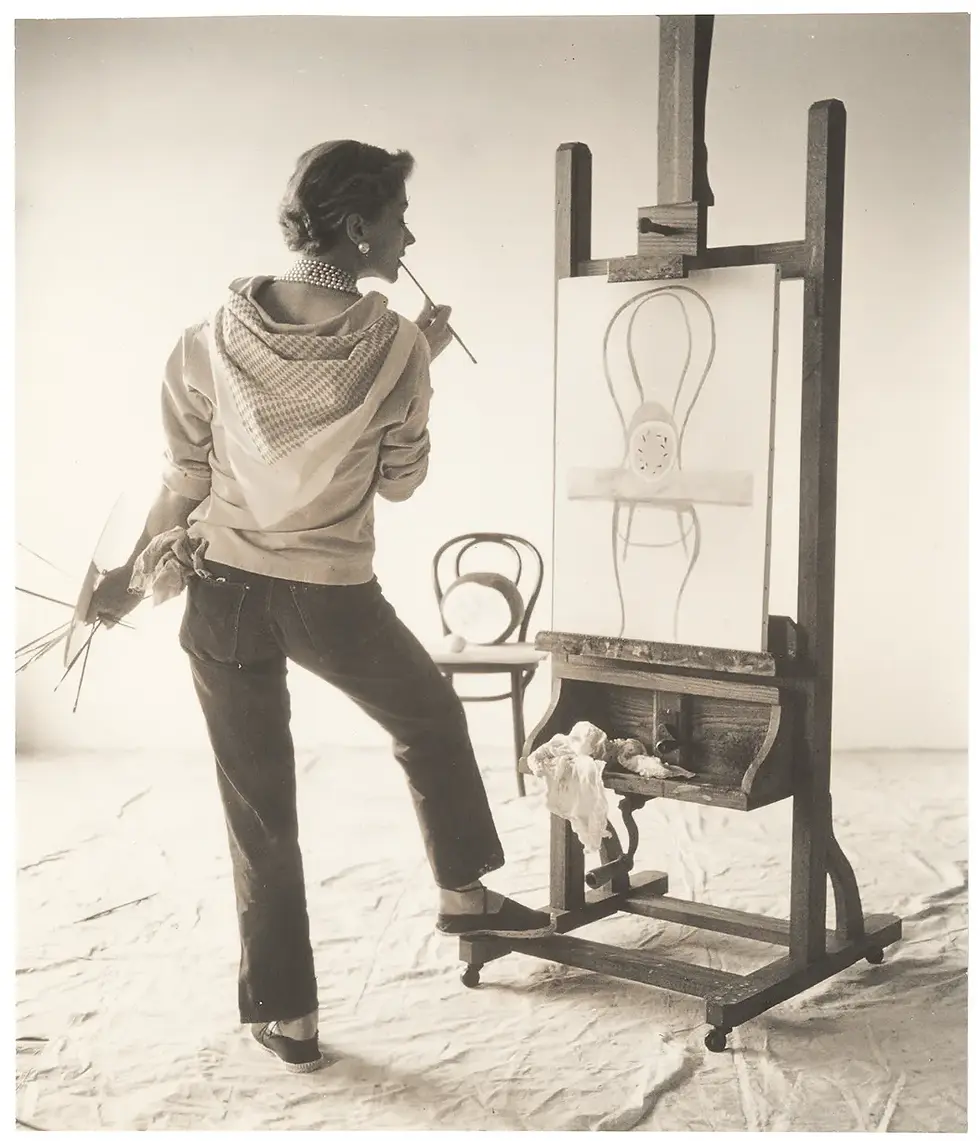
In the 1960s, she enrolled in the Art Students League to sharpen her drawing. She set up a sculpture studio in the couple's Long Island house. She began exhibiting in group shows in 1968 and progressed to solo exhibitions. She was eventually represented by the Marlborough Gallery in Manhattan, one of the most prestigious galleries in the world, exhibiting sculptures in marble, bronze, and fibreglass. In 1986, she had a solo show there. Three years after her death, the Moderna Museet in Stockholm held a retrospective dedicated to her sculptural work, and the Penn family donated a collection of her sculptures and watercolours to the museum.
Alexander Liberman, the editorial director of Condé Nast, who knew her for decades, described her as "a real artist." So did Priscilla Rattazzi, who photographed her later in life. "She was gorgeous, and incredibly classy," Rattazzi said. "And there was clearly a strong bond between her and Penn. But most importantly, she was a real artist."
She'd never claimed otherwise.
A Legacy Bigger Than Fashion
Lisa Fonssagrives died of pneumonia in New York on 4 February 1992, aged 80. She left behind a husband who'd spent forty-two years photographing her, two children who both went into design and art, a body of sculptural work serious enough to earn museum retrospectives, and a modelling career that had essentially defined the concept of what a supermodel could be before anyone had bothered to coin the term.

What she didn't leave behind was any obvious desire to be remembered for the modelling. She'd done it well, made good money at it, worked with extraordinary people, and then moved on. The contrast with the culture of celebrity that followed is hard to miss.
Gisele Bündchen, Cindy Crawford, Linda Evangelista, Naomi Campbell. All of them came after. None of them appeared on more Vogue covers. None of them preceded her in appearing on the cover of Time. And none of them, it's fair to say, followed their modelling careers by securing representation at the Marlborough Gallery and donating sculptures to national museums.
A photographer once asked her to model some hats. She was terribly shy but flattered. She arrived for the test shoot in a homemade suit with unmanageable hair, and she'd never looked at a fashion magazine in her life.
Sixteen years later, she was the most famous face in the world. A few years after that, she was a sculptor.
"I was a form in space," she said.
She wasn't wrong.


