

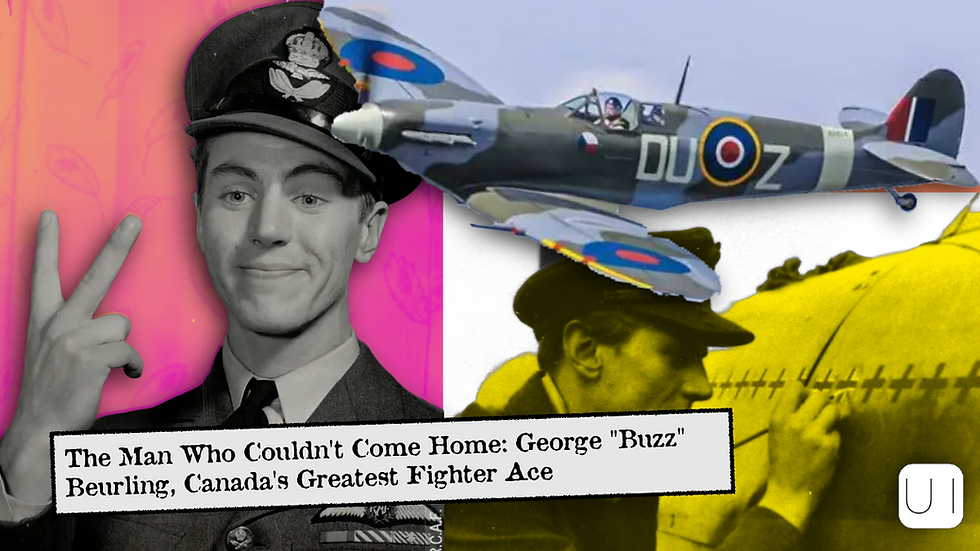
The Man Who Couldn't Come Home: George "Buzz" Beurling, Canada's Greatest Fighter Ace
- May 20
- 10 min read
"I would give ten years of my life to live over again those six months I had in Malta in 1942 ... combat, it's the only thing I can do well; it's the only thing I ever did that I really Liked." - Screwball
George Frederick Beurling shot down 31 enemy aircraft over Malta in the summer of 1942 and became Canada's most celebrated war hero. He also got quietly fired by his own military for shooting at his commanding officer's plane with a shotgun, couldn't hold a job in peacetime, was rejected by every air force on earth, and died at 26 in a fireball on a covert arms run to Israel. The medals are in one part of this story. The mess is in the rest of it, and honestly the mess is far more interesting.
The Kid Who Crossed the Atlantic Twice on a Freighter Just to Enlist
Beurling grew up in Verdun, a working-class neighbourhood of Montreal, in a family so devout they were members of the Plymouth Brethren, a strict Protestant sect that emphasised daily Bible reading and frowned on most earthly pleasures. He didn't share their quietism. By age nine he was hanging around the local airfield doing chores in exchange for rides. By sixteen he had soloed. He was, by most accounts, the sort of teenager who made adults nervous.

When war broke out in 1939 he tried to enlist in the Royal Canadian Air Force (RCAF). They turned him down. He tried the Chinese Air Force, which was fighting the Japanese and desperate for pilots. Turned down. He tried Finland, then at war with the Soviet Union. Also turned down. The RCAF rejected him a second time.
What happened next tells you something about who he was. Rather than accepting the verdict, he got himself a berth on a merchant freighter crossing the U-boat infested North Atlantic and made it to Britain to try the RAF. They wanted him, but he didn't have his passport. He turned around, crossed back through the submarine zone, picked it up in Montreal, then crossed the Atlantic a second time. He'd now made four transatlantic crossings through one of the most dangerous sea lanes of the Second World War, on cargo ships, just so someone would let him fly.
The RAF accepted him in 1940. He got his wings in September 1941 and was posted to 403 Squadron flying Hurricanes, and then Spitfires over France. He scored one kill and managed to make enemies of half the squadron before being posted to Malta in June 1942, which, under the circumstances, was probably the best thing that could have happened to everyone.
Twenty-Seven Kills in Fourteen Days Over a Besieged Island
In the summer of 1942, Malta was arguably the most intensively bombed place on earth. The island sat at the chokepoint of Axis supply lines to North Africa, and the Luftwaffe and Regia Aeronautica were attempting to bomb it into submission. Axis aircraft flew in waves. The island's garrison was on near-starvation rations. Pilots were flying multiple sorties a day in Spitfires that needed constant repair. It was, in short, the kind of war that broke most men. Beurling found it exhilarating.
While other pilots tried to get some rest between sorties, he spent his spare time doing calculations. He was obsessed with deflection shooting, meaning the geometry of firing ahead of a moving target so the bullets and the plane arrive at the same point simultaneously. Most pilots estimated this by instinct and guesswork. Beurling turned it into something close to mathematics, working out the angles and distances with the same focused intensity that other lone wolves throughout history brought to their singular obsessions.

He also practised on Malta's lizards. He'd stand motionless with his .38 pistol, waiting for a lizard to enter his field of vision at a distance roughly equivalent to a German fighter at 250 yards, and try to hit it with a single shot. The lizard population of Malta had a difficult summer.
On 6 July 1942 he recorded three confirmed kills in a single day. By the end of July he had 17 confirmed kills, 15 of them in a 23-day stretch. In that remarkable run he shot down the Italian ace Furio Niclot Doglio, a celebrated pre-war pilot who held seven international flying records and himself had six Spitfire kills to his name. Beurling was awarded the Distinguished Flying Medal, then a bar to it, then the Distinguished Flying Cross, then the Distinguished Service Order. By October 1942, operating from Takali Air Base on an island under siege, on near-starvation rations, with dysentery, he had 28 confirmed kills and was Canada's top ace.
His tactical approach was unusual even for a fighter pilot. He preferred to close to within 250 feet of a target before opening fire, a distance most pilots considered suicidal. He didn't aim at the aircraft generally; he aimed at specific components, announcing after engagements which part of which plane he'd been targeting. He talked about oxygen bottles, fuel tanks, the cockpit. His fellow pilots found this level of clinical detail somewhere between admirable and unsettling.
His nickname with the RAF was "Screwball." When the Canadian propaganda machine got hold of him and brought him home for war bond tours, they decided "Screwball" wasn't quite the image they wanted and renamed him "Buzz." He didn't particularly care either way.
"I Was the Team": A Personality Built for Cockpits and Nowhere Else
Beurling's ego and antisocial streak were not incidental features of his character. They were load-bearing. He referred to fellow pilots as "blind bats." When a reporter congratulated him on a successful team mission and asked about the group effort, he replied without missing a beat: "Team? I was the team." He refused to fly in formation because, in his view, formation flying was a distraction from the actual job. "I'm here to shoot Nazis," he explained, "not hold hands."

He treated regulations as polite suggestions that applied to people who weren't as good as him, which he genuinely believed covered almost everyone. His commanding officers were not wrong to find him impossible. He clashed with every superior he served under and seemed to generate a steady background hum of institutional friction wherever he was posted. The remarkable thing is not that the RCAF eventually got rid of him but that they tolerated him as long as they did, which was only because he kept being more useful in the air than he was disruptive on the ground.
There's a pattern here that turns up in a certain type of exceptional person: skills so extreme they bypass the usual social filters, but only in one specific environment. History is full of figures like this who functioned brilliantly in chaos and couldn't manage a Tuesday afternoon. Beurling was this taken to its logical extreme. Malta in 1942 was the specific chaos his specific wiring was optimised for. Nothing else ever came close.
He was also, it should be said, genuinely brave in ways that had nothing to do with aerial combat. When the transport plane carrying him home from Malta crashed into Gibraltar harbour, he swam back through the wreckage to pull other survivors out while bleeding from his own wounds. That wasn't antisocial calculation. That was just what he did.
The Propaganda Tour and the Shotgun Incident
Canada wanted a hero and Beurling was the most convenient one available. He was sent on a Victory Loan tour of Canadian cities in late 1942, photographed everywhere, feted at public rallies, turned into a poster boy for a war effort that needed vivid human faces. He was deeply unsuited for this role. He was awkward in public, gave interviews that confused publicists, and seemed generally uninterested in being a symbol.

Back in active service with the RCAF in 1943 and posted to 403 Squadron in Kent, he continued flying but the war had moved on and there was less combat to be had over England than over Malta. His behaviour, always difficult, became harder to manage. The shotgun episode happened around this time.
Unhappy with his new service cap because he thought it made him look like a rookie, he threw it in the air and shot it with his shotgun, considering the resulting holes an acceptable form of customisation.
Separately, spotting his wing commander flying overhead in a de Havilland Tiger Moth, he took aim and fired at the plane. The wing commander landed without knowing why his aircraft had small holes in the left wing. His ground crew were baffled. Beurling said nothing.
He was eventually ordered to stop buzzing the squadron headquarters at low altitude. He flatly refused, told his commanding officer that nobody could tell him what to do, went straight up and did it again. Any other pilot would have faced a court martial. Beurling was Canada's top ace. They gave him an honourable discharge instead and quietly sent him home in late 1943.
Peacetime: The Worst Thing That Happened to Him
The postwar years were grim. He tried to re-enlist in the RCAF. They weren't interested. He applied to the United States Army Air Forces. They also declined, deciding they didn't need a misfit regardless of his record. He tried to find work as a civilian pilot and couldn't. He had married Diana Whittall, a Vancouver socialite he'd met during the war bond tour, but was apparently flirting with other women while still on his honeymoon, and the marriage lasted about as well as might be expected.
The problem, as people who knew him described it, was that combat flying was the only thing he'd ever been truly good at, the only context in which his personality worked rather than against him. His lack of team instinct, his disregard for authority, his tendency to calculate angles and ranges rather than think about other people, his difficulty sitting still: all of this was a liability in ordinary life and an asset at 20,000 feet over Malta. Without the war, he didn't quite function.
He drifted through 1944, 1945, 1946 and 1947 in varying states of financial difficulty. It's a pattern that turned up repeatedly among men who'd been shaped entirely by combat, as our piece on David Funchess explored in a different era. Canada's most famous military hero could not find steady employment. There was talk of a book. There were occasional newspaper interviews. Nothing much came of any of it.
The Bible-Carrying Christian Who Died Flying for Israel
Beurling had always carried his Bible. His Plymouth Brethren upbringing had given him a genuine attachment to the Old Testament and to the idea of the Holy Land as a real and significant place rather than just a metaphor. When Israel declared independence in May 1948 and immediately came under attack from surrounding Arab states, Beurling saw it through a specifically biblical lens.
He made contact with Ben Dunkelman, the Jewish agent in Montreal recruiting aircrew for the nascent Israeli Air Force, in early 1948. He agreed to fly for standard pay and apparently quoted scripture to demonstrate his sincerity. The Haganah, the Jewish paramilitary organisation that would become the core of the Israeli Defence Forces, was not in a position to be choosy. Beurling was signed up and told to make his way to Rome.
He sent his mother a package of postcards of Italy the day before the scheduled flight. On the morning of 20 May 1948, Beurling and Leonard Cohen, a British volunteer pilot who had also fought in the Malta campaign, took off from Rome's Aeroporto dell'Urbe in a Noorduyn Norseman transport plane they were supposed to deliver to Israel. Witnesses on the ground saw flames coming from the engine on the landing approach on a test flight. The plane exploded on touchdown. Both men died instantly.
It was Beurling's tenth crash.

Who Killed George Beurling?
The official Italian investigation concluded the cause was mechanical failure, specifically a backfire caused by carburetor engulfment. This explanation has never fully satisfied anyone and the conspiracy theories have not gone away in the decades since.
The geopolitical context was genuinely murky. Rome in May 1948 was swarming with agents from all factions in the Arab-Israeli conflict. Britain, officially maintaining an arms embargo on both sides but in practice tilting toward the Arab states that remained within its sphere of influence, had reason to want the Israeli air buildup disrupted. It's the kind of murky post-war intelligence environment that, as our piece on Operation Paperclip showed, was producing all manner of covert operations in these years. Arab governments had reason to want a pilot of Beurling's capability kept out of Israeli cockpits. Jewish extremists opposed to volunteers arriving from abroad were apparently also present, according to one Haganah operative who claimed a British agent had been tasked with disrupting flights to Palestine.
In a Maclean's interview shortly before his death, Beurling had described himself as a mercenary and acknowledged that the Arab side had apparently offered him $1,600 a month to fly for them instead. He turned them down. Whether this was relevant to what happened at Urbe airfield is unknown. Whether the crash was sabotage or mechanical misfortune remains officially unresolved.
What happened to his body afterwards is almost as strange as his death. Canada didn't claim the remains. His widow didn't attend the funeral. The Canadian Consul in Rome organised his burial at Rome's Catholic cemetery, where the Jews of Rome closed their shops to attend out of respect for a devout Christian who'd come to fight for their homeland. His charred remains were stored for some months in a cemetery warehouse before burial was arranged. The coffin bore a small brass plate reading "Colonel Georgio Beurling," an Italian rendering of his name and a rank he didn't actually hold.
Two years later, with his family's permission, Israel brought his body to Haifa and buried him in a special section for non-Jewish soldiers at the Mount Carmel Military Cemetery. He was given the posthumous rank of Flight Commander. He'd been buried between the graves of Percy Bysshe Shelley and John Keats in Rome's Protestant Memorial Garden while awaiting reburial, which is either a beautiful coincidence or a very on-brand way to spend one's afterlife if you're George Beurling.
What He Actually Was
The standard framing of Beurling's life is "tragic waste": a genius undone by his own inability to conform. This isn't wrong exactly, but it misses something. He was also someone who worked the mathematics of shooting with obsessive precision while sitting in a starving, bombed-out garrison. Someone who kept his Bible through every sortie. Someone who crossed the submarine-infested North Atlantic four times on merchant ships because he wanted to fly badly enough to find it worth doing twice.
The RCAF rejected him at least twice, the USAAF rejected him, his own country essentially washed its hands of its most decorated air ace the moment he stopped being useful to the propaganda effort. He died at 26 broke, unemployed, and on an unofficial arms run to a country he'd never visited, because it was the only war left. Israel turned up to claim his body when Canada didn't bother.
His quotes have the ring of someone who genuinely didn't understand why other people found him difficult. "I'm here to shoot Nazis, not hold hands" isn't bravado for the press. It's a man explaining, with complete sincerity, how he saw the world. It's also, unfortunately, a worldview with a fairly limited shelf life once the Nazis are gone.
He's in the Canadian Aviation Hall of Fame now. Malta was collectively awarded the George Cross. The lizards of Malta presumably still have complicated feelings about the whole affair.
Sources
1. Brian Nolan, Hero: The Buzz Beurling Story, Penguin Books, 1981 — https://books.google.com/
2. Warfare History Network, "Canadian Fighter Ace George Beurling: The Falcon of Malta" — https://warfarehistorynetwork.com/article/canadian-fighter-ace-george-beurling-the-falcon-of-malta/
3. Wikipedia, "George Beurling" — https://en.wikipedia.org/wiki/George_Beurling
4. Canada's Aviation Hall of Fame, "George Frederick Beurling" — https://cahf.ca/george-frederick-beurling/
5. Historica Canada Education Portal, "George Buzz Beurling" — http://education.historicacanada.ca/en/tools/163
6. World Machal, "George (Buzz) Beurling" — https://www.machal.org.il/personal-stories/george-buzz-beurling/
7. Israel National News, "The Canadian Falcon of Malta who died for Israel" — https://www.israelnationalnews.com/news/317589
8. HistoricWings.com, "George Buzz Beurling, Ace of Malta" — https://fly.historicwings.com/2012/06/george-buzz-beurling-ace-of-malta/
9. 101Squadron.com, "George Beurling" — https://101squadron.com/101real/people/beurling.html
10. Government of Canada / DND, "How Screwball Beurling Got His Nickname" — https://www.canada.ca/en/department-national-defence/maple-leaf/rcaf/migration/2018/how-screwball-beurling-got-his-nickname.html


