


The Cicero Race Riot of 1951: When 4,000 People Attacked a Family Over an Apartment
Updated: 7 days ago

In the summer of 1951, a bus driver named Harvey Clark tried to move his wife and two kids into a rented apartment in Cicero, Illinois. He never spent a single night there. Instead, for the better part of a week, thousands of his new neighbours turned up outside the building to riot, and it took the National Guard, tear gas and fixed bayonets to bring the town back under control. It remains one of the largest and most well documented race riots in American history, and it happened not in the Deep South but eight miles from downtown Chicago.
A Family Looking for More Space
Harvey E. Clark Jr. and his wife Johnetta had met as students at Fisk University in Nashville. Clark was a World War II veteran who'd moved north from Mississippi, and by 1951 he was working as a bus driver for the Chicago Transit Authority. The couple had two young children, Michele and Harvey III, and the whole family was crammed into a two room tenement on Chicago's South Side, sharing the space with another family of five. It was a common story for Black Chicagoans at the time. The city's South Side had become badly overcrowded during the Great Migration, as hundreds of thousands of Black families arrived from the South only to find themselves squeezed into a handful of neighbourhoods by restrictive covenants and outright discrimination elsewhere.

Looking for something bigger and closer to his job, Clark found an apartment in Cicero, a working class suburb just west of the city, owned by a woman named Camille DeRose. DeRose had recently fallen out with her existing tenants over a rent dispute and had been ordered to refund part of what she'd charged them. Whether out of spite, straightforward profit, or both, she agreed to rent Clark the apartment even though Cicero at the time had no Black residents at all.
Word travelled fast. A senior Cicero official warned DeRose there would be trouble if the family moved in. On 8 June 1951, when a moving van carrying around $2,000 worth of the Clarks' furniture arrived at the building, Cicero police stopped it before it could even be unloaded. A crowd gathered as officers pulled a gun on the rental agent and ordered him away. Police told Clark to leave or be arrested for his own protective custody, and when he didn't move fast enough a detective allegedly threatened to bust his head open. Clark was grabbed by around twenty officers, hit repeatedly, shoved into a car and told to get out of Cicero for good or he'd get a bullet through him.
The NAACP Steps In
Clark refused to let it go. He hired NAACP attorney George N. Leighton, who would go on to become a federal judge, and filed suit against the Cicero Police Department on 26 June 1951. The court sided with the Clarks, and with a legal order in hand the family finally moved their belongings into the apartment. It didn't take long for word to spread around town that there was going to be, in the phrase used at the time, some "fun" at the Clarks' new address.

Four Nights of Rioting
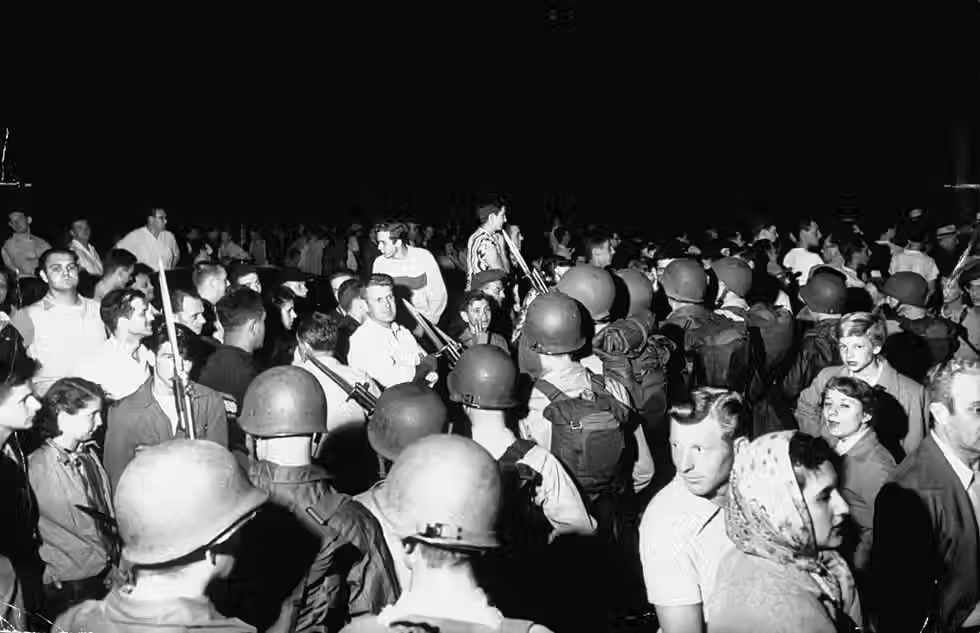
At dusk on 11 July 1951, a crowd began gathering outside the apartment building at 6139 to 6143 West 19th Street. Estimates of the size of the mob vary between sources, ranging from around 2,000 up to 6,000 people at its peak, with most putting the figure at roughly 4,000. Whatever the exact number, it was a lot of people for one family's apartment. Only around 60 police officers had been assigned to the scene, and by most accounts they did little to hold the crowd back.
Women in the crowd carried stones from a nearby pile of rubble to throw through the Clarks' windows. Others threw lit firebrands onto the window ledges and the roof. The building's other 21 tenants, all of them white, fled before the worst of it began. Furniture was thrown out of windows and smashed on the pavement three storeys below while onlookers cheered. One woman, watching the Clarks' belongings burn in the street, was recorded saying it was a shame that American soldiers were dying in Korea for democracy while this was happening at home, apparently without registering the irony in her own words.

Firefighters who arrived to deal with the blaze were met with a hail of bricks and stones themselves. Sheriff's deputies asked them to turn their hoses on the rioters instead of the fire, but the firemen refused to do so without their lieutenant's authorisation, and he couldn't be found. Most of the people actually throwing stones and setting fires were reported to be teenagers, egged on by a much larger crowd of adult spectators who'd turned out to watch.
By the second night, the situation had gone far beyond anything local police or sheriff's deputies could handle. County Sheriff John E. Babbs asked Governor Adlai Stevenson, who would run for president the following year, to call in the Illinois National Guard. It was the first time the Guard had been deployed for a race riot in the state since the Chicago riots of 1919. Reports put the number of troops sent in anywhere from 500 up to 2,000 or more, arriving armed with two rounds of ammunition each along with bayonets and tear gas. Even soldiers weren't spared the mob's anger: guardsmen were pelted with bricks and stones as they tried to move in, and had to use rifle butts and fixed bayonets to push the crowd back before finally ringing the building with barbed wire and holding a perimeter roughly 300 yards wide. Rioting continued in various forms for close to four days before it finally died down around 14 July, by which point somewhere between 117 and 157 people had been arrested.
The Clark family never spent a single night in the apartment they'd fought so hard, and so publicly, to secure. They left Cicero for good, and total damage to the building was estimated at somewhere between $20,000 and $50,000, worth well over half a million dollars today.
The First Race Riot on Television
What set Cicero apart from the wave of similar attacks that had followed Black families trying to move into white Chicago-area neighbourhoods throughout the late 1940s wasn't really its scale. Plenty of earlier incidents around the city, in places like the Fernwood Park area, had involved large and violent crowds too. What made Cicero different was that it happened in front of a television camera. It's generally regarded as the first race riot in American history to be broadcast on local TV, meaning that for the first time many viewers in and around Chicago watched a mob attack a family's home from their own living rooms before they ever picked up a newspaper. Combined with wire service photographs that ran in papers around the world, the coverage turned a local housing dispute into an international embarrassment for the United States, at the height of the Cold War, when American officials were trying to hold up the country's civil rights record against Soviet propaganda.

Justice Turned on Its Head
What happened next in the courts was, if anything, even more telling than the riot itself. Despite well over a hundred arrests and extensive newspaper and television evidence of exactly who had thrown stones and set fires, the Cook County grand jury refused to indict a single rioter. Instead, in September 1951, it indicted Camille DeRose, her rental agent Charles Edwards, her lawyer George C. Adams, and Clark's own NAACP attorney George Leighton, on charges of inciting a riot and conspiracy to damage property, essentially arguing that the crime was renting an apartment to a Black family in the first place.

The move drew fierce criticism from civil rights organisations and legal observers around the country. Leighton's defence was taken on by Thurgood Marshall, then special counsel for the NAACP and still more than a decade away from becoming the first Black justice of the US Supreme Court. Under mounting public pressure, the charges against all four were eventually dropped.
The response from federal authorities was, for the era, unusually forceful. The United States Attorney General ordered an investigation, and a federal grand jury indicted four Cicero officials, including the town's police chief, along with three police officers, for violating Clark's civil rights. Charges against the fire chief were dropped, in part because his firefighters had refused police requests to turn hoses on the rioters. In the end, Police Chief Erwin Konovsky and two of his officers were fined a total of $2,500, a modest sum even by the standards of the day, but a federal civil rights prosecution over a housing case was still considered a genuinely rare and significant step at the time.
A Town Already Notorious
Cicero didn't need the 1951 riot to make a name for itself. The town had been synonymous with organised crime since the 1920s, when Al Capone relocated his operations there after falling out with Chicago's reform-minded mayor, turning Cicero into what locals still called Gang City decades later. That reputation for lawlessness and corrupt local government hung over the riot's aftermath too. Long after Capone's era ended, Cicero stayed defiantly, deliberately white. Fifteen years later, in 1966, the National Guard was called back to the town in similar numbers, this time to protect a civil rights march led out of Chicago rather than to protect a single Black family trying to move in, a sign of how little had changed. A Black teenager named Jerome Huey was beaten with a baseball bat by three white men that same year simply for coming into Cicero looking for work.
What Happened to the Clarks
Harvey and Johnetta Clark eventually settled elsewhere in the Chicago area and got on with their lives away from the spotlight. Harvey Clark died in 1998 at his home in North Carolina, aged 75. Their daughter Michele, who was eight years old and hiding inside that apartment building as the mob gathered outside in 1951, grew up to become a pioneering journalist. She joined CBS News and became the first Black woman to work as a network television correspondent in the United States. In 1972, Michele Clark was killed in a plane crash on approach to Chicago's Midway Airport, only a few blocks from the same Cicero street where, as a child, she'd watched her family's furniture burned in the street.

The Legacy of Cicero
Despite the violence, and despite the courts initially punishing the victims rather than the rioters, the Cicero case became an important marker in the long fight over housing segregation in the North. It exposed, on television, exactly how restrictive covenants and hostile white neighbourhoods worked together to keep postwar suburbs segregated, decades before fair housing law caught up with the problem. Historians researching the wider pattern of racial violence in Chicago housing during this period, including incidents like the 1919 mob violence chronicled in the Will Brown lynching and courthouse riot in Omaha, have pointed to Cicero as part of a much longer American pattern of white mobs responding to Black families simply trying to live somewhere new.
The building at 6139 to 6143 West 19th Street was still standing and occupied as recently as 2017. Cicero itself didn't finish reckoning with its reputation for decades afterward. It took a federal discrimination lawsuit in the 1980s, and a very slow demographic shift, before the town Al Capone once ran became the majority Hispanic community it is today. For a wider picture of how racial violence and mob justice played out elsewhere in America during the same era, our piece on the lynching of Thomas Shipp and Abraham Smith covers a similarly disturbing case of a crowd taking the law into its own hands.


