

The Story Of Mary Jo Kopechne, The Political Aide Who Drowned In Ted Kennedy’s Car
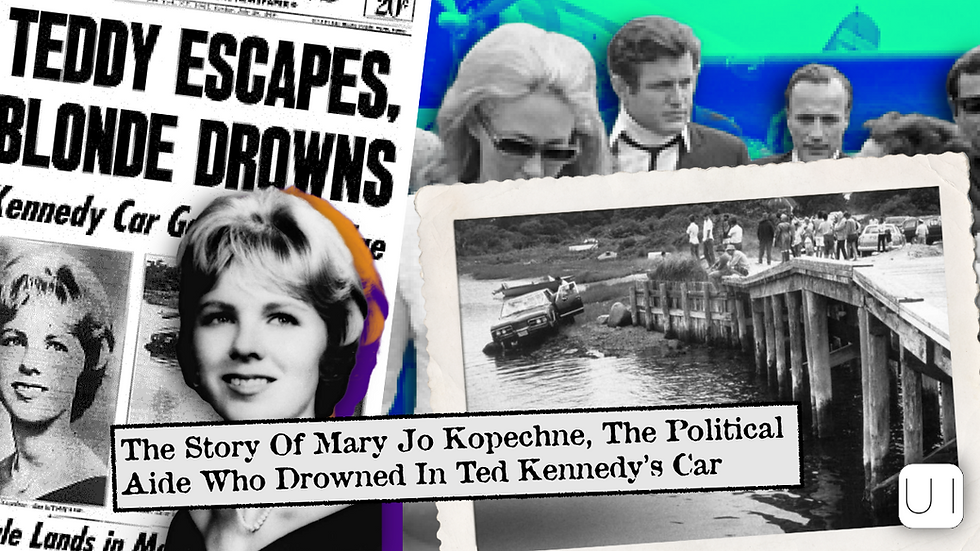
On the night of 18 July 1969, a car went off a bridge on Chappaquiddick Island, Massachusetts, and sank into Poucha Pond. The driver, Senator Ted Kennedy, got out. His passenger, 28-year-old Mary Jo Kopechne, didn't. Kennedy waited ten hours before reporting the accident to police. There was no autopsy. The grand jury that convened the following year was prevented from calling key witnesses. Kennedy pleaded guilty to leaving the scene, received a two-month suspended sentence, and went on to serve another forty years in the United States Senate.
For fifty years, as the author William C. Kashatus put it, Mary Jo Kopechne was treated as "collateral damage" by the Kennedys and the Washington political establishment. She deserves better than that. Here is her story, and what actually happened at Chappaquiddick.

A Life Built Around Politics
Mary Jo Kopechne was born on 26 July 1940 in Wilkes-Barre, Pennsylvania. Her parents, Joseph and Gwen, were not political people, but their daughter became one almost from the moment she understood what politics was. As a 20-year-old, she was galvanised by John F. Kennedy's inaugural address in 1961 and his challenge to Americans to ask what they could do for their country rather than what their country could do for them.
After graduating from Caldwell College in 1962, she moved to Montgomery, Alabama, where she taught at Montgomery Catholic High School for a year. She was drawn south by the civil rights movement, and the students she taught remembered her clearly. One recalled her as someone with "confidence and a zest for life that was intriguing. She was humble and kind and stood firm in her beliefs."
Teaching wasn't where she felt she could have the most impact. In 1963 she took a job in the Washington office of Florida senator George Smathers, and the following year transferred to Robert Kennedy's Senate office. Her father said simply: "Politics was her life." Her mother agreed. "It was a good career, working with the politicians. It was what she wanted to do."

The Boiler Room Girls
In Robert Kennedy's office, Kopechne quickly distinguished herself. She and five other women, Rosemary Keough, Esther Newberg, Nance and Maryellen Lyons, and Susan Tannenbaum, became known as the "Boiler Room Girls," a nickname that came from their cramped, windowless, airless office. The name was affectionate but slightly misleading. These weren't secretaries. They were political operatives.
Of the six, Kopechne was considered the sharpest political mind. Dun Gifford, who oversaw the group, recalled her as "the most politically astute" of them all. During the 1968 presidential primary, her specific skill was delegate intelligence: tracking the shifting loyalties of delegates across dozens of states in real time, negotiating on Kennedy's behalf, and feeding his campaign the information it needed to make decisions. "That ability allowed her to negotiate deals on RFK's behalf, to travel with him when necessary, and even to offer her opinions when she had the best working knowledge of a situation," Gifford said. If Kennedy had won the presidency, Gifford believed, "Mary Jo would have been rewarded with a very significant job in his administration."
He never got the chance to give it to her. On 5 June 1968, Robert Kennedy was shot dead at the Ambassador Hotel in Los Angeles, minutes after winning the California primary. You can read more about the timeline of the assassination of Dr Martin Luther King, who was killed just two months before Kennedy, in a separate piece.
Kopechne was devastated. She told a former teacher she couldn't bring herself to return to Capitol Hill: "It will never be the same again." She took a position at a consulting firm in Washington but stayed close to the other Boiler Room Girls. Their reunions, one family friend recalled, were "almost like war veterans getting together," women who had shared something intense and irreplaceable and lost it in the most sudden, violent way possible.

Chappaquiddick Island, July 1969
Ted Kennedy had been watching his brothers die for years. John assassinated in Dallas in 1963. Robert gunned down in Los Angeles in 1968. Now, at 37, the political spotlight had fallen entirely on him. Polls in 1969 showed 79% of American voters believed he might run for the presidency in 1972. Even Richard Nixon was worried about facing another Kennedy.
That summer, Kennedy was competing in the Edgartown Regatta, sailing the family boat Victura, the same vessel that had belonged to JFK. He and his cousin Joe Gargan organised a reunion cookout for the Boiler Room Girls on Chappaquiddick Island, a small barrier island accessible from Edgartown only by ferry. Kennedy's wife Joan was at home in Massachusetts, pregnant with their fourth child.
The party on 18 July 1969 was held at a rented cottage. There were twelve people: the six Boiler Room Girls, Kennedy, Gargan, lawyer Paul Markham, Kennedy's part-time driver John Crimmins, family friend Raymond La Rosa, and attorney Charles Tretter. There was food, drink, and conversation about Bobby Kennedy. People danced in the front yard.
Around 11:15pm, Kennedy asked his driver for the car keys. He said he wanted to return to his hotel and that Kopechne wasn't feeling well, possibly from too much sun. Kopechne left with him without telling anyone, leaving her purse and her room key on the table.

The Bridge
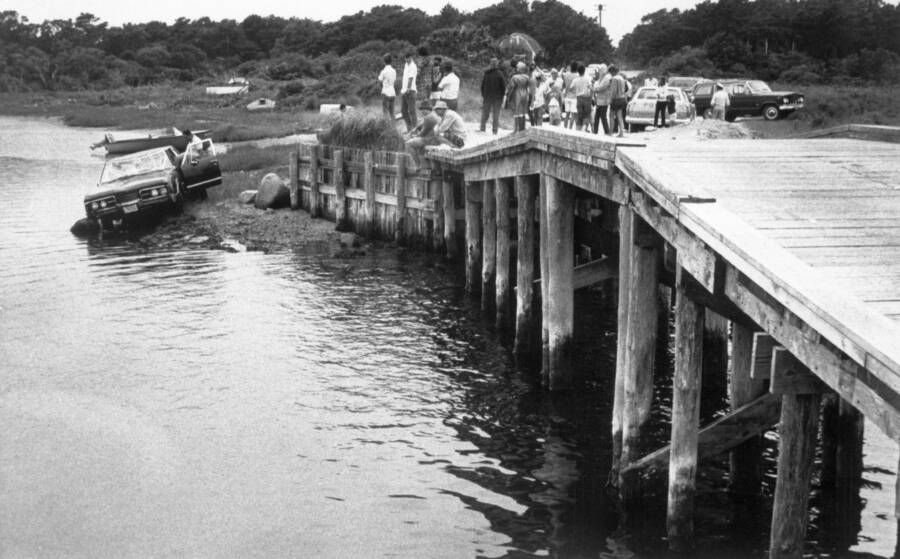
Dike Bridge was a narrow, wooden, unlit structure that crossed from the main road of Chappaquiddick to a remote beach area. Kennedy was expected to turn left toward the ferry landing. Instead, he turned right, onto the unpaved and unlighted Dike Road. Multiple witnesses later noted that Kennedy had driven that route before, which made his claim of simple disorientation harder to accept.
The Oldsmobile went off the bridge and somersaulted into Poucha Pond. Kennedy later testified: "There was complete blackness. Water seemed to rush in from every point, from the windshield, from underneath me, above me." He said he couldn't recall exactly how he got out, but he did. He said he dived repeatedly to try to reach Kopechne. He said the current was too strong. He gave up and swam to shore.
What happened next is the part of the story that Kennedy's defenders have never been able to satisfactorily explain. Rather than going directly to the nearest house and calling for help, he walked back to the party cottage, roughly two miles away. He spoke privately to Gargan and Markham. All three returned to the bridge and Gargan and Markham made their own attempts to dive to the car. They failed. Kennedy told them he would report the accident to the police.
He didn't. He went back to his hotel, changed his clothes, slept, and in the morning asked the hotel desk clerk what time it was. Fishermen had already spotted the submerged car at around 7:30am. Kennedy called police at 9:45am, nearly ten hours after the crash. His call came after the car, and Mary Jo Kopechne's body, had already been found.
According to Leo Damore's 1988 book Senatorial Privilege, which drew on extensive interviews with Joe Gargan, Kennedy had at one point considered claiming that Kopechne had been driving the car, with himself as a passenger. Gargan, by Damore's account, refused to go along with it.

Could She Have Survived?
The medical examiner at the scene, Dr Donald Mills, made a preliminary determination of drowning and, given the prominent people involved, deferred to the district attorney on whether a full autopsy was needed. No autopsy was ordered. Kopechne's body was released and her parents took her home to Pennsylvania. When the district attorney later petitioned to exhume the body for examination, a Pennsylvania court refused. Kopechne's parents, who had been told the proposed autopsy was primarily to determine whether their daughter had been pregnant, supported the decision to deny it. The truth of what killed her was never formally established.
John Farrar, the captain of the Edgartown Fire Department's search and rescue dive team, had a view on it. He testified at the inquest that when he entered the submerged car, he found Kopechne in the rear footwell, her head tilted upward toward a pocket of trapped air at the back of the vehicle. There was little water in her lungs. Farrar's conclusion was that she hadn't drowned immediately. She had been breathing trapped air and may have survived for several hours after the car went into the water.
"It took her at least three or four hours to die," Farrar said. "I could have had her out of that car twenty-five minutes after I got the call. But he didn't call."
If Farrar's assessment is correct, and it has never been definitively refuted, then Mary Jo Kopechne was alive in the car while Kennedy slept at his hotel.
The Investigation That Went Nowhere
Kennedy pleaded guilty to leaving the scene of an accident and received a two-month suspended sentence. Judge James Boyle, who noted in his ruling that Kennedy had been negligent, retired from the bench just days after sentencing. The inquest in January 1970 was closed to the public. When the Dukes County grand jury convened in April 1970, surviving jurors later said its investigative powers were effectively hamstrung by court officials. The Boiler Room Girls were never called to give evidence that might contradict Kennedy's account. No indictment was returned. Kennedy had his driver's licence suspended for sixteen months.
Edgartown police chief Dominic Arena, who had taken Kennedy's statement, later told Damore that he had felt confused and pressured from the outset. He was a small-town police chief who had suddenly found himself at the centre of a case involving one of the most powerful political families in America, using his office phone while standing in a puddle of water in what he described as "a state of confusion."
Kennedy's legal team was among the most expensive and connected money could buy. The machine around him moved fast and effectively. The full truth of what happened between 11:15pm on 18 July and 9:45am on 19 July 1969 has never been established in a court of law.
The Televised Address
On 25 July 1969, the same day he pleaded guilty, Kennedy gave a twelve-minute televised address to the people of Massachusetts from Hyannis Port. He called his failure to report the accident promptly "indefensible." He denied any "private relationship" with Kopechne. He denied being drunk. He described himself as "deeply scarred" by the deaths of his brothers and invoked what he called a "curse" on the Kennedy family. He asked Massachusetts voters to help him decide whether he should resign his Senate seat.
The response was overwhelmingly supportive. The Boston Globe received calls at a two-to-one ratio in his favour. The Kennedy family received telegrams running 100-to-1 for him to stay. He stayed.
The neck brace Kennedy wore at Kopechne's funeral and in the days following attracted its own controversy. His personal physician, Dr Robert Watt, later said he had never recommended Kennedy wear one publicly. Whether the brace reflected genuine injury or was a visible marker of suffering calculated to generate sympathy, nobody can say for certain.
What Became of Ted Kennedy
Kennedy never ran for the presidency in 1972. He did run in 1980, challenging incumbent Jimmy Carter for the Democratic nomination, and lost. In a primary debate, when asked directly why he wanted to be president, he gave a famously incoherent answer that many analysts blamed on Chappaquiddick's psychological shadow. He withdrew from the race and never ran again.

He remained a senator from Massachusetts until his death from brain cancer in August 2009, aged 77. He became one of the most consequential legislators in Senate history, a champion of healthcare reform, civil rights, and immigration law, and was eulogised as the "Lion of the Senate." In his memoir, True Compass, he described Kopechne's death as "a horrible tragedy that haunts me every day of my life."
Whatever the haunting amounted to privately, it didn't end his career. The system that was supposed to investigate what happened at Chappaquiddick protected him at every turn, and he benefited from a degree of public sympathy that had everything to do with his family name and very little to do with his conduct that night.
What Mary Jo Kopechne Deserves to Be Remembered For
Her cousin William Nelson said that Kopechne was a woman ahead of her time. "I'm pretty sure she would have pioneered a new path for women in Washington. She was kind of glossed over as the girl in the car. It was all about Ted Kennedy. She would have gone on to do great things."
Her mother Gwen, speaking to the Boston Globe in 2007, thirty-eight years after her daughter's death, said: "Sometimes I'd like to scream a lot but I'm trying to hold it back. It would be nice if somebody spoke up."
The 2017 film Chappaquiddick, directed by John Curran and starring Jason Clarke as Kennedy, significantly revived public interest in the case. It was widely praised for its refusal to sentimentalise Kennedy and for treating Kopechne as a real person rather than a plot device. It didn't answer the questions that the investigations of 1969 and 1970 chose not to ask, but it put them back in front of a new generation.
Mary Jo Kopechne was 28 years old. She was one of the sharpest political operatives of her generation, working in a field that barely acknowledged that women could do that job at all. She had survived the assassination of the man she'd devoted years of her professional life to and kept going. She died because a senator made a wrong turn, got out of a sinking car, and spent the next ten hours doing nothing. The questions her family spent the rest of their lives asking were never properly answered.
Ted Kennedy served in the Senate for another forty years. He is remembered as the Lion of the Senate. Mary Jo Kopechne is remembered, when she's remembered at all, as the woman in his car.
SOURCES
1. Britannica: Chappaquiddick Incident — https://www.britannica.com/event/Chappaquiddick-incident
2. History.com: Senator Ted Kennedy Drives Car Off Bridge at Chappaquiddick Island — https://www.history.com/this-day-in-history/july-18/incident-on-chappaquiddick-island
3. Martha's Vineyard Times: The Crash That Launched Chappaquiddick — https://www.mvtimes.com/2019/07/17/crash-launched-chappaquiddick/
4. E! Online: The Kennedys and a Cover-Up: The Bizarre True Story of Chappaquiddick — https://www.eonline.com/news/925270/the-kennedys-and-a-cover-up-the-bizarre-true-story-of-chappaquiddick
5. Leo Damore: Senatorial Privilege: The Chappaquiddick Cover-Up (1988)
6. William C. Kashatus: Before Chappaquiddick: The Untold Story of Mary Jo Kopechne (2019)
7. EBSCO Research Starters: Chappaquiddick Scandal — https://www.ebsco.com/research-starters/law/chappaquiddick-scandal


