

Death On The Mountain: The Tragic End Of Tom Simpson
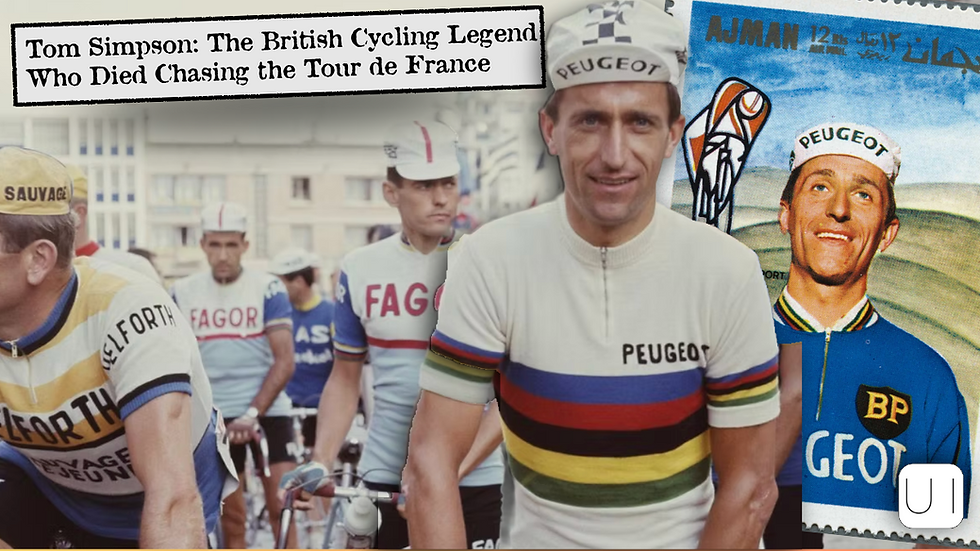
On the afternoon of 13 July 1967, a 29-year-old cyclist from a County Durham mining family rode himself to death on one of the most brutal climbs in sport. Tom Simpson, the most successful British road cyclist of his generation, collapsed near the summit of Mont Ventoux during the 13th stage of the Tour de France. He never regained consciousness. His death shocked the cycling world, exposed the sport’s rampant drug culture, and ultimately forced the introduction of doping controls that reshaped professional racing. Yet beyond the tragedy that swallowed his final chapter, Simpson’s story is one of extraordinary ambition, sharp intelligence, and a talent for reinvention that was decades ahead of its time.

The Boy Who Delivered Groceries to Buy a Better Bike
Thomas Simpson was born on 30 November 1937 in Haswell, County Durham, into a working-class mining family that later settled in Harworth, Nottinghamshire. As a teenager he worked as a grocery delivery boy, saving the money to buy himself a better bicycle. The job shaped the man: frugal, purposeful, always thinking a few moves ahead. He took up track cycling in his mid-teens and was good enough to be selected for the 1956 Melbourne Olympics at the age of just 18, where he won a bronze medal in the team pursuit. Two years later he added a silver at the British Empire and Commonwealth Games.
But track cycling wasn’t the dream. The dream was the road, and the road meant France. In April 1959, Simpson packed a French dictionary, a spare set of wheels, £100 in savings, and an unshakeable self-belief, and left for the continent. “I don’t want to be sitting here in twenty years’ time, wondering what would have happened if I’d gone to France,” he told his mother. He was 21 years old.
From Amateur Races to the Yellow Jersey
Simpson made his professional debut at Paris-Roubaix, one of the oldest and most gruelling one-day races in the world. He launched a solo attack early, rode alone at the front for 40 kilometres, and was caught just two kilometres from the finish, eventually coming in ninth. In his first big race. The emotional crowd called him back for a lap of honour, and televised footage of his effort sent his name around Europe overnight.
A year later he started his first Tour de France, riding for the French team Raphael-Gitane-Dunlop. Then in 1961 he won the Tour of Flanders, one of cycling’s “Monuments”, announcing himself at the very highest level of the sport. The following year, at the 1962 Tour de France, he became the first British rider to wear the Yellow Jersey, finishing sixth overall. It was a landmark moment not just for Simpson but for British cycling more broadly, at a time when the sport barely registered at home.

Major Tom: Salesman, Entertainer and World Champion
Simpson understood the business of cycling in a way that most of his rivals simply didn’t. Long before the modern era of personal branding, he was consciously constructing a public image. The French press began featuring him as the idealised British gentleman abroad: bowler hat, umbrella, bike. He’d be photographed at Paris cafes drinking tea and reading The Times in a sharp suit. He picked up the nickname “Major Tom” and leaned into it hard.
In a 1960s interview, Simpson articulated a commercial philosophy that would sound perfectly at home in a modern sports agency: a professional cyclist, he said, was “an entertainer, a publicity agent and a sportsman all rolled into one, in that order.” He was, in short, selling something. And he was brilliant at it.
The results kept coming too. He moved to Peugeot in 1963, winning Bordeaux-Paris that year and Milan-San Remo in 1964. Then 1965 produced his greatest season: he became Britain’s first professional road race World Champion, winning the UCI Road World Championships, and also won the Giro di Lombardia. The combination made him the first cyclist ever to win the BBC Sports Personality of the Year award. He also collected the Daily Express Sportsman of the Year and the Sports Journalists’ Association Sportsman of the Year, the latter presented to him by Prime Minister Harold Wilson. At the peak of his powers, Simpson was being offered £300 to £350 per appearance at post-race criterium events, and riding an estimated 12,000 miles a year in contracted races on top of his main schedule.
Despite the glamour, his nephew Chris Sidwells recalled a man who had a harder edge beneath the charm. Simpson could be dismissive and even vindictive toward those he didn’t consider his equals. When teammate Barry Hoban broke away in a race, Simpson personally chased him down, explaining flatly: “Because I’m the number one British cyclist in Europe, not you.” Simpson’s relationship with Eddy Merckx (his Peugeot teammate) was similarly combustible, particularly after a disputed incident at Paris-Nice in 1967.
The Season That Was Building to a Reckoning
1966 was a write-off. Simpson broke his right leg on a skiing holiday in January, spent three months in a plaster cast, and never recovered his form. He had to quit the Tour de France that year after injuring his arm in a collision with a press motorcycle. But 1967 started promisingly. He won Paris-Nice overall and took two stage wins at the Vuelta a España, and headed to the Tour de France with genuine belief he could challenge for a podium finish.
Simpson was in his eighth year as a professional, deeply aware that his earning window was narrowing. His plan was specific: finish in the top three or wear the Yellow Jersey, which would secure far larger appearance fees from the post-Tour criterium circuit. He had earmarked three key stages. One of them was Stage 13, over Mont Ventoux.

Going into that stage, his manager Daniel Dousset was already pressuring him for results despite the fact that Simpson had been suffering from diarrhoea and stomach cramps since Stage 10, during which he’d crossed the Col du Galibier in considerable distress. He’d dropped from sixth to seventh overall. His teammate Vin Denson urged him to limit his losses and accept what he had. Simpson refused.
13 July 1967: The Giant of Provence
Mont Ventoux is not like other climbs. It rises to 1,909 metres above sea level, entirely exposed on its upper reaches, a barren lunar landscape of white limestone that absorbs and radiates heat with brutality. On the morning of Stage 13, with Marseille to Carpentras covering 211.5 kilometres and the temperature already approaching 40 degrees Celsius, Tour doctor Pierre Dumas muttered a grim prediction to a journalist: “If the boys stick their nose in a ‘topette’ [bag of drugs] today, we could have a death on our hands.”
At the start line Simpson looked exhausted. Asked whether the heat was the problem, he said simply: “No, it’s not the heat, it’s the Tour.” On the lower slopes of the climb, his team mechanic Harry Hall spotted him stepping out of a building and putting the lid back on his water bottle. Race commissaire Jacques Lohmuller confirmed he saw the same thing: Simpson had been adding brandy. Later it would emerge he’d had at least one drink at the Chalet Reynard bar near the foot of the summit climb.
High on the mountain, with the summit in sight, Simpson began zig-zagging across the road. The journalist Jacques Augendre, later the Tour’s official archivist, described watching him “streaming with sweat, haggard and comatose.” A kilometre from the summit, Simpson fell from his bike. Team manager Alec Taylor and Harry Hall arrived in the team car. Hall tried to convince him to stop: “Come on Tom, that’s it, that’s your Tour finished.” Simpson’s reply, as Hall remembered it, wasn’t the often-quoted “Put me back on my bike”. His actual words were “On, on, on.”
Hall helped him back into the saddle. Looking down, Simpson noticed his toe straps were still loose. “Me straps, Harry, me straps!” Those were his last known words. Within 500 yards he collapsed again. He was unconscious but still gripping the handlebars when his limp body was lifted to the roadside. Mouth-to-mouth resuscitation was attempted at the scene. Tom Simpson was airlifted to Avignon Hospital and pronounced dead that afternoon.
Tour doctor Dumas found three small tubes of amphetamine in Simpson’s jersey as he tried to revive him, two empty and one labelled Tonédron, partially used. Police found more drugs in his luggage back at the hotel. The official cause of death was recorded as heart failure caused by exhaustion. The post-mortem confirmed amphetamines and alcohol in his system, a diuretic combination that, alongside the stomach illness, the extreme heat, and the savage gradient of Ventoux, had pushed his body past the point of no return. Initial media reports called it heat exhaustion. It was British journalist J.L. Manning of the Daily Mail who broke the true story on 31 July 1967, reporting that Simpson had been “so doped that he did not know he had reached the limit of his endurance.”
The live television broadcast of his collapse was the first time a death caused by doping had been shown on screen. Crucially, Simpson’s family has never seen the autopsy report and never will: French law required it to be destroyed after 30 years.

The Grief That Followed
The day after Simpson died, the peloton reached a silent agreement: his teammate Barry Hoban, the man Simpson had chased down in a race just months before, would be allowed to ride clear of the pack and take the stage win unopposed. It was one of cycling’s most poignant gestures. Hoban went on to win seven more Tour stages over the following decade.
Simpson’s funeral at his 12th-century village church in Harworth was attended by an estimated 5,000 mourners. Eddy Merckx, still a young Peugeot teammate, was the only continental rider to make the journey. Simpson was buried at Harworth Cemetery with an epitaph taken from a card left by his brother Harry: “His body ached, his legs grew tired, but still he would not give in.”
Simpson was married to Helen Sherburn, with whom he had two daughters, Jane and Joanne. For years, Joanne avoided Mont Ventoux entirely, her mother having begged her not to climb it. Then, on the 30th anniversary of her father’s death, she finally made the ascent. She has been back many times since. “I just like to be here,” she said. “I feel my dad is here rather than buried in England.”

The Legacy That Changed the Sport
Simpson’s death wasn’t the cause of doping in professional cycling — it was, as five-time Tour winner Jacques Anquetil had frankly admitted to French television just days before Simpson collapsed, simply what the sport was. “You would have to be naive or a hypocrite to insist that the Tour de France can be ridden on just mineral water,” Anquetil said. “All the riders take something.” But Simpson’s death, broadcast live and impossible to ignore, forced the sport’s hand. Mandatory doping tests were introduced the following year at the Giro d’Italia, the Tour de France, and the 1968 Summer Olympics.
A granite memorial on the spot where he fell, one kilometre east of the summit, was unveiled in 1968, funded partly by a cycling community collection that raised around £1,500. The words read: “Olympic medallist, world champion, British sporting ambassador.” It has become a pilgrimage site. Cyclists leave water bottles, caps, and race numbers at its base. In 1997, on the 30th anniversary of his death, a smaller plaque was added: “There is no mountain too high.”
A small museum dedicated to Simpson opened in Harworth in 2001, inaugurated by Belgian cyclist Lucien Van Impe. Its main display includes the bicycle Simpson used to win the 1967 Paris-Nice and the jersey, gloves, and shorts he wore the day he died. In nearby Bédoin, at the foot of Ventoux, a plaque installed by Tour journalists marks the start of the climb he never finished.

In 2012, British rider David Millar won Stage 12 of the Tour de France on the 45th anniversary of Simpson’s death. Millar, who had previously served a ban for doping, used the moment to pay tribute to Simpson and reinforce what his death should mean. He later wrote the introduction for a reissue of Simpson’s autobiography, Cycling is My Life, published in 2009.
Bradley Wiggins once called Simpson “the most complete British rider ever.” Chris Froome, Geraint Thomas, Mark Cavendish — all of them stand on a foundation that Simpson helped lay, in an era when British cyclists were barely considered credible on the continent. He got there by sheer force of personality and an almost frightening refusal to accept limits, which in the end is what killed him.
The lessons from his death are still being learned. Or not learned. The monument on Ventoux says “Olympic medallist, world champion, British sporting ambassador.” It probably should also say: the man who changed everything, even though it cost him everything.
Sources


